"Jeongjo Filial Piety Culture Festival" to Be Held on September 27
The "Jeongjo Filial Piety Culture Festival" and the "King Jeongjo Royal Procession," which reenact King Jeongjo's journey to visit the tomb of his father, Crown Prince Sado, and honor his filial devotion, will be held from September 27 to 28 at Dongtan Central Park, Yunggeolleung, and Yongjusa Temple in Hwaseong.
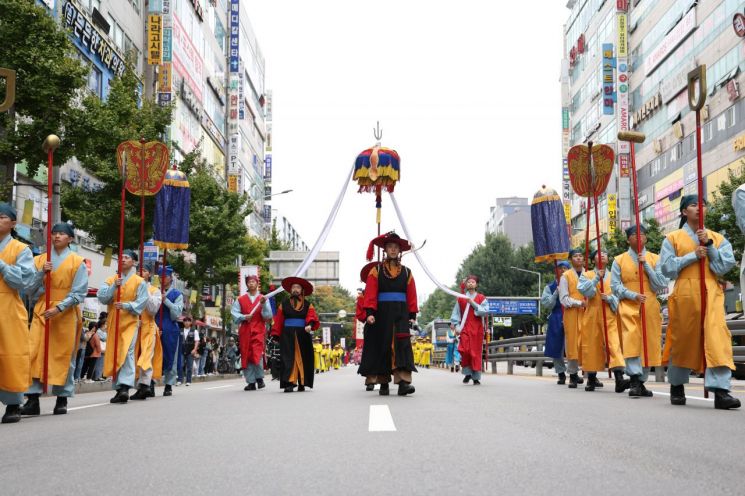 Participants are passing through Dongtan New Town in Hwaseong during last year's "King Jeongjo Royal Procession" event. Photo by Hwaseong City
The King Jeongjo Royal Procession originated in 1795 when King Jeongjo personally traveled to commemorate the 60th birthday of his mother, Lady Hyegyeong, and to pay respects at the tomb of his father, Crown Prince Sado, at Hyeollyungwon (now Yungneung). The eight-day procession is recorded in the "Wonhaeng Eulmyo Jeongni Uigwe" and is regarded as one of the largest ceremonial events of the Joseon Dynasty.
The royal procession began at Changdeokgung Palace, crossed the Han River at Ttukseom, and reached Suwon. From there, King Jeongjo stayed at Hwaseong Haenggung Palace before continuing to Hyeollyungwon, located on Hyohaeng-ro in Hwaseong.
During the procession, King Jeongjo allowed "Gyeokjaeng," a practice in which citizens could beat gongs to directly appeal their grievances, enabling him to hear the voices of the people. He also held a special state examination, known as "Byeolsi," during the procession. Those who passed the examination were appointed to positions such as Gyujanggak proofreaders.
The royal procession continues from Gyeongbokgung Palace in Seoul, passes through Suwon and Hwaseong Haenggung Palace, and finally reaches Hwaseong Yungneung. The Hwaseong section will begin at 11 a.m. on September 28. In Hwaseong, the event will span a total of 7.2 kilometers, divided into three sections: the traditional section, the modern section, and the future section.
The traditional section covers 2.9 kilometers from Hwanggye-dong to Hyeonchung Park and Jeongjo Hyogong Park, faithfully recreating King Jeongjo's procession based on historical records. The modern section, which stretches 4.6 kilometers through Dongtan New Town, connects King Jeongjo's vision of a new city with the present-day development of Dongtan. In the future section, which runs 3 kilometers from Hyeonchung Park to Jeongjo Hyogong Park, citizens will participate in a forward-looking procession symbolizing the future.
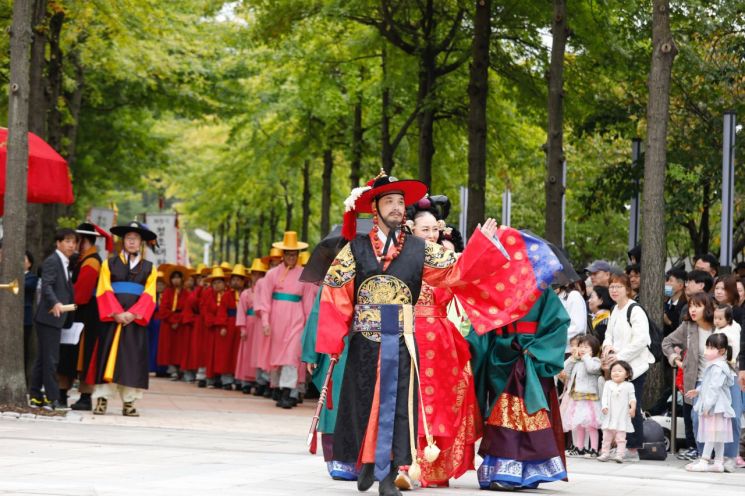 A participant dressed as King Jeongjo at last year's "King Jeongjo Royal Procession" is greeting citizens upon arriving at the final destination, Jeongjo Hyogong Park. Photo by Hwaseong City
The royal procession will feature children, foreigners, citizen parade groups, and the "Messengers of the Wind" selected from the Hwaseong Boat Festival, highlighting the event as a symbolic space where King Jeongjo's spirit-encompassing tradition, modernity, and the future-comes to fruition.
Jung Myunggeun, Mayor of Hwaseong, stated, "King Jeongjo's filial piety, compassion for the people, and reformist spirit remain valuable even today. Through the royal procession, we will widely promote Hwaseong as the 'City of Filial Piety' that carries on King Jeongjo's legacy in a modern way."
© The Asia Business Daily(www.asiae.co.kr). All rights reserved.













