Despite Kim Jong Un's Demand for Recognition as a Nuclear State, Denuclearization Principle Maintained
Rubio Responds to Request for Measures to Prevent Recurrence of the Georgia Incident: "Close Cooperation"
The foreign ministers of South Korea, the United States, and Japan held a trilateral meeting and reaffirmed their commitment to the "principle of denuclearization of the Korean Peninsula." This comes as North Korean State Affairs Commission Chairman Kim Jong Un has demanded that the United States abandon its denuclearization stance as a precondition for North Korea-U.S. dialogue, and as President Lee Jaemyung has expressed in a foreign media interview a willingness to accept a nuclear freeze if an agreement is reached between North Korea and the United States.
According to the Ministry of Foreign Affairs on September 23, Foreign Minister Cho Hyun, U.S. Secretary of State Marco Rubio, and Japanese Foreign Minister Iwaya Takeshi held a foreign ministers' meeting in New York, United States, on September 22. They discussed issues concerning the Korean Peninsula and the region, as well as ways to enhance economic security cooperation among the three countries, and adopted a joint statement reflecting these discussions.
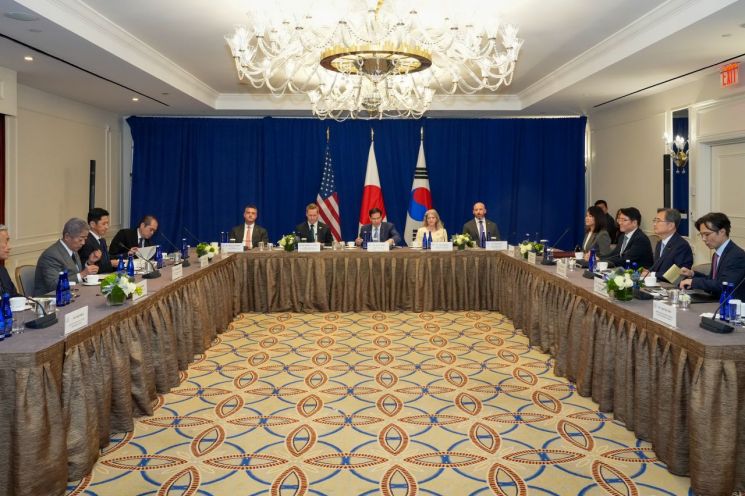
During the meeting, the three ministers agreed to maintain close cooperation on North Korea policy while upholding the principle of denuclearization of the Korean Peninsula and a deterrence posture against North Korea. In particular, Minister Cho emphasized the need for active cooperation to achieve substantial progress toward peace on the Korean Peninsula and the resolution of the North Korean nuclear issue, including the resumption of dialogue with North Korea.
In the joint statement, the three ministers reaffirmed their firm commitment to the complete denuclearization of North Korea in accordance with United Nations Security Council resolutions. They also highlighted the need for a coordinated response to North Korea's nuclear and missile programs and stressed the importance of maintaining and strengthening the sanctions regime against North Korea by resolutely addressing violations and evasions of UN Security Council resolutions in cooperation with other countries.
Additionally, the three ministers exchanged views on ways to deepen cooperation in economic security and advanced technology sectors. Minister Cho reaffirmed South Korea's willingness to cooperate as an optimal partner for the United States in its advanced technology and manufacturing renaissance. He emphasized that ensuring smooth personnel exchanges, instituting systemic improvements to prevent a recurrence of the Georgia incident, and introducing new visa systems are essential to make this possible, and called for special measures from the U.S. side.
Secretary Rubio responded to Minister Cho's remarks by noting that these are bilateral rather than trilateral issues, but given the friendly alliance between the two countries, the United States would work closely with South Korea for a prompt resolution.
The three ministers also expressed hope for continued expansion of practical cooperation in areas such as quantum technology, nuclear energy, artificial intelligence (AI), and supply chains. They agreed to actively utilize the South Korea-U.S.-Japan Secretariat and to continue reviewing progress at the ministerial level to ensure action-oriented and tangible outcomes.
© The Asia Business Daily(www.asiae.co.kr). All rights reserved.












