Partnership Signed with Five Medical Institutions
Enhanced Support for Post-Discharge Patient Care
Park Seungwon: "We Will Closely Link Medical and Care Services to Create a Secure City"
Gwangmyeong City in Gyeonggi Province is set to establish a regionally tailored integrated support system that connects care and medical services by collaborating with local medical institutions and social welfare facilities.
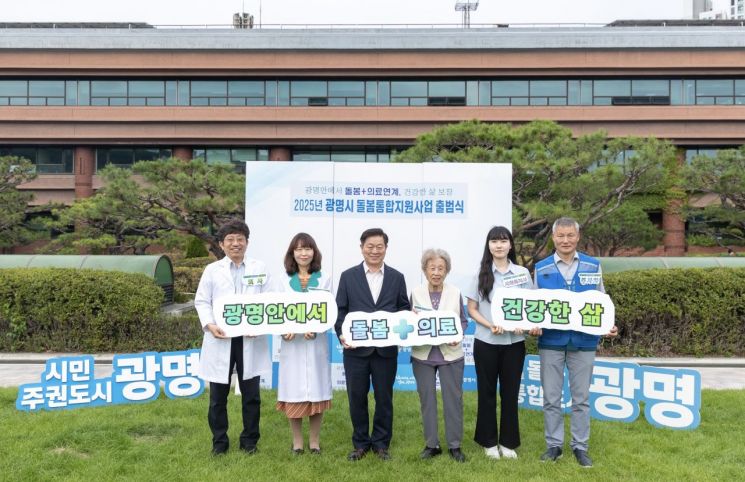 At the launch ceremony of the "Gwangmyeong-type Integrated Care Support Project" held on the lawn square of Gwangmyeong City Hall on the 22nd, Park Seungwon, mayor of Gwangmyeong (third from the left), is pledging with representatives of participating organizations to establish a smooth integrated care support system. Provided by Gwangmyeong City
On the 22nd, Gwangmyeong City held the launch ceremony for the "Gwangmyeong-type Integrated Care Support Project" on the lawn square of City Hall. The event was organized to declare the project’s vision together with citizens, ahead of the official launch on October 1, following its selection as a pilot project for integrated care support by the Ministry of Health and Welfare.
Under the slogan "Care + Medical Linkage within Gwangmyeong, Guaranteeing a Healthy Life," the launch ceremony was attended by over 100 people, including representatives of local hospitals and clinics, social welfare facilities, related organizations, and citizens.
During the event, five local medical institutions-Chung-Ang University Gwangmyeong Hospital, Gwangmyeong Seongae Hospital, Gwangmyeong Gidaechan Hospital, Gwangmyeong 21st Century Hospital, and Gwangmyeong Saeum Hospital-signed a memorandum of understanding (MOU) to establish a partnership for post-discharge patient care.
The core of the agreement is to build a support system that enables discharged patients to continue receiving care in the community without any gaps in medical services. Participating hospitals will refer patients in need of care to the city, which will then connect them to the integrated care support project, providing medical and welfare services to help patients return to their daily lives. For example, if an elderly person living alone is discharged, the hospital will notify the city, which will then coordinate customized services such as in-home care, meal support, and home visits by oriental medicine doctors, ensuring uninterrupted care at home.
The city will provide administrative support, integrated case management, and serve as a coordinator for public-private resources to establish a sustainable local care system. The main tasks will include developing a field-oriented model tailored to local conditions, building a collaborative system between medical and care services, and raising public awareness through consensus-building among citizens.
Park Seungwon, mayor of Gwangmyeong, said, "The Gwangmyeong-type Integrated Care Support Project marks an important turning point in helping citizens continue to live healthy and happy lives in their own communities," and added, "We will closely link medical and care services to create a city where everyone can feel secure."
© The Asia Business Daily(www.asiae.co.kr). All rights reserved.












