President Lee Jaemyung's Interviews with Reuters and BBC
U.S. Demands $350 Billion in Cash Payment
President Lee Rejects, Warning of "Financial Crisis"
Lee Stresses North Korean Nuclear "Production Freeze" Before Denuclearization
"Says He Will Accept If Trump and Kim Jong-un Reach Agreement"
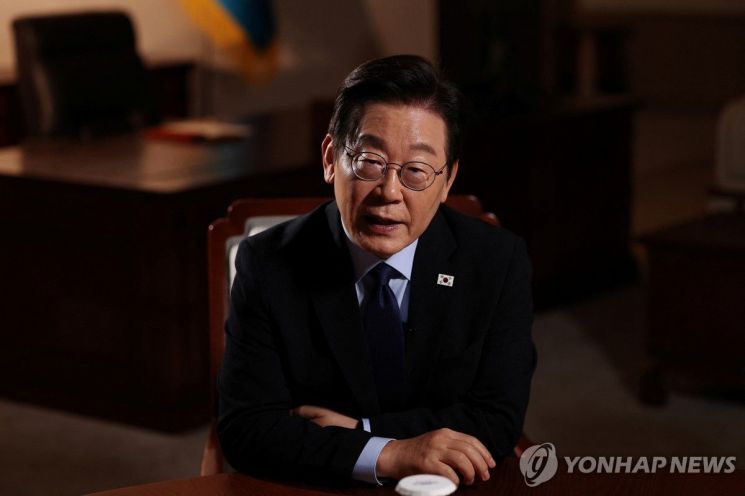
In an interview with Reuters released on September 22 (Korean time), President Lee Jaemyung expressed concerns that paying the $350 billion U.S. investment fund in cash could trigger a severe financial crisis. With tariff negotiations at a standstill, the president has directly rejected the U.S. demand for cash payment. President Lee stated that he wants to conclude the tariff negotiations swiftly based on "commercial rationality."
Lee: "Detailed agreements ensuring commercial rationality are crucial"
On September 19, during an interview with Reuters at his office in Yongsan, President Lee said, "If we withdraw $350 billion and invest it in cash as the U.S. demands, without a Korea-U.S. currency swap, Korea would face a situation similar to the 1997 foreign exchange crisis." He implied that converting such a large amount of won into dollars would inevitably impact the foreign exchange market.
At the end of July, Korea agreed to lower tariffs on U.S. goods from 25% to 15% in exchange for investing $350 billion in the United States. However, while Korea regarded the investment as a guarantee limit, the U.S. insisted on a cash payment, preventing the negotiations from being finalized. The Korean government demanded an "unlimited currency swap," but the United States reportedly did not accept this. The U.S. is pressuring Korea to follow the example of Japan, which was given full authority to select investment targets.
President Lee stated that Korea and Japan are different. He cited the fact that Japan established a $550 billion U.S. investment fund, has more than double Korea’s foreign reserves ($410 billion), the yen is an international currency, and Japan has a currency swap agreement in place.
President Lee said, "Reaching a detailed agreement that guarantees commercial rationality is currently the most important task and the biggest obstacle." He added, "The proposals from working-level talks do not guarantee commercial viability, making it difficult to bridge the gap." He also said, "I believe that at least a minimum level of rationality will be maintained between allied nations with a blood alliance," and emphasized, "We must end this unstable situation as soon as possible."
Regarding the case of a Korean national detained by U.S. Immigration and Customs Enforcement (ICE), he warned that "companies may hesitate to invest in the United States." However, President Lee said, "I do not believe this incident was intentional," adding, "The U.S. apologized, agreed to seek reasonable measures, and is pursuing them." He also gave a positive assessment of President Donald Trump’s decision to allow workers to stay.
Lee: "If Trump and Kim Jong-un agree to freeze production, it will be accepted"
In an interview with the BBC broadcast in the United Kingdom on the same day, President Lee emphasized that he could accept an agreement between President Trump and North Korean leader Kim Jong-un to freeze production, even if it does not lead to denuclearization. President Lee mentioned, "It seems that President Trump and Chairman Kim have a certain degree of mutual trust," and said he believes another meeting is possible.
President Lee reiterated that freezing North Korea’s nuclear program is an "emergency temporary measure" and a "feasible and realistic alternative." He stressed that since North Korea produces 15 to 20 nuclear weapons annually, halting this production should be the priority. President Lee explained, "As long as we do not abandon the long-term goal of denuclearization, there is a definite advantage to having North Korea halt its nuclear and missile development," and added, "The question is whether to stick to the fruitless goal of denuclearization or to set a more realistic goal and achieve at least part of it."
He also made it clear that the government intends to maintain its conciliatory stance toward North Korea. When asked about the rationale for suspending radio broadcasts to the North after his inauguration, President Lee replied, "I determined that they had little actual effect." He continued, "The important thing is restoring trust between the two Koreas," and said, "We believe such measures can bring North Korea back to the negotiating table."
However, President Lee commented on the recent display of closer ties between North Korea, China, and Russia during the Victory Day celebrations in Beijing, saying, "Such closeness is not desirable for us," and mentioned the possibility of responding through Korea-U.S.-Japan cooperation.
© The Asia Business Daily(www.asiae.co.kr). All rights reserved.












