Transition to Voluntary Vaccination for All Ages, Including High-Risk Groups
Health Experts Warn of Serious Public Health Confusion
There has been a significant change in the COVID-19 vaccine guidelines issued by U.S. health authorities.
On September 19 (local time), the Advisory Committee on Immunization Practices (ACIP) under the U.S. Centers for Disease Control and Prevention (CDC) announced that it would no longer recommend the COVID-19 vaccine for anyone. As a result, the decision to get vaccinated is now left to individual choice, with a new recommendation that people consult with healthcare professionals before making a decision.
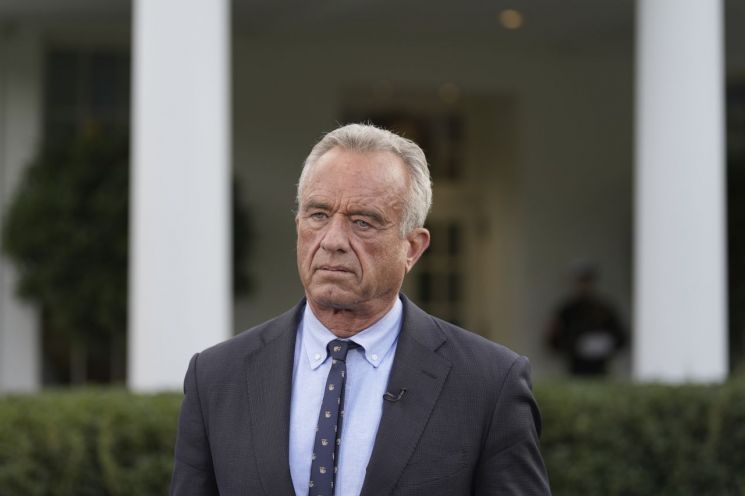 Robert F. Kennedy Jr., United States Secretary of Health and Human Services, is preparing for a TV interview outside the West Wing of the White House in Washington. Photo by AP Yonhap News
The advisory committee finalized this recommendation through a vote, deciding not to recommend vaccination even for those previously considered priority groups, such as people aged 65 and older or those with underlying health conditions. This move directly contradicts the existing COVID-19 vaccination policies in the United States.
The committee also called for government information materials on COVID-19 vaccines to more clearly present information about the potential risks and side effects of the vaccines. In addition, proposals to mandate vaccination or require prescriptions for the vaccine were not adopted, as the majority opposed them.
This new recommendation is seen as reflecting the policy stance of Robert F. Kennedy Jr., the Secretary of Health and Human Services, who is known as a "vaccine skeptic." In June, Secretary Kennedy dismissed all previous members of the Advisory Committee on Immunization Practices and reconstituted the committee with individuals who share his views. Since then, many long-standing CDC guidelines have been subject to review.
In fact, just the day before, a recommendation was passed to discontinue the previous practice of administering the MMRV combination vaccine (measles, mumps, rubella, and varicella) to children under four years old, instead advising that each vaccine be given separately. Such changes have raised concerns that vaccine accessibility and efficiency could be undermined.
The Associated Press reported that this recommendation is unprecedented in CDC history. The CDC's previous policy had been to recommend regular COVID-19 vaccinations, similar to the flu vaccine, based on a medical consensus that safety and efficacy had been proven through billions of doses administered.
Health experts warn that this measure could send the wrong message to the public. Paul Offit, director of the Vaccine Education Center at the Children's Hospital of Philadelphia, said, "Even though vaccination is possible, not recommending it for high-risk groups can cause confusion." Sean O'Leary, chair of the Committee on Infectious Diseases at the American Academy of Pediatrics, criticized attempts to promote vaccine distrust during the advisory committee's discussions, warning that "this could immediately impact children's health."
© The Asia Business Daily(www.asiae.co.kr). All rights reserved.

![Clutching a Stolen Dior Bag, Saying "I Hate Being Poor but Real"... The Grotesque Con of a "Human Knockoff" [Slate]](https://cwcontent.asiae.co.kr/asiaresize/183/2026021902243444107_1771435474.jpg)














