Record Number of Foreign Tourists Visit Seoul in July Amid "K-Pop Demon Hunters" Craze
Netflix: "Catalyst for K-Content Expansion... Foundation for Sustainable Growth"
Boom in Related Industries... "Enjoy the Momentum and Preserve the Ecosystem"
#. In July, a record 1.56 million foreign tourists visited Seoul, the backdrop of the Netflix original "K-Pop Demon Hunters" (hereafter referred to as "K-Pop Demon Hunters"). Previously, "When Life Gives You Tangerines," which was released earlier, heightened interest in Jeju's traditional culture, including the haenyeo (female divers). As a result, the number of vehicles visiting Gimnyeong Beach roughly doubled compared to before the show aired.
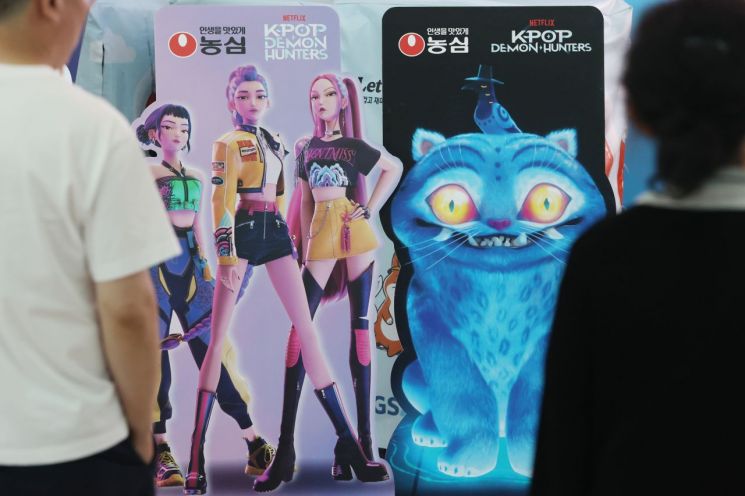 Promotional materials for the popular animated film "K-Pop Demon Hunters" are attracting attention at the GS25 convenience store in Terminal 2 of Incheon International Airport. Photo by Yonhap News Agency
From Content to Economy... Netflix "Driving the Expansion of the Korean Wave"
K-content invested in by Netflix is generating economic value in tourism, dining, and manufacturing industries, creating what is now called the "Netflix effect."
On September 19, Netflix announced that, as of last year, more than 8 out of 10 global subscribers had watched at least one piece of K-content. In addition, a survey conducted this year with 11,511 people across eight countries found that Netflix viewers (72%) were about twice as likely to express an intention to visit Korea compared to non-viewers (37%).
A Netflix representative emphasized, "Netflix has become both a catalyst and an accelerator for Korean content to permeate the daily lives of people worldwide. In this process, the Korean Wave has expanded beyond content into related industries and has begun to be translated into the language of the economy," adding that this is the result of a philosophy that believes in the 'power of storytelling.'
Since entering Korea in 2016, Netflix has continued to invest in K-content. In particular, in 2023, the company announced plans to invest more than 3 trillion won (2.5 billion dollars) over the next four years, demonstrating its commitment to a long-term partnership.
This has provided predictability for Korean creators and related industries, promoted employment and new investments, and established a foundation for sustainable growth across the entire production ecosystem. Works of Hollywood-level quality have emerged, and genres and subject matter have become more diverse.
Deloitte Consulting analyzed that Netflix's domestic content investment from 2016 to 2020 generated approximately 5.6 trillion won in social and economic ripple effects and created about 16,000 jobs. In particular, through collaboration with various domestic creators in production and distribution fields such as filming, editing, dubbing, and special effects, about 2.7 trillion won in economic value was created.
 Kim Sook, CEO of Culture Media Lab (left), and Kim Taehoon, pop columnist, are sharing their opinions on "The Cultural and Economic Impact of the Development of K-Content on Korea" at the 30th Busan International Film Festival 'Netflix Insight' media session held on the 19th at Dongseo University Centum Campus in Haeundae-gu, Busan. Photo by Noh Kyungjo
The "K-Pop Demon Hunters" Phenomenon Spreads... "Coexistence for Ecosystem Preservation"
A representative example of K-content demonstrating the industrial and economic value of culture is "K-Pop Demon Hunters," which is based on traditional Korean culture. On September 14, this work became the first on Netflix to surpass 300 million cumulative views. Its original soundtrack also topped both the US Billboard and UK Official Charts simultaneously, continuing the "K-Pop Demon Hunters" phenomenon.
According to Google Trends, in the week following the release of "K-Pop Demon Hunters" starting August 17, searches for "Korea" reached their highest level in two years and eight months since the end of 2022. This figure is even higher than the search volume for "Korea" immediately after the declaration of martial law in December last year.
Domestic companies are enjoying the "K-Pop Demon Hunters" boom. For example, the share price of Nongshim recently hit a 52-week high, as the ramen eaten by the Huntress members in the show reminds viewers of "Shin Ramyun." All 1,000 sets of the "K-Pop Demon Hunters Limited Edition Shin Ramyun" sold out in just 1 minute and 40 seconds. With the scalability of K-content receiving positive reviews, last month, venture capital investment in related startups reached 19 billion won, more than doubling from the previous month (8.2 billion won).
The success of "K-Pop Demon Hunters" is attributed to its ability to universalize unique subject matter. Pop columnist Kim Taehoon commented, "'K-Pop Demon Hunters' cleverly blends the format of 'Charlie's Angels' with exorcists, combining two genres, and incorporates the universally relatable message of 'finding one's identity,' which everyone experiences at some point. Viewers can find characters they identify with."
He added, "I don't think K-content is just a passing fad. Rather than being limited by Korean directors or distribution networks, I hope that people who are not Korean will enjoy creating something with Korean elements."
He also stressed the need to maintain the current, well-developed ecosystem. Kim emphasized, "Coexistence is essential for sustaining the ecosystem. There is no guarantee that gentrification will not occur even on platforms. Netflix and creators must work together to find the best way to preserve the ecosystem."
© The Asia Business Daily(www.asiae.co.kr). All rights reserved.













