Naju Introduced to the World at the Global Energy Forum 2025
Deputy Mayor Kang Sanggu: "Building Next-Generation Power Grids in Naju"
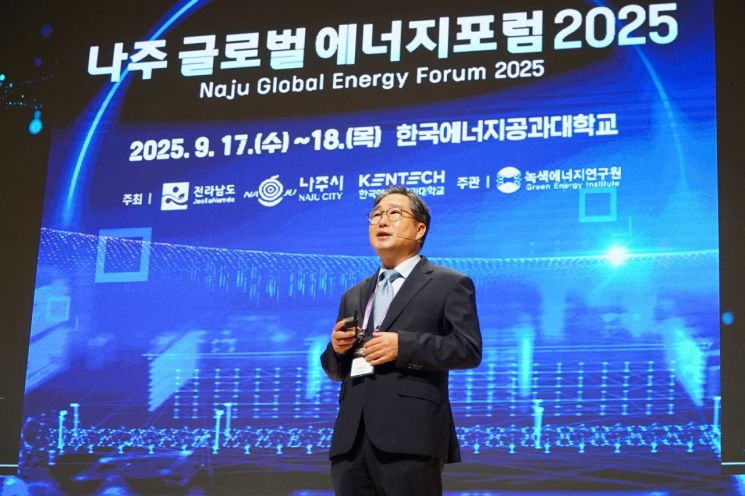 Kang Sanggu, Deputy Mayor of Naju, appeared as a speaker at the "Naju Global Energy Forum 2025," emphasizing that Naju is a city prepared for the era of energy transition. Photo by Naju City
Naju City in South Jeolla Province has unveiled a blueprint to advance beyond its status as the energy capital of Korea and become a global investment hub.
On September 18, Kang Sanggu, Deputy Mayor of Naju, drew the attention of global investors by presenting Naju's investment competitiveness and future vision during the Business & Investment session at the Naju Global Energy Forum 2025, held at Korea Institute of Energy Technology.
The Naju Global Energy Forum 2025 is an international event hosted by Naju City over two days, from September 17 to 18, aiming to establish itself as a central location in the global era of energy transition.
This year, Professor Konstantin Novoselov, recipient of the 2010 Nobel Prize in Physics, delivered the keynote address, focusing on 'Decentralization, Direct Current, and Digital AI.'
The session began with presentations by Choi Jongwoong, CEO of Encored Technologies, and Kang Sanggu, Deputy Mayor of Naju, followed by a keynote speech from Amin Badr El Din. The event continued with an online panel discussion featuring international investors such as Brian Gu, Thomas Lefebvre, Steve Westly, and National Assembly member Ahn Hyunju.
In particular, Deputy Mayor Kang captured the audience's attention by connecting Naju's history and present, emphasizing, "Just as rice was once the backbone of the national economy, today renewable energy is the rice of future industries."
Deputy Mayor Kang highlighted that Naju was the largest granary and the birthplace of the first markets during the Joseon Dynasty, and that today, it is growing as the heart of Korea's energy transition, based on renewable energy, artificial intelligence, and its designation as a direct current special zone.
He presented five key investment attractions of Naju.
First, he emphasized that Naju is Korea's largest energy valley, home to Korea Electric Power Corporation, 16 public institutions, and over 500 energy companies. Second, he introduced Naju as the center of South Jeolla Province, which accounts for 20% of the nation's renewable energy capacity, boasting abundant renewable energy resources.
Third, he highlighted the business-friendly regulatory environment linked to the government's RE100 industrial complex special law. Fourth, he pointed out Naju's excellent accessibility to the Seoul metropolitan area via KTX high-speed rail.
Finally, he stressed Naju's future value as a testbed for next-generation power grids based on high-voltage direct current (HVDC), AI, and big data, as well as its role as a talent supply hub thanks to the concentration of energy-specialized educational institutions, including the Korea Institute of Energy Technology.
Deputy Mayor Kang stated, "If the power grid is the vascular system, Naju is the heart and brain," and added, "I hope you will invest in Naju, the most optimal city equipped for the convergence of energy and AI and the construction of next-generation power grids."
© The Asia Business Daily(www.asiae.co.kr). All rights reserved.












