Starting with the Ministry of Foreign Affairs on October 13
Fierce Ruling and Opposition Party Debates Expected
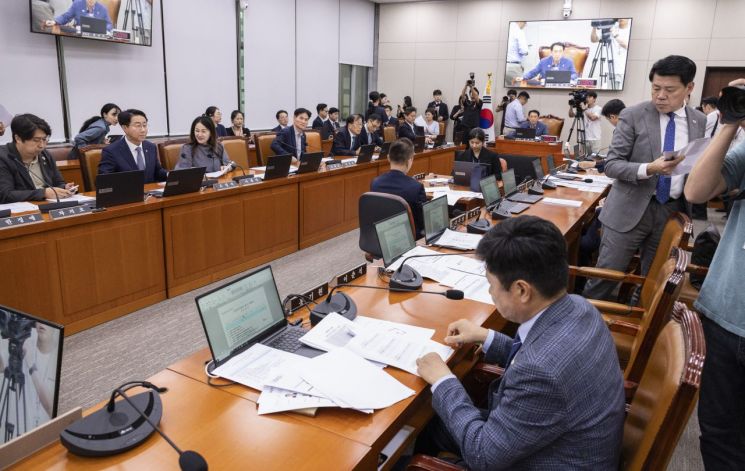
The ruling and opposition parties have reached a tentative agreement to hold this year’s National Assembly audit immediately after the Chuseok holiday, marking the first such audit since the inauguration of the Lee Jaemyung administration. In the economic and industrial sectors, issues such as fiscal soundness, household debt management, the effectiveness of real estate supply policies, and regional polarization have emerged as major points of contention.
According to the National Assembly on September 18, the Foreign Affairs and Unification Committee will begin the audit with the Ministry of Foreign Affairs on October 13, followed by the Ministry of Unification on October 14, and will conduct a comprehensive audit on October 28. Other standing committees, including the Strategy and Finance Committee, the Political Affairs Committee, the Land, Infrastructure and Transport Committee, the National Defense Committee, and the Science, ICT, Broadcasting and Communications Committee, have also tentatively agreed to begin their audits on October 13. They plan to start audits of relevant ministries on October 13 and conduct comprehensive audits between October 29 and 31. The Legislation and Judiciary Committee plans to start on October 13 and finish on October 30, but related discussions have not yet taken place. A committee official explained, “Since the appointment of the People Power Party’s secretary was rejected, there has been no sharing of schedules between the ruling and opposition party secretaries.”
In the Strategy and Finance Committee, fiscal soundness and the increase in mandatory expenditures are expected to be the main issues. The rapid annual increase in mandatory expenditures-budget items the government is required to spend-is cited as a threat to fiscal sustainability. In the economic and industrial sectors, including the Ministry of Trade, Industry and Energy and the Land, Infrastructure and Transport Committee, topics will include trade risks stemming from Korea-US tariff negotiations, power shortages due to the development of the artificial intelligence (AI) industry, and nuclear power plant policies. Regarding real estate, discussions are expected to focus on the effectiveness of the September 7 real estate supply measures, the polarization of housing prices between the Seoul metropolitan area and non-metropolitan regions, and issues related to foreign real estate investment.
In the Political Affairs Committee, internal control issues resulting from a series of financial accidents are expected to be a focal point. Household debt management is also likely to be discussed. Since the June 27 lending regulations led to market turmoil and polarization of loans between high-credit and mid- to low-credit borrowers, the effectiveness of short-term quantitative controls is expected to be addressed. The Democratic Party is emphasizing the imposition of social responsibility on financial institutions, such as limiting interest rates for low-credit borrowers, and related discussions are expected to continue.
© The Asia Business Daily(www.asiae.co.kr). All rights reserved.












