On September 18, Samsung Securities analyzed that, following the United States' decision to cut its benchmark interest rate, attention should be paid to the IT, communication, and consumer discretionary sectors.
The United States Federal Reserve lowered its benchmark interest rate by 0.25 percentage points on the 17th (local time), marking the first rate cut in nine months. The Federal Reserve reduced the federal funds rate to a range of 4.00% to 4.25% at the regular Federal Open Market Committee (FOMC) meeting.
The Federal Reserve indicated that it plans to lower rates two more times (by a total of 0.5 percentage points) by the end of this year. In the Summary of Economic Projections (SEP) released on the same day, the Fed revised its year-end benchmark rate forecast from 3.9% to 3.6%.
On this day, the New York stock market showed volatility, initially surging after the rate cut announcement but later giving up its gains.
According to the New York Stock Exchange, the technology-focused Nasdaq Composite Index closed at 22,261.32, down 0.33% from the previous session. The large-cap S&P 500 also fell 0.1% to finish at 6,600.35. Only the Dow Jones Industrial Average rose, closing up 0.57% at 46,018.32.
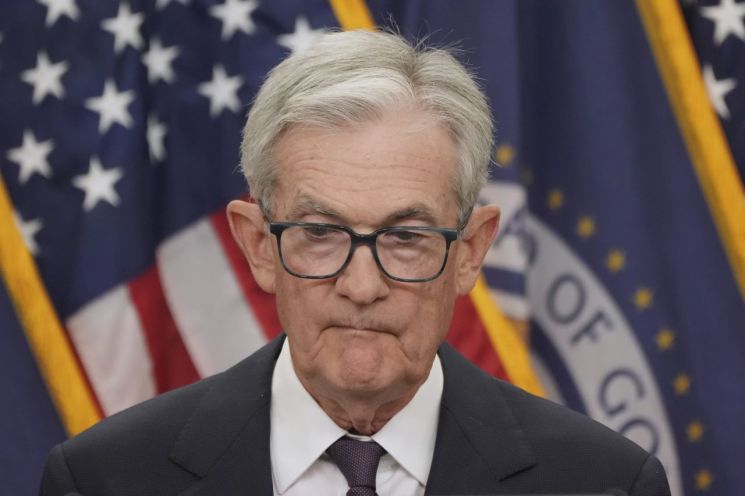 Jerome Powell, Chairman of the United States Federal Reserve, is holding a press conference on the 17th (local time). Photo by AP
Park Hyeran, a researcher at Samsung Securities, explained, "High valuations have been an obstacle, and although technology stocks saw their upward momentum slow somewhat in August, the recent resurgence of the artificial intelligence (AI) momentum has pushed the IT sector's price-to-earnings ratio to 30 times, surpassing the COVID-19 peak of 27.9 times." She added, "In the short term, investors should be cautious of profit-taking opportunities as the rate cut event passes and as we enter an earnings lull."
However, she projected that the Federal Reserve's commitment to preventing a recession, along with robust earnings growth driven by AI industry demand, will further support the stock market.
Park noted, "Strong corporate demand for AI and the resulting increase in capital expenditures (CAPEX) are likely to lead to further upward earnings revisions. This could offset the risk of downward earnings revisions in other sectors facing high tariff uncertainties." She also pointed out, "A possible summit between the United States and China and a potential trade agreement within the year are upside factors."
Park highlighted that IT, communication, and consumer discretionary sectors performed well in previous periods when the United States cut interest rates. She stated, "There have only been six cases of rate cuts since 1995 that allow us to examine sector and style performance, but even so, it is noteworthy that certain sectors and styles consistently outperformed during those periods."
She analyzed, "By sector, IT, communication, and consumer discretionary stocks performed significantly well over the following year. In terms of style, growth and sensitive stocks (energy, industrials, IT, and communication) outperformed the market (S&P 500)." She added, "Meanwhile, healthcare, energy, and materials sectors consistently underperformed the market, and likewise, value and low-volatility styles were weak during the same periods."
© The Asia Business Daily(www.asiae.co.kr). All rights reserved.












