City Hosts Policy Debate on 'AI Mobility' Strategy at National Assembly
Ministry of Land and Ministry of Industry to Launch National Policy Implementation Next Year
Kang Gijeong: "AI-Automotive Convergence... Creating New Growth Engines"
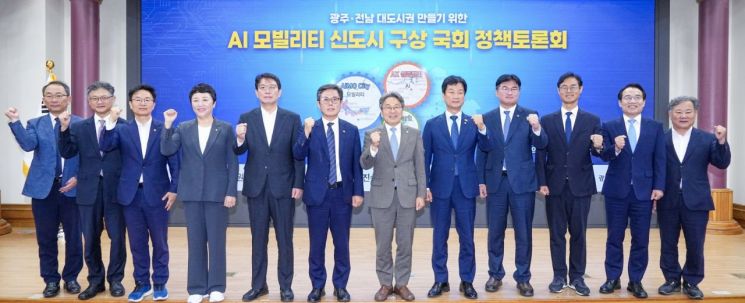 On the morning of the 17th, at the First Conference Room of the National Assembly Members' Office Building in Yeouido, Seoul, participants including Kang Gijeong, Mayor of Gwangju, and members of the National Assembly Park Gyuntaek, Ahn Dogeol, Jeon Jinsook, Jeong Junho, and Jeong Jinwook are taking a commemorative photo at the "AI Mobility New Town Concept National Assembly Policy Forum." Provided by Gwangju City
Gwangju City has officially begun its efforts to become a leading mobility city in South Korea, leveraging the nation's only artificial intelligence (AI) infrastructure, including the National AI Data Center.
On September 17, Gwangju City held the "Policy Debate on the AI Mobility New City Concept for Creating the Gwangju-Jeonnam Metropolitan Area" at the First Conference Room of the National Assembly Members' Office Building. The debate was co-hosted by eight local lawmakers and co-organized by Gwangju City and the Gwangju Research Institute. Over 100 participants attended, including Mayor Kang Gijeong, lawmakers Ahn Dogeol, Jeon Jinsuk, Jung Junho, Jung Jinwook, Cho Incheol, Park Gyuntaek, Choi Chiguk, head of the Gwangju Research Institute, as well as officials from the National Assembly, government, research institutions, and companies.
This policy debate was organized to share Gwangju’s vision after the city's core pledge to become “South Korea’s representative mobility city” was included as a national policy agenda. The event aimed to explore concrete and actionable plans and strategies in collaboration with the National Assembly and the government.
Mayor Kang Gijeong delivered a keynote presentation on the theme of "AI Mobility New City." The subsequent panel discussion featured Kim Hongmok, Director General of the Mobility and Automobile Bureau at the Ministry of Land, Infrastructure and Transport; Park Dongil, Director General for Manufacturing Industry Policy at the Ministry of Trade, Industry and Energy; Jin Jonguk, President of the Korea Automotive Technology Institute; Kim Sungjin, President of the Gwangju Future Automobile Mobility Promotion Institute; and Choi Chiguk, President of the Gwangju Research Institute, who discussed the direction of the initiative.
In his keynote, Mayor Kang emphasized, "Gwangju, as the nation’s second-largest automotive city, will create an AI Mobility New City that combines AI and mobility, transforming it into a growth engine for South Korea that leads both citizens’ daily lives and industrial innovation."
Mayor Kang presented several strategies for the successful development of the AI Mobility New City: establishing a regulation-free mega sandbox, building national infrastructure for fully autonomous driving demonstrations, expanding the mobility industry in the Honam region, creating an RE100 industrial complex, and establishing a new Gwangju New Industry Line connecting the Gwangju R&D Special Zone, Gwangju Songjeong Station, Bitgreen and Future Car National Industrial Complex, and Yeonggwang.
During the debate, participants discussed the direction and strategies for creating the AI Mobility New City, focusing on building an AI industry ecosystem anchored by the "National AI Data Center-Talent-Companies" triangle.
Local lawmakers attending the policy debate agreed, stating, "Gwangju is a city where the automotive industry is the backbone of the economy and is a leader in future mobility by integrating AI. The National Assembly will actively cooperate to ensure the success of projects led by the Ministry of Land, Infrastructure and Transport and the Ministry of Trade, Industry and Energy."
Meanwhile, on September 16, the government approved 123 national policy tasks to be pursued over the next five years during a Cabinet meeting. The government largely confirmed the 123 key tasks previously prepared by the National Policy Planning Committee. These include implementation plans that reflect Gwangju’s pledges, prepared by the Ministry of Land, Infrastructure and Transport and the Ministry of Trade, Industry and Energy.
The Ministry of Land, Infrastructure and Transport included the "AI Mobility National Pilot City" in its implementation plan for realizing future mobility and K-AI City (National Policy Task No. 31). The Ministry of Trade, Industry and Energy incorporated the "Physical AI-based Future Car Industry Innovation Cluster" into its plan to discover and foster new growth engines for national advancement in advanced industries (National Policy Task No. 29).
The AI Mobility National Pilot City project aims to build a new city equipped with advanced infrastructure, such as transportation systems for demonstration and operation and an AI-based integrated urban management system. Starting with a preliminary planning study this year, the project aims to conduct a basic design study in 2026, carry out a preliminary feasibility study and secure national funding in 2027, commence construction in 2028, and complete the project by 2030.
The Physical AI-based Future Car Industry Innovation Cluster project aims to support local parts companies in developing, demonstrating, and certifying future car components, while bringing together related companies and research institutions to create an advanced industry ecosystem. The plan is to conduct a preliminary feasibility study planning service this year, undergo feasibility review in 2026, pass the feasibility study and secure national funding in 2027, implement the project in 2028, and complete it by 2030.
© The Asia Business Daily(www.asiae.co.kr). All rights reserved.












