NICE Credit Rating (NICE Ratings) has assessed that the domestic oil and chemical industry is facing a crisis on all sides due to oversupply and deteriorating price competitiveness.
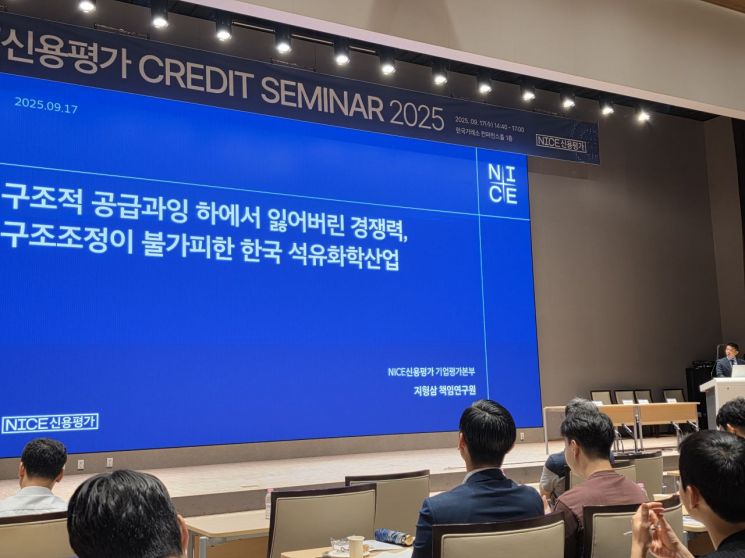
Ji Hyeongsam, lead researcher at NICE Ratings, explained at the 'NICE Credit Seminar 2025' held at the Korea Exchange on the 17th, "Korean oil and chemical companies are being outcompeted by China in the general product segment and by Japan in the specialty product segment."
NICE Ratings explains that the slowdown in Korea's oil and chemical industry has been heavily influenced by oversupply, particularly centered on China. Researcher Ji stated, "Over the past five years, China's ethylene production capacity has increased by approximately 25 million tons," and added, "Significant capacity expansions are also scheduled for the next three years, mainly in China, making further declines in operating rates and profitability inevitable." He continued, "China maintains sound financial stability based on large-scale naphtha cracking center (NCC) facilities and a stable domestic demand base."
He also pointed out that Korea lags behind Japan in product segments. While Japan has restructured its product portfolio, Korea remains focused on general products. He said, "Japan recognized its structural limitations and has diversified its portfolio around fine chemicals and specialty products since the late 1990s. As a result, even during recent industry downturns, Japanese oil and chemical companies have generated about 40% of their total operating profit from specialty products, thereby maintaining overall solid profitability."
He particularly noted that domestic companies are suffering from both a sharp decline in profitability and an increased debt burden. He stated, "Since 2022, Korea has faced an unprecedented dual burden of plummeting profitability and rising debt. In this situation, restructuring of the Korean petrochemical industry is an unavoidable task."
Previously, ten major domestic petrochemical companies signed a voluntary industry restructuring agreement last month to revitalize the oil and chemical sector, agreeing to reduce NCC capacity by 2.7 to 3.7 million tons. This 3.7 million tons accounts for about 25% of total domestic facilities. Korea’s three main petrochemical complexes are located in Yeosu, Ulsan, and Daesan.
He said, "Daesan is a region where major groups such as LG, Hanwha, Lotte, and HD Hyundai, all of which have a high proportion of oil and chemical businesses, operate. If facility integration becomes a reality, it will serve as a meaningful precedent for similar integration efforts in other petrochemical complexes such as Yeosu and Ulsan."
Regarding credit ratings, he explained there would be no immediate downgrades. This is because the current government- and industry-supported voluntary agreements do not constitute a default event. He said, "I understand there is confusion because the terms 'restructuring' and 'voluntary agreement' are being used interchangeably, but the two are clearly different. A voluntary agreement is a private agreement at a normal stage. If a broad-based default involving actual debt restructuring occurs, a rating watch will be assigned upon application and an immediate downgrade to the 'CCC~C' range may follow."
However, he also advised that credit ratings could still be downgraded at this stage. He added, "If events such as facility integration, conversion to joint ventures, or facility closures occur during the process, we plan to reassess the appropriate credit rating by considering changes in business and financial risk levels."
© The Asia Business Daily(www.asiae.co.kr). All rights reserved.












