Obligation for Overseas Operators to Appoint a Local Representative
if Annual Sales Exceed KRW 1 Trillion or AI Service Sales Exceed KRW 10 Billion
Fact-Finding Investigations May Be Omitted
if “Sufficient Evidence Secured” or in Case of “Unjust Complaints”
Fines Deferred for at Least One Year,
with Consulting and Financial Support Provided
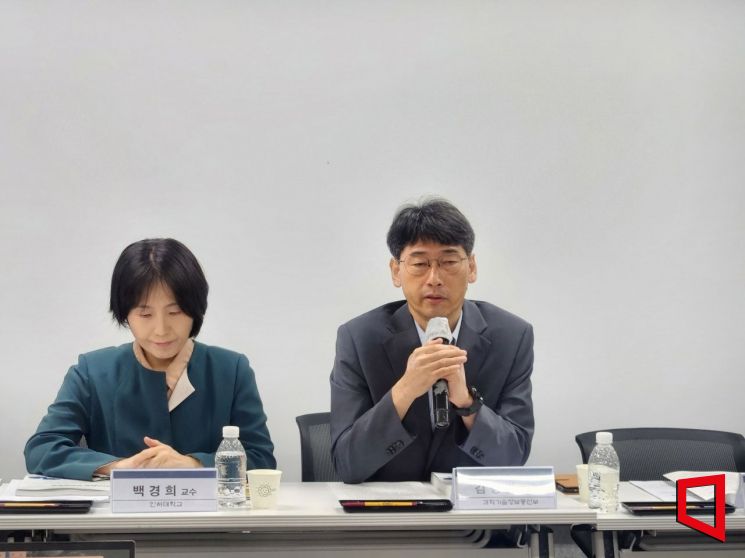 On the morning of the 17th in Jung-gu, Seoul, Kim Kyungman, Director of AI-Based Policy at the Ministry of Science and ICT, is explaining the "Direction for Enacting Subordinate Legislation of the AI Basic Act." Photo by Park Yujin
Major overseas tech companies such as OpenAI and Google will now be required to designate a local representative in South Korea. The Ministry of Science and ICT on the 17th released the direction for the enforcement decree, notification, and guidelines of the Artificial Intelligence (AI) Basic Act, which includes key issues that have drawn industry attention, such as requirements for overseas operators, exceptions to fact-finding investigations, management of high-impact and high-risk AI, and the operation of a grace period. The government plans to explain the main points of the subordinate legislation to stakeholders, including industry, academia, research institutes, and civic groups, collect feedback within this month, complete the legislative notice next month, and release the final version of the guidelines within the year.
According to the draft enforcement decree prepared ahead of the law’s implementation in January next year, overseas companies such as OpenAI and Google must appoint a local representative if their annual sales (based on headquarters) exceed 1 trillion won or if their AI service sales exceed 10 billion won in the previous year. This requirement is in line with the standards set by the Information and Communications Network Act and the Personal Information Protection Act. The representative may be a corporation or a law firm based in Korea.
The burdensome fact-finding investigation provision for companies now clearly stipulates exceptions. The Ministry of Science and ICT will allow investigations to be omitted if sufficient data or evidence has already been secured, or if a report or complaint is deemed to be for personal gain or to obstruct official duties. Regarding the standards for ‘sufficient evidence’ and the entity responsible for determining the ‘legitimacy of the purpose,’ the Ministry explained that these are based on the Administrative Investigation Act and the Civil Petition Processing Act, minimizing the risk of abuse and aiming to reduce market confusion.
The enforcement decree also distinguishes and manages high-performance and high-impact AI separately. The obligation to ensure safety applies to models with a cumulative computational workload of at least 10^26 FLOPS. Currently, no domestic or international models meet this standard, but the government expects such models to be released soon. This standard reflects the U.S. national security memorandum and is less stringent than the European Union’s threshold of 10^25 FLOPS.
High-impact AI refers to systems in 10 sectors, including healthcare, transportation, education, and energy, that have a significant effect on human life and safety. Operators are required to establish and publicly disclose risk management and user protection measures, and their responsibilities will vary depending on the development and operational stages. Whether an AI system is considered high-impact will be determined with the advice of a panel of experts, but this determination is not legally binding and the final decision rests with the government. Experts explained that this approach sets a minimum common denominator by reflecting international standards.
Penalties for violations of the AI Basic Act will not be imposed immediately after the law takes effect. The government will implement a grace period of at least one year, during which fact-finding investigations and corrective orders will be possible, but no fines will be levied. A Ministry of Science and ICT official explained, “This is not a regulation intended to punish, but a guide to help the industry adapt to the new system,” adding, “In particular, we will provide consulting and financial support to ease the burden on startups and small and medium-sized enterprises.” The grace period may also be applied differently depending on the industry and company size.
© The Asia Business Daily(www.asiae.co.kr). All rights reserved.












