Retail Sales Exceed Forecast at 0.6%
Mark Third Consecutive Month of Growth
Last month, U.S. retail sales continued to rise, surpassing market expectations. Despite concerns about weakened consumer sentiment due to President Donald Trump's aggressive tariff policies and a recent slowdown in employment, consumer spending has shown signs of recovery.
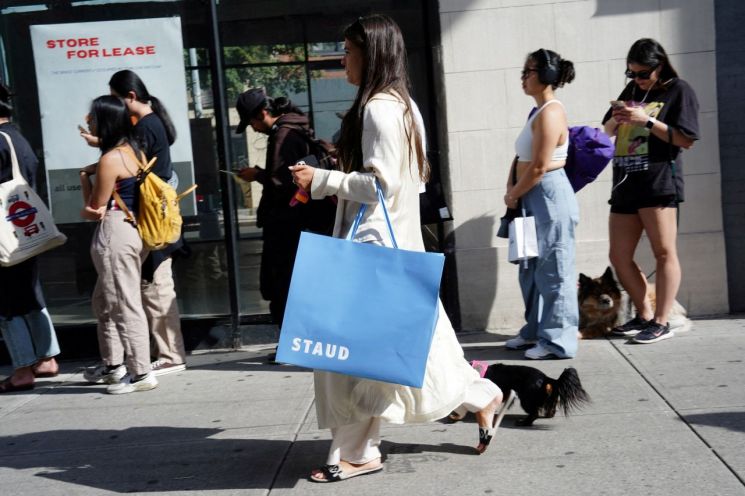
According to the U.S. Department of Commerce on September 16 (local time), retail sales in August 2025 reached $732 billion, up 0.6% from the previous month. The July retail sales growth rate was also revised upward from 0.5% to 0.6%. As a result, retail sales have recorded growth for three consecutive months.
The 0.6% increase in August retail sales significantly exceeded Bloomberg's forecast of 0.2% and maintained the same level as the previous month (0.6%). Excluding automobiles, retail sales rose by 0.7%, outpacing the market expectation of 0.4%. Core retail sales (the control group), which exclude highly volatile sectors, increased by 0.4% from the previous month. Core retail sales are a key indicator reflected in the calculation of gross domestic product (GDP), excluding food services, automobiles, building materials, and gasoline sales.
By category, nine out of thirteen sectors saw increases. Consumer spending rose at online retailers (2.0%), clothing and accessories stores (1.0%), and sporting goods and bookstores (0.8%), which analysts attribute to back-to-school shopping demand ahead of September. Food services and bars (0.7%), gas stations (0.5%), and motor vehicles and parts dealers (0.5%) also posted gains. In contrast, spending declined at general merchandise stores (-1.1%), furniture and home improvement stores (-0.3%), health and personal care stores (-0.1%), and department stores (-0.1%).
U.S. retail sales had declined in April and May due to concerns over the economic impact of tariff policies, but have been on a recovery trend since June. Despite worries about slowing employment, robust consumer spending has demonstrated the resilience of consumption, which supports the U.S. economy. Consumer spending accounts for about two-thirds of the U.S. GDP, making it a key indicator.
These consumer indicators, along with employment and inflation, are expected to influence the U.S. Federal Reserve's monetary policy. The Federal Reserve will hold a two-day Federal Open Market Committee (FOMC) meeting starting today and will decide the benchmark interest rate on September 17. With concerns over slowing employment growing, there is a strong expectation that the current rate of 4.25-4.5% per annum will be cut by 0.25 percentage points.
© The Asia Business Daily(www.asiae.co.kr). All rights reserved.












