Government Announces Comprehensive Labor Safety Measures
5% Fine on Operating Profit for Three or More Deaths
Business Registration Revoked for Repeated Accidents
"Major Companies Inevitably Face More Accidents
Unfair to Impose Fines a
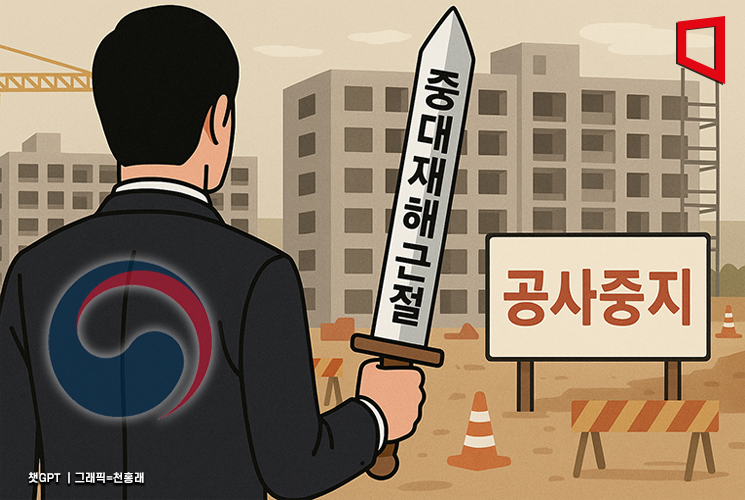
Following the government's announcement of a comprehensive occupational safety plan-centered on imposing a 5% penalty on annual operating profit if three or more deaths occur at industrial sites, and canceling business registration in the event of repeated accidents-the construction industry, which ranks first in industrial accident fatalities, has been thrown into turmoil. While eliminating serious industrial accidents is essential, industry representatives have pointed out that overlapping financial penalties imposed under various laws could push even top-tier companies into management crises.
An official from a major construction company said on September 16, "The larger the company, the more sites it operates, which structurally increases the likelihood of accidents. Imposing penalties and even suspending business or restricting public bidding simply based on a 'three deaths' standard is unreasonable," he said. "If major companies are consecutively suspended or penalized, leading to construction halts, smaller construction firms with poorer safety records will end up taking over the projects," he added.
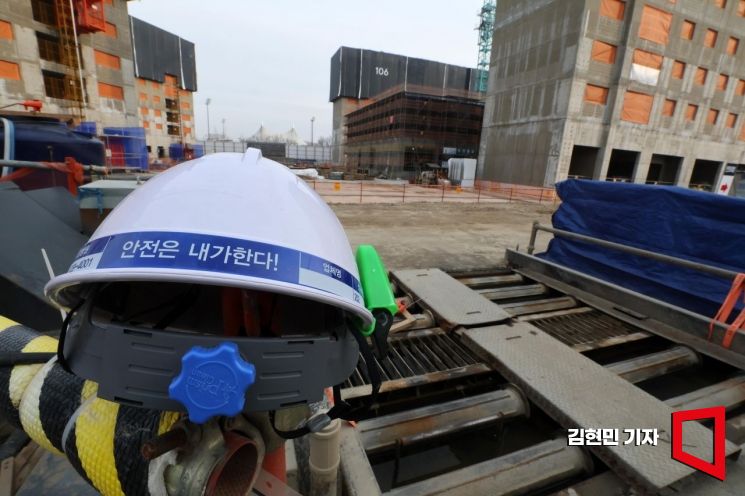
The construction industry identified the potential for overlapping penalties under multiple laws as its greatest concern. A representative from the Korea Construction Association stated, "Provisions regarding penalties are being redundantly proposed in the Occupational Safety and Health Act, the Serious Accidents Punishment Act, and the Special Act on Construction Safety," he said. "If penalties are imposed under each law for the same incident, even companies with strong safety management could face a management crisis after a single accident." While the principle of double jeopardy applies to criminal punishment, there is no mechanism to coordinate overlapping administrative penalties such as fines.
There are growing concerns that such administrative burdens could ultimately sap the vitality of the entire construction industry. The association representative added, "As business uncertainty increases, new hiring will shrink, and large-scale housing supply projects will inevitably face setbacks." In the case of Daewoo Engineering & Construction, which has recently experienced a series of fatal accidents, the penalty would amount to 20.2 billion won under the government's new criteria.
The industry has welcomed the requirement for clients to ensure appropriate construction periods and costs. However, some argue that this measure alone is insufficient. A construction industry official said, "Current policies place responsibility primarily on general contractors, but they fall short in fostering a safety culture among all participants, including subcontractors and workers." He continued, "Responsibility and roles for establishing a safety culture should be assigned to everyone involved in the construction process, from clients to workers." He also noted, "In Singapore, for example, clients appoint separate safety managers and share responsibility for site safety management and accidents with contractors."
Regarding the measures for foreign workers, the response has been more negative than positive. Expanding employment restrictions from site-level to company-level when illegal workers are found may actually encourage illegal employment by blocking access to legal workers.
A representative from the Korea Specialty Contractors Association, whose members are subcontractors, said, "According to the Construction Workers Mutual Aid Association, 1.7 million workers are needed, but only 1.57 million are actually deployed on sites." He added, "With such a shortage, we have no choice but to rely on foreign labor, but legal quotas are small and procedures are complicated, which pushes companies toward illegal hiring." He explained, "The concrete frame work for an apartment building is completed in 10 months, which does not meet the minimum one-year employment contract requirement, resulting in more illegal workers." He warned, "If sanctions are imposed at the company level, even sites that previously used legal labor may be forced to abandon it."
Amid a downturn in the construction market, there are predictions that the new measures will shrink the industry overall. Park Sera, a researcher at Shin Young Securities, said, "The construction industry is suffering a triple blow: a drought in orders, rising labor costs, and now strengthened safety management obligations." She added, "With industry restructuring likely to accelerate, a reduction in the scale of the entire construction sector, including major companies, is inevitable." Park also noted, "This will be a time to seriously reflect on what truly constitutes competitiveness in the construction industry."
© The Asia Business Daily(www.asiae.co.kr). All rights reserved.