With three weeks remaining until Chuseok, the cost of purchasing items for the holiday ancestral rites table at traditional markets has fallen below 300,000 won for the first time in four years.
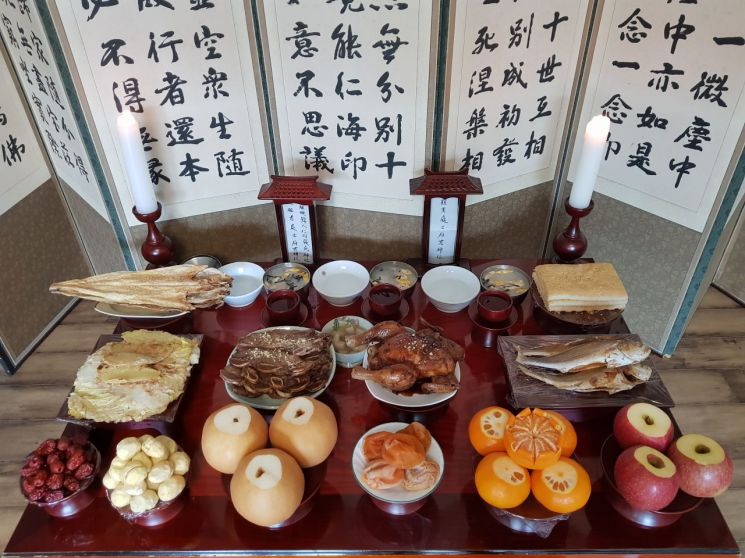
According to Korea Price Information on September 14, the cost of preparing a Chuseok ancestral rites table for a family of four, surveyed at traditional markets on September 12-about three weeks before Chuseok (October 6)-was calculated at 299,900 won. This is 1.2% (3,500 won) less than the same period last year. The cost for shopping at traditional markets three weeks before Chuseok was 274,500 won in 2021. It remained above 300,000 won for three consecutive years-300,000 won in 2022, 309,000 won in 2023, and 302,500 won in 2024-before dropping below 300,000 won this year.
The decrease in cost is largely due to lower fruit prices, which constitute a significant portion of the total, and a drop in vegetable prices as supply has recovered. Although the growth of apples and pears has been delayed by heatwaves and heavy rain, this year’s Chuseok falls about three weeks later than last year’s (September 17), so there are no issues with holiday shipments. In addition to the Hongro (apple) and Wonhwang (pear) varieties, other varieties are also available, offering a wider range of choices. There has also been no damage from typhoon-related fruit drop.
According to the Korea Agro-Fisheries & Food Trade Corporation’s Agricultural Products Distribution Information (KAMIS), as of September 11, 24 days before Chuseok, the retail price for 10 premium Hongro apples was 27,110 won, which is 601 won cheaper than 27,711 won recorded 24 days before last year’s Chuseok (August 24). The price for 10 premium Wonhwang pears was 20,749 won on September 11, down 19.3% (6,455 won) from 33,504 won during the same period last year. The Korea Rural Economic Institute’s Agricultural Outlook Center expects the shipment volume of apples and pears during the Chuseok peak season (two weeks before Chuseok) to increase by 7% each compared to last year.
Looking at itemized prices at traditional markets, the price of three apples and three pears each dropped by 33.3% from 15,000 won last year to 10,000 won this year. Spinach (one bunch) fell by 25.0% from 8,000 won to 6,000 won, radish (one piece) dropped by 37.5% from 4,000 won to 2,500 won, and napa cabbage (one head) decreased by 10.0% from 10,000 won to 9,000 won.
On the other hand, the price of new crop rice (2kg) rose by 27.3% from 5,500 won to 7,000 won. Songpyeon (1kg) and sirutteok (3 pieces) each increased by 20.0% from 10,000 won to 12,000 won, while croaker (3 fish) went up by 25.0% from 12,000 won to 15,000 won. Both pollack (1 fish) and pork front leg meat for yukjeon (600g) rose by 14.3% from 7,000 won to 8,000 won, and eggs (10 pieces) increased by 20.0% from 2,500 won to 3,000 won.
Korea Price Information also announced that, according to this survey, the cost of shopping for a Chuseok ancestral rites table at large discount stores was 391,350 won, down 0.7% (2,810 won) from last year. Lee Donghun, team leader at Korea Price Information, stated, "With three weeks left until Chuseok, variables such as typhoons and autumn rain could still affect shopping prices," but added, "Overall, this year’s agricultural harvest is good, so we do not expect major fluctuations."
© The Asia Business Daily(www.asiae.co.kr). All rights reserved.












