At Telford Exotic Zoo
"Gave birth without contact with a male"
Eight iguana babies draw attention
'Parthenogenesis' produces offspring genetically identical to the mother
A female iguana at a zoo in the United Kingdom, which had never come into contact with a male, has given birth to eight babies, drawing widespread attention.
According to the BBC on September 10 (local time), a female helmeted iguana housed at the Telford Exotic Zoo in Shropshire, near Birmingham, gave birth to eight babies at the end of last month. Helmeted iguanas are native to Central and South America and typically inhabit trees. This female iguana laid eggs without any contact with a male, and the eggs hatched into babies, surprising the zoo staff.
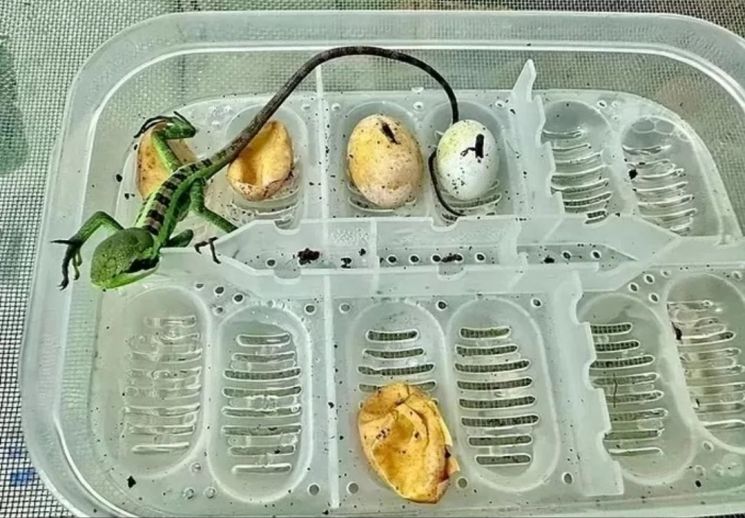 A baby helmeted iguana born at the Telford Exotic Zoo in the United Kingdom. Screenshot from social media (SNS).
This phenomenon is presumed to be 'parthenogenesis,' in which an unfertilized egg develops directly into an embryo, resulting in offspring that are genetically identical to the mother, born from eggs that have not encountered sperm.
This occurrence is extremely rare among vertebrates, and even when parthenogenesis does take place, it is even more uncommon for healthy babies to be born and successfully hatched. While parthenogenesis is exceptionally rare in nature, it has been observed in some reptiles, fish, and amphibians, particularly as a survival strategy in isolated environments. Earlier this year, there was also a case in the United States where a baby was born in an aquarium tank in Louisiana that housed only female sharks.
'Parthenogenesis' is extremely rare among vertebrates
Zoo director Scott Adams said, "When we confirmed that the eggs had been fertilized without a male, we were utterly astonished," adding, "This is one of the rarest events in the animal kingdom."
He explained, "The iguana we had raised for years suddenly laid eggs, so we put them in an incubator, and the eggs looked white and healthy. A few months later, eight babies were crawling around." All the babies are female and are nearly identical genetic clones of their mother. Jokingly, Adams remarked, "They all cry at exactly the same time." He added, "This case serves as a powerful reminder that life finds a way even in the most unexpected circumstances."
Currently, the babies are being cared for in the zoo’s specialized reptile nursery, where temperature and humidity are controlled 24 hours a day. They are scheduled to be made available for public viewing within a few weeks, and two of them will be sent to other zoos.
© The Asia Business Daily(www.asiae.co.kr). All rights reserved.











