2 Out of 10 Companies Plan No New Hires
Up 7.3 Percentage Points from Last Year
Number of Companies Reducing Hiring Doubles
Hiring Cutbacks Amid Management Austerity and Economic Downturn
Due to prolonged domestic market stagnation and changes in the global trade order, external and internal uncertainties are increasing, causing difficulties for companies. As a result, the job market for the second half of this year is expected to be bleak.
The Korea Economic Association announced on September 11 the results of its "2025 Second Half New Graduate Recruitment Plans" survey, which was conducted by the polling agency Research & Research and targeted the top 500 companies in sales. According to the survey, 62.8% of respondent companies said they either have not established plans for new hiring in the second half of this year or do not intend to hire at all. Of these, 38.0% had not yet set hiring plans, while 24.8% said there would be no hiring.

The proportion of companies responding "no hiring" for the second half of this year (24.8%) increased by 7.3 percentage points compared to the second half of last year (17.5%), while those responding "undecided" on hiring plans (38.0%) decreased by 2.0 percentage points from last year (40.0%).
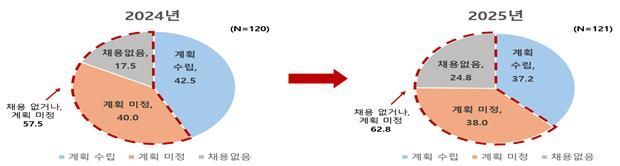 Survey Results on New Hiring Plans for the Second Half of the Year by the Top 500 Companies in Sales. Provided by the Korea Economic Association
Among companies that have established new hiring plans for the second half of this year (37.2%), 37.8% said they would maintain the same hiring scale as last year, 37.8% said they would reduce hiring, and 24.4% said they would increase hiring. The proportion of companies planning to reduce hiring (37.8%) more than doubled compared to the second half of last year (17.6%), while those planning to increase hiring (24.4%) rose by 6.8 percentage points from last year (17.6%).
The Korea Economic Association analyzed, "The proportion of companies with no hiring plans for the second half of this year (24.8%) has increased significantly from last year (17.5%), and the proportion of companies planning to reduce hiring (37.8%) has more than doubled from last year (17.6%), raising concerns that the job market may contract compared to last year."
When asked why they would not conduct new hiring or would not increase hiring, companies most frequently cited management tightening in response to increased internal and external uncertainties and deteriorating profitability (56.2%). This was followed by increased cost burdens such as rising raw material prices and higher labor costs (12.5%), and prolonged global economic recession and sluggish economic conditions due to high exchange rates (9.4%).
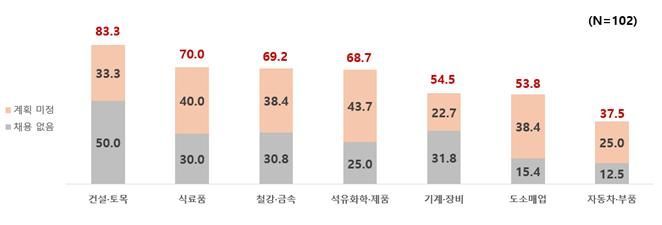 Survey Results on the Proportion of Companies with No New Hiring or No Plans for New Hiring in the Second Half of the Year by Industry. Provided by the Korea Economic Association
Companies that said they would increase new hiring cited securing future talent regardless of economic conditions (45.4%), increased demand for personnel in new industries or new job categories (36.4%), and replenishment due to employee turnover (18.2%) as their main reasons.
By industry, the proportion of companies that have not established new hiring plans or do not intend to hire in the second half of this year was highest in construction and civil engineering (83.3%), followed by food products (70.0%), steel and metals (69.2%), and petrochemicals and related products (68.7%).
The Korea Economic Association analyzed, "Due to the prolonged slump in the construction industry, increased cost burdens and sluggish domestic demand in the food sector, U.S. steel tariffs, global oversupply, and decreased demand for petrochemical products, major industries such as construction, food products, steel, and petrochemicals are experiencing downturns, leading companies to take a cautious approach to new hiring."
Although young people are facing difficulties in finding jobs, there is a job mismatch in the corporate field where companies cannot find suitable talent. The most frequently cited hiring challenge was "difficulty in securing suitable talent" (32.3%). Specifically, companies pointed to difficulties in finding talent that meets their requirements (29.4%) and a shortage of talent in science and technology fields such as new industries and new technologies (2.9%).
As for job categories where securing talent is most difficult, research and development positions were cited most frequently (35.9%), followed by professional and technical positions (22.3%), and production and field positions (15.9%).
The Korea Economic Association diagnosed, "In the industrial field, there is high demand for specialized research and technical personnel who can respond to rapid technological advances, but the supply of such talent in the job market is insufficient, resulting in continued job mismatches."
To promote new graduate hiring, companies most frequently cited the need for easing regulations to encourage increased corporate investment and employment (38.9%). This was followed by expanding incentives for companies that increase employment (22.3%), strengthening support for companies in new growth engine industries (10.7%), and resolving mismatches between job seekers' capabilities and employers' needs (10.7%).
Lee Sangho, head of the Economic and Industrial Division at the Korea Economic Association, emphasized, "Traditional core industries are losing vitality due to the reorganization of the trade order and prolonged domestic market stagnation, and even companies in new industries have not yet gained enough competitiveness to expand employment. With the management environment becoming even more challenging due to recent amendments to the labor union and commercial laws, the government and National Assembly must support companies' hiring capacity through regulatory easing and investment support."
© The Asia Business Daily(www.asiae.co.kr). All rights reserved.














