First Hearing of Impeachment Trial
Choo Mi-ae and Cho Jiho Speak Directly
The legal team representing Commissioner General Cho Jiho of the National Police Agency, who was impeached for his involvement in the December 3 Martial Law Incident, argued during the impeachment trial that Cho contributed to the resolution to lift martial law by defying orders from his superiors three times during the period. The National Assembly countered, asserting that the decision to lift martial law was achieved by citizens and lawmakers.
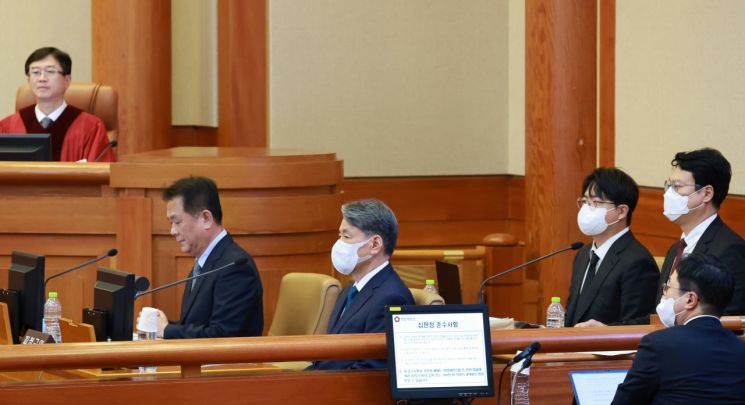
At the first hearing of the impeachment trial held at the Constitutional Court on September 9, Cho's legal representative stated, "The respondent's actions during martial law can be summarized as three instances of defiance and an expression of intent to resign," adding, "We ask that these actions, which contributed to the prompt decision to lift martial law and to the defense of democracy amid chaos, be duly recognized."
Cho's legal team classified the following as the first to third instances of defiance: first, after hearing former President Yoon Suk Yeol's martial law plan during a meeting at a safe house in Samcheong-dong just before martial law was declared, Cho took no action and returned to his office to rest; second, he ignored a request from the commander of the Defense Security Command to support a team for arresting politicians; and third, he refused all presidential orders to detain lawmakers following the proclamation of martial law.
They further argued, "Martial law was an event that unfolded over just three hours, and as a non-lawyer, the respondent could not make a clear judgment that it was 'obviously unconstitutional' in such an urgent situation," adding, "Even the Constitutional Court took three months to determine the unconstitutionality of martial law in the impeachment trial of former President Yoon Suk Yeol."
In response, the National Assembly's legal representative retorted, "The resolution to lift martial law was achieved by lawmakers, citizens, and aides who even climbed over walls to do so. To claim that the respondent passively or tacitly allowed this to happen is infuriating." He cited Cho's actions during martial law, including the blockade and restricted access to the National Assembly, the perimeter control and restricted access at the National Election Commission, and interference with the National Workers' Rally, stating, "Instead of fulfilling the police's duty to protect the lives, safety, and property of the people, he obeyed the orders of a regime clinging to unconstitutional martial law."
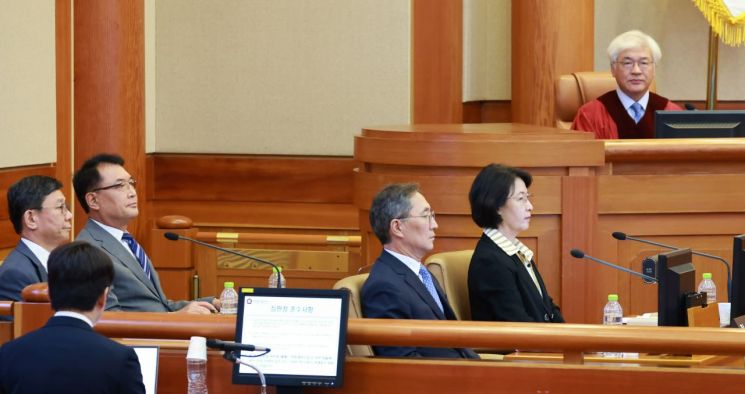
At the first formal hearing, Choo Mi-ae, chair of the Legislation and Judiciary Committee and the National Assembly's impeachment prosecutor, and Commissioner General Cho Jiho, the respondent in the trial, both appeared and made statements. Chairperson Choo criticized Cho's claim that it was difficult to judge the unconstitutionality of martial law in a short time, saying, "How many years of experience do you have? Aren't you the top expert in field judgment? To now claim you couldn't make a decision at the time is an admission that you were less capable than the soldiers and subordinates who fiercely resisted on the ground."
In response to a question from Justice Jeong Jeongmi about why an emergency situation would arise in the National Assembly upon the declaration of martial law, Commissioner General Cho replied, "I believed that any clashes between citizens with differing interests must be prevented." Regarding the deployment of police to the National Election Commission, he said, "When I heard from the Defense Security Command that police would be sent to the Election Commission, I thought it would be wrong not to issue any instructions, as unexpected incidents could occur."
Chairperson Choo requested clarification on whether there had been any request from the National Assembly for security during martial law, and whether Cho had ever instructed the National Assembly security chief or others to protect citizens in preparation for unforeseen incidents.
Meanwhile, Cho's legal team requested a fact-finding inquiry to determine whether any government agency, such as the Ministry of Justice, the Supreme Prosecutors' Office, or the Ministry of Government Legislation, had concluded at the time that martial law was unconstitutional. The request was denied.
Cho's legal team also announced plans to call six witnesses, including Kim Bongsik, former chief of the Seoul Metropolitan Police Agency; Kim Junyoung, former chief of the Gyeonggi Nambu Police Agency; Park Hyunsoo, then director of the National Police Bureau (currently acting chief of the Seoul Metropolitan Police Agency); and Joo Jinwoo, former head of the Seoul Police Security Division. The court will decide later whether to accept these witnesses.
The Constitutional Court has scheduled the second hearing for September 30 at 3 p.m.
© The Asia Business Daily(www.asiae.co.kr). All rights reserved.













