Analyzing Pilot Program Outcomes to Launch Full System by 2027
Required Funding Varies Greatly by Outpatient Coverage and Waiting Period
Debate Continues Over Funding: Taxation vs. Social Insurance
It has been estimated that up to 3.6 trillion won in funding will be required to implement the "sickness benefit" system, which the government aims to introduce in 2027. There is an urgent need to establish concrete evidence and reach a social consensus regarding the scope, operational structure, and funding methods for the sickness benefit program.
At the "Social Dialogue for Institutionalizing Sickness Benefits" forum held on September 9, hosted by Assemblywoman Kim Sunmin of the Homeland Innovation Party and Assemblyman Seo Youngseok of the Democratic Party of Korea, Kang Heejung, Director of the Health Security Policy Research Office at the Korea Institute for Health and Social Affairs, projected that the required budget for sickness benefits would range from a minimum of 131.9 billion won to a maximum of 3.5999 trillion won.
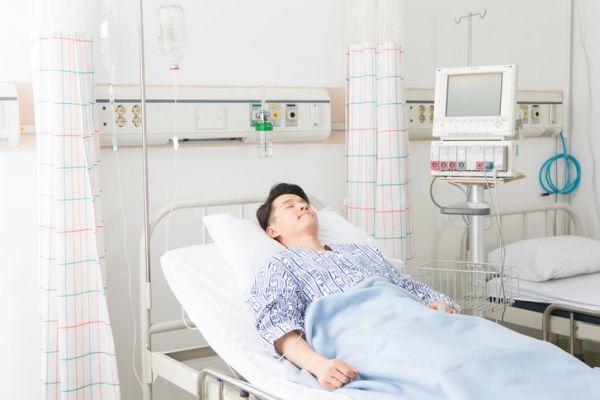
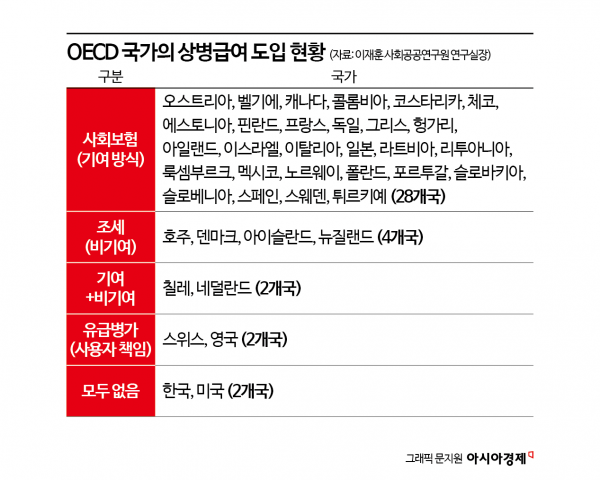
The sickness benefit system is designed to guarantee a minimum income for workers who are unable to work due to illnesses or injuries unrelated to their work. Among the 38 member countries of the Organisation for Economic Co-operation and Development (OECD), only South Korea and the United States do not have a sickness benefit system. In South Korea, discussions about introducing such a system began during the COVID-19 pandemic, amid criticism that it was a "society where people cannot rest even when sick." Since July 2022, various pilot programs have been implemented in select cities, counties, and districts. According to the Ministry of Health and Welfare, as of July, a total of 12,991 people in 14 regions nationwide received an average of 1.41 million won each for an average of 30 days.
Director Kang estimated the required funding for sickness benefits under four models, depending on whether outpatient care is included and the length of the unpaid waiting period. If the model with a 14-day waiting period, coverage for hospitalization only, and a 30-day payment period is applied, the annual budget required would be 131.9 billion won. In contrast, a model with a 3-day waiting period, coverage for both hospitalization and outpatient care, and a 180-day payment period would require 3.5999 trillion won per year.
Previously, in a report titled "Designing Sickness Benefits for Sustainable Social Welfare Finance," published in December last year by Kim Pyungsik, Associate Research Fellow at the Korea Institute of Public Finance, it was estimated that if no income criteria are applied, the required budget in 2050 would range from a minimum of 1.7566 trillion won (3-day waiting period, 180-day coverage) to a maximum of 9.3405 trillion won (14-day waiting period, 30-day coverage). If income criteria are applied, the estimate ranges from 1.0282 trillion won to 5.3619 trillion won.
To secure the vast funding required, the government is considering both a tax-based approach, which would use public funds, and a social insurance approach, such as through health or employment insurance. If the system is designed as a tax-funded national program, it would allow for targeted support to those in urgent need, but it would increase the fiscal burden and could overlap with existing social security programs (such as basic livelihood security and emergency welfare). On the other hand, if designed as a social insurance program, it would be advantageous in protecting a broader range of workers, but could increase the public's financial burden by introducing new insurance premiums for sickness benefits.
Director Kang suggested, "We could start with a relatively small budget of 100 billion to 500 billion won and gradually expand the system. For example, set the waiting period at 7 days (3 days for the self-employed), limit the benefit period to 3 months, use the emergency welfare support system for those with a monthly income of 1.79 million won or less, and provide sickness benefits to those above that threshold."
In contrast, Kim Heungsoo, Vice Chairman of the Public Transport Workers' Union of the Korean Confederation of Trade Unions, who also participated in the forum, argued, "To minimize poverty caused by loss of labor capacity, the waiting period should be minimized. The minimum sickness benefit should be set above the minimum wage, the payment period should be extended to 18 months, and a wide range of special-type workers, such as platform workers and the self-employed, should be included."
The government plans to analyze the policy effects based on the results of the pilot programs and prepare a plan for the full introduction of the system by the first half of next year at the latest. Kang Mingu, head of the Sickness Benefit System Team at the Ministry of Health and Welfare, stated, "The required funding for sickness benefits varies greatly depending on how the system is designed, so it must be structured at a level that society can bear. The overall framework should be decided between the end of this year and early next year to ensure a smooth launch of the full program in 2027."
© The Asia Business Daily(www.asiae.co.kr). All rights reserved.













