Korea-US Nuclear Energy Cooperation Forum Held
Proposal for a Joint Government Task Force
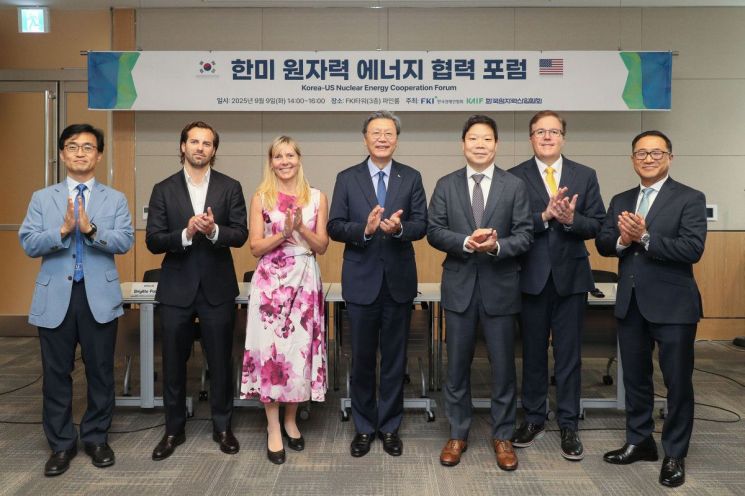 Kim Changbeom, Vice Chairman of the Federation of Korean Industries, and other guests are attending the "Korea-US Nuclear Energy Cooperation Forum" held at the FKI Tower on the 9th and are taking a commemorative photo. From the left in the photo: Jeong Yonghoon, Professor at KAIST; Robert Farari, Executive Director of Apollo; Bridget Posh, Head of Apollo APAC Credit; Kim Changbeom, Vice Chairman of the Federation of Korean Industries; Michael Hyun, Chief Commercial Officer of PSEG; Robert Denight, Vice President of PSEG Nuclear Power Division; Bae Junbeom, Lawyer at Mayer Brown. Federation of Korean Industries. Photo by Korea Economic Daily
Since President Donald Trump signed an executive order in May to quadruple the nuclear power plant capacity in the United States by 2050, discussions on nuclear cooperation between Korea and the United States have become more concrete. At the "Korea-US Nuclear Energy Cooperation Forum," hosted by the Federation of Korean Industries and the Korea Atomic Industrial Forum on September 9, American nuclear power companies expressed their desire to collaborate with Korean companies.
Michael Hyun, Chief Commercial Officer (CCO) of the American energy company PSEG, stated at the event held at the FKI Tower in Yeouido, "Korean companies excel in engineering, procurement, and construction (EPC), possess a skilled workforce, and have the ability to complete projects on time and within budget," adding, "We are interested in and look forward to partnering with Korea."
PSEG operates transmission and distribution infrastructure primarily in New Jersey, supplying 40 percent of the state's electricity. The company operates or holds stakes in five nuclear power plants in the New Jersey and Pennsylvania regions, including Hope Creek, Salem, and Peach Bottom. PSEG plans to add two more light water reactor nuclear power plants. The Korean APR1400 reactor and Westinghouse's AP1000 model are among the potential candidates.
Michael Hyun noted, "Over the past 30 years, Korea has constructed 22 nuclear power plants, while the United States has connected only four reactors to the grid in the same period," expressing his expectation that "Korea's experience in new nuclear power plant construction can help reduce the risks of building nuclear plants in the United States."
This comes as discussions on nuclear cooperation between the two countries have been progressing, following the signing of the "Korea-US Principles of Nuclear Export and Cooperation Interagency MOU" in January and further talks during President Lee Jaemyung's recent visit to the United States.
Nuclear power is also included in the $200 billion strategic industry investment fund for the United States announced by the Korean government in August.
American companies highly value the experience of Korean firms in constructing nuclear power plants on schedule. Delays in nuclear plant construction lead to ballooning financing costs and undermine economic feasibility. Michael Hyun explained, "At the Vogtle nuclear power plant in the United States, short-term borrowing costs rose to $6,000 per kilowatt (kW) due to procurement issues and construction delays," adding, "Korea's expertise in construction, procurement, and building can help mitigate the risks of U.S. nuclear power projects."
Opportunities for Korean companies are expected not only in new nuclear power plants but also in the continued operation of existing aging plants.
Michael Hyun stated, "Currently, 20 nuclear power plants in the United States are pursuing license renewals, continued operation, or restart," and explained, "There will be opportunities for Korean companies in vessel component replacement, supply and replacement of large pumps and valves, turbines, and inspections." He added, "U.S. nuclear power plants are highly interested in Korea's aging management, and the digital twin technology applied to Korean nuclear plants could also be exported."
On this day, Jeong Yonghun, Professor of Nuclear and Quantum Engineering at KAIST, said, "The resolution of the intellectual property dispute between Korea Hydro & Nuclear Power and Westinghouse, as well as the Korea-US summit, have created conditions for bilateral cooperation," and suggested, "A joint venture (JV) consortium model supported by the public and private sectors is possible."
This cooperation model involves Korea Hydro & Nuclear Power and domestic EPC companies handling construction and commissioning, Westinghouse managing design and U.S. regulatory compliance, and both governments providing financial and policy support.
Professor Jeong stated, "We should consider forming a Korea-US government joint task force (TF)," and added, "For Korea-US nuclear cooperation, we can explore financial models utilizing the Inflation Reduction Act (IRA) and the Title 17 Clean Energy Financing Program."
The subsequent panel discussion featured Michael Hyun, Professor Jeong, Robert Denight, Vice President of PSEG's Nuclear Power Division, Bridget Posh, Apollo APAC Credit Head, and Robert Ferrari, Apollo Executive Director.
Apollo is an alternative asset management firm based in New York and recently provided unsecured bonds to France's EDF, which is constructing the Hinkley Point C nuclear power plant in the United Kingdom. Apollo plans to invest $50 billion in clean energy and climate transition projects by 2027 and $100 billion by 2030.
Kim Changbeom, Executive Vice Chairman of the Federation of Korean Industries, emphasized, "The world is once again focusing on nuclear power to respond to extreme weather, climate change, and the surge in electricity demand driven by AI development," and added, "Korea possesses technological expertise, safety, and world-class supply chain management capabilities in nuclear power plant construction."
Meanwhile, President Donald Trump issued an executive order in May directing the Department of Energy to increase nuclear power capacity by 5 GW and to begin construction of ten large reactors by 2030. The goal is to expand nuclear power capacity from the current level of 100 GW last year to 400 GW by 2050.
© The Asia Business Daily(www.asiae.co.kr). All rights reserved.











