AI Utilization for Automatic Identification of Close Contacts
Expanding Data Integration with External Institutions and Increasing Public Access
Restructuring Response Systems Based on Infectious Disease Characteristics
Seungkwan Lim, Commissioner of the Korea Disease Control and Prevention Agency (KDCA), who is now two months into his tenure, has identified "strengthening artificial intelligence (AI) capabilities" and "preparing for future pandemics" as the agency's key policy priorities moving forward.
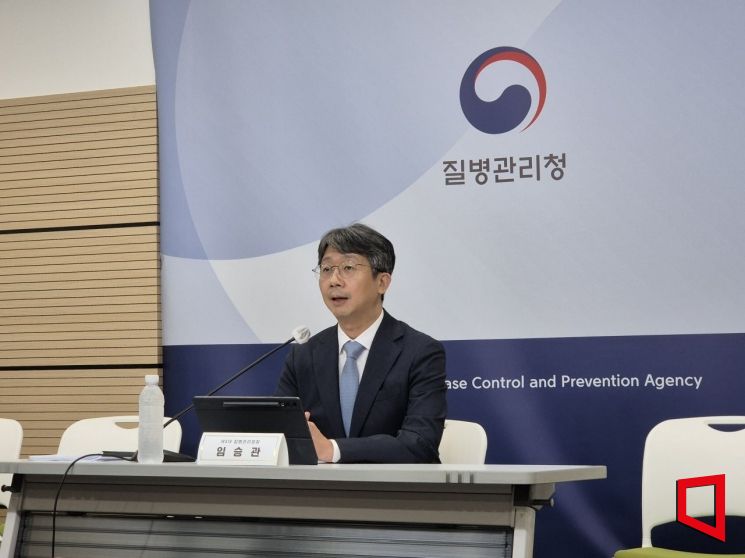 Seungkwan Lim, Commissioner of the Korea Disease Control and Prevention Agency, held a press conference on the morning of the 9th at the Korea Disease Control and Prevention Agency in Cheongju, Chungbuk, discussing future operational plans for the agency. Photo by Taewon Choi
On September 9, at the KDCA headquarters in Cheongju, Chungbuk, Commissioner Lim held his first press conference since taking office, stating, "We will focus on predicting and managing diseases based on data science, and, in terms of preparing for new infectious diseases, we aim to restructure the infectious disease crisis response system."
Commissioner Lim first announced a bold plan to innovate the overall operations of the agency through data science. The plan includes operating a dedicated task force led by the Commissioner to break down barriers between work areas and integrate specialized technologies.
The agency will also actively expand and open up its big data projects. For example, it will seek to link data with various external institutions, such as the National Cancer Center, to establish evidence-based policies grounded in vast datasets. Additionally, by opening its data to the public, the agency aims to invigorate disease-related research by private researchers.
The use of AI in the healthcare sector will also be expanded. The goal is to enhance efficiency throughout the entire process of collecting, analyzing, and utilizing disease and health information using AI technologies. For instance, Commissioner Lim mentioned using AI to automatically identify close contacts during epidemiological investigations of infectious disease patients. In the quarantine process, "AI quarantine officers" will automatically screen inbound travelers with suspected symptoms, streamlining entry procedures.
AI could also be used to provide individuals with personalized national health survey results and health information. The agency will utilize AI to monitor false health information on social networking services (SNS), thereby minimizing public health risks caused by misinformation. The KDCA's vision for AI utilization was also selected as a support area in the government's "Public AI Transformation (AX) Project," which aims for a major public sector AI transition.
To prepare for future crises, the agency will also begin restructuring the infectious disease crisis response system. Commissioner Lim stated, "We will use our successful COVID-19 response experience as an asset, but we will restructure the national infectious disease crisis response system to ensure it remains effective amid future changes in the social environment," adding that he will oversee these reforms personally. Starting next year, the agency plans to implement reforms such as overhauling crisis response programs, securing resources, and revising relevant laws and regulations.
During the restructuring process, the agency plans to ensure efficient responses by considering the unique characteristics of each infectious disease and the differences in crisis types. Social and environmental factors will also be taken into account. This approach is based on the analysis that efficient responses require consideration of factors such as national fiscal capacity, a super-aged population structure, and changes in public acceptance of disease control measures.
The agency will also seek to establish a dedicated organization to support surveillance systems. Beginning next year, it will significantly expand the number of key sentinel surveillance institutions and pathogen surveillance agencies, as well as enhance supplementary surveillance systems such as wastewater monitoring, to reinforce a multi-layered surveillance network.
The KDCA also intends to actively support the development of messenger RNA (mRNA) vaccines, one of the core resources for responding to future pandemics. It will comprehensively transfer systems, technology, and infrastructure to strengthen the capabilities of countries with vulnerable healthcare systems.
Commissioner Lim cited expert predictions that RNA-based or respiratory viruses are likely candidates for future pandemics, emphasizing, "The rapid development of vaccines and the establishment of a universal rapid development platform are extremely important."
© The Asia Business Daily(www.asiae.co.kr). All rights reserved.












