Partial Acceptance of Government Demands... Security Facilities to Be Obscured
"Strengthening Cooperation with Korean Partners... Map Export Expected to Bring Economic Benefits"
Google Maintains Its Stance Against Establishing a Domestic Data Ce
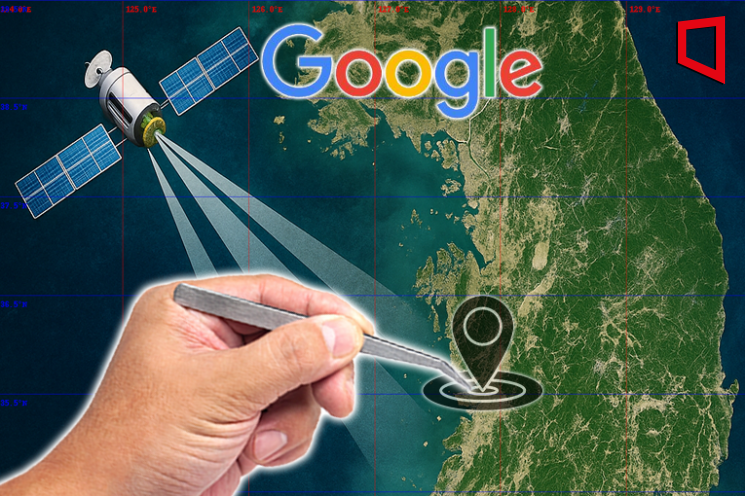
Google has agreed to comply with the South Korean government's request to obscure security facilities in satellite images in connection with the export of high-precision maps. The company also plans to implement measures to ensure that coordinate information of domestic maps will not be visible to any users of Google Maps.
However, Google maintained its existing position that it cannot establish a domestic data center, which is one of the government's requirements. The government plans to decide around November whether to provide Google with high-precision maps, and Google's decision to accept some of the requirements is expected to become a variable in the discussions.
 Chris Turner, Vice President of External Affairs Policy Knowledge and Information at Google, is speaking at a press conference held on the morning of the 9th at the Google Startup Campus in Gangnam-gu, Seoul. Photo by Google Korea
Chris Turner, Vice President of External Affairs Policy Knowledge and Information at Google, stated at a press conference held on the morning of the 9th at the Google Startup Campus in Gangnam-gu, Seoul, "In addition to obscuring security facilities in satellite images, we will comply with the South Korean government's request to make coordinate information of the Korean territory invisible to both domestic and overseas users of Google Maps."
Accordingly, if the export of high-precision domestic maps is approved, coordinate information for the Korean region will not be displayed to Google Maps users worldwide. He explained, "When sharing a location by clicking on Google Maps, the route coordinates for that point are shown. If the map export application is approved, those coordinate details will not be displayed."
Vice President Turner added, "Google will strengthen its cooperation with the South Korean government to address concerns that have been raised regarding the map data export application."
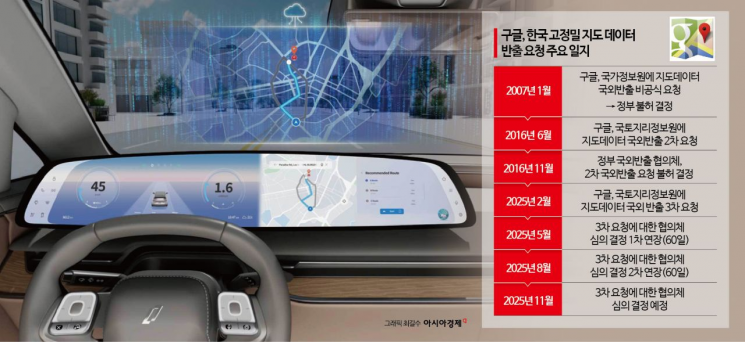
Currently, domestic high-precision maps with a scale more detailed than 1:25,000 are prohibited from being exported overseas for military and security reasons. To export these maps, approval must be obtained through a consultative body composed of the Ministry of Land, Infrastructure and Transport and other relevant agencies.
Previously, Google requested to export 1:5,000 scale maps in both 2011 and 2016. However, the government denied these requests, citing concerns about potential information leaks if map data containing information on military bases and other security facilities were stored on overseas servers. In February of this year, Google made its third request to export high-precision map data, and after two postponements, the government is scheduled to decide by November 11 whether to approve Google's export request.
Vice President Turner emphasized that the issues raised regarding the map service so far are misunderstandings. He explained, "The map that Google has requested to export is the 1:5,000 national base map produced by the National Geographic Information Institute, and this data has already been provided by the South Korean government with sensitive military and security information excluded." He further stated that the reason for needing the 1:5,000 scale map is to provide navigation services in urban areas.
Regarding concerns that sensitive facilities such as military installations are exposed in satellite images on Google Earth, Vice President Turner clarified, "The satellite images owned by Google are unrelated to the national base map subject to the export application. They are materials purchased from commercial image providers worldwide." He added, "To address the South Korean government's concerns, Google will implement additional security measures, such as obscuring sensitive facilities on both Maps and Google Earth."
However, Google indicated that it maintains its previous position that it cannot establish a domestic data center, which is one of the South Korean government's requirements. Yoo Youngseok, Head of Communications at Google Korea, said, "Establishing a data center in a specific region requires consideration of many factors," adding, "To ensure prompt responses as desired by the South Korean government, we are discussing ways to have a responsible person and a hotline in place so that concerns can be addressed in a timely manner."
Vice President Turner also announced plans to strengthen cooperation with domestic partners such as Tmap Mobility. He said, "Google will continue to cooperate with the South Korean government and strengthen partnerships with domestic companies such as Tmap Mobility. If necessary, we are also considering purchasing and utilizing satellite images that have already been obscured and approved by the government from domestic partners."
He also argued that the export of map data is expected to have economic benefits. According to the paper he cited, "The Economic Impact of Opening Digital Map Data on the Growth of Advanced Industries," if map data export is permitted, an additional cumulative revenue of approximately 18.46 trillion won is projected from 2026 to 2030.
Vice President Turner added, "Google Maps will play an important role in this transformation and will contribute to providing greater value to both Korean users and international tourists."
Regarding the potential impact of customs negotiations between South Korea and the United States on the map export decision, Vice President Turner said, "I am not aware of any negotiations taking place between the two countries, so I have nothing further to share." He continued, "I understand that the United States raises non-tariff barriers in trade negotiations with all countries around the world, and South Korea is no exception."
The domestic mapping industry criticized Google for repeating its previous claims. An industry insider commented, "There is almost nothing new in what Google presented today compared to its previous position. They are simply repeating that they will do the bare minimum required by the government, as if doing us a favor."
The insider further criticized, "Google has yet to express any intention to establish a data center in South Korea, so it is just repeating itself. They are ignoring proper procedures and applying pressure by linking the issue to trade and customs negotiations between South Korea and the United States."
© The Asia Business Daily(www.asiae.co.kr). All rights reserved.














