An ultra-lightweight wearable knee robot has been developed, reducing the burden of wearing it on the user while enhancing performance.
The Korea Institute of Industrial Technology announced on September 9 that the research team led by Senior Researcher Ahn Beommo from the Human-Centered Robotics Division has developed the ultra-lightweight knee assist robot "AirKNEE," which weighs just 1.1 kg.
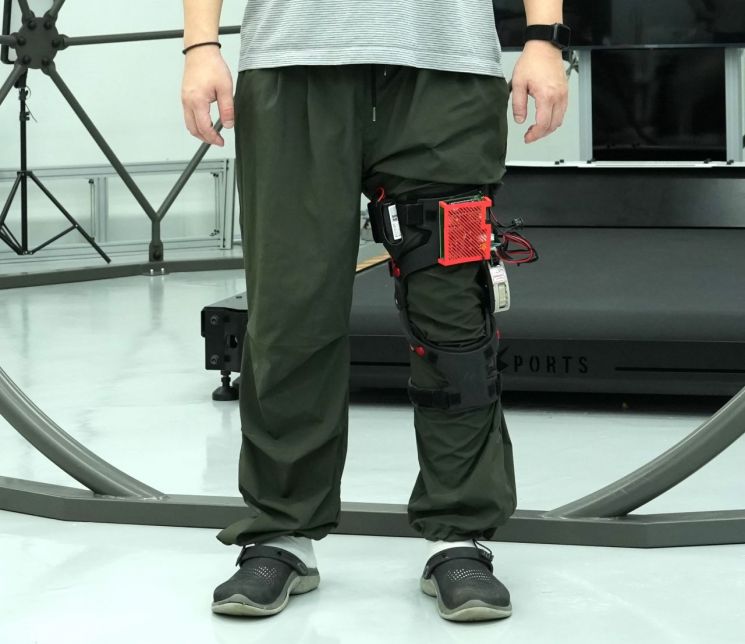
AirKNEE achieved world-class weight reduction by minimizing the number of components and applying a high-performance compact motor. The research team focused their efforts on improving wearing comfort and reducing fatigue and pressure even during extended use.
To accomplish this, the team constructed the frame using lightweight and high-strength "Polyamide 12 (PA12)" material, and optimized the electronic components to incorporate a three-cell battery.
Additionally, the drive unit features a compact servo motor with high torque density (a device that converts servo mechanism signals into power to control rotational speed or change position), enabling sufficient force despite the reduced size.
As a result, the research team explained that they were able to nearly halve the weight of existing knee assist robots, which previously weighed around 2.1 kg.
Despite the weight reduction, walking assistance performance has been improved compared to previous models through control technology utilizing sensors. The six-axis IMU sensor applied to AirKNEE recognizes gait signals in real time, detecting both the moment the heel touches the ground and the moment the leg is extended forward. By supporting movement at the precise moment the wearer needs to straighten their knee, the robot can assist with more than 40% of the maximum torque generated at the knee (31.4 Nm, based on a 70 kg adult).
In a walking experiment where the subject wore a 20 kg weighted vest, it was confirmed that calf muscle activity decreased by 21% and thigh muscle activity decreased by about 17% when using AirKNEE, indicating a reduction in muscle load.
The research team also enhanced user convenience for AirKNEE wearers. By lowering internal resistance to 0.2 Nm, users can comfortably bend and extend their knees as if not wearing the robot, even when the device is powered off. The frame, designed with a sports knee brace structure, increases stability. Furthermore, the integration of the controller, sensor, and battery into a single unit makes attachment and detachment easy, which is also considered a major advantage.
Previously, in July, the research team received the Best Application Award for AirKNEE at "Ubiquitous Robots 2025," an international robotics conference held in the United States, recognizing its technical excellence and practicality.
Senior Researcher Ahn stated, "AirKNEE delivers maximum performance in various situations, such as walking, sitting, standing, and moving on stairs or slopes, by reducing muscle activity. Our team will continue research so that a wide range of users who need knee assist robots can benefit from AirKNEE."
Meanwhile, knee assist robots, which help reduce energy consumption and muscle strain during walking, are being distributed by some local governments to environmental officers who work in settings that require long-distance movement and extended periods of activity.
© The Asia Business Daily(www.asiae.co.kr). All rights reserved.












