New Nuclear Command and Control Aircraft to Be Deployed by 2036
Serves as Emergency Command Post in Case of Nuclear War on the Mainland
 The new nuclear command and control aircraft E-4C being developed by the American aerospace company Sierra Nevada. Sierra Nevada official website
The U.S. Air Force has begun test flights of its new nuclear command and control aircraft, the E-4C. The goal is to deploy the E-4C for operational use by 2036. In the event of a nuclear war on the U.S. mainland, the E-4C will serve as an emergency airborne command post. The United States is accelerating the development of its nuclear command and control aircraft following the 'Golden Dome' missile defense project, a move interpreted as a response to the rapid strengthening of China's nuclear capabilities.
U.S. New Nuclear Command and Control Aircraft E-4C Begins Test Flights...Targeting Operational Deployment by 2036
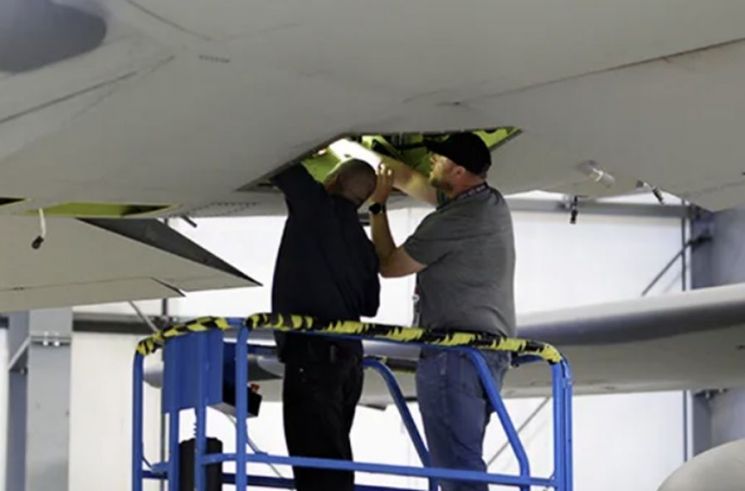
According to the U.S. military media outlet Defense News, the U.S. Air Force began test flights of the E-4C aircraft on September 5 (local time). This aircraft, known as the 'Survivable Airborne Operations Center (SAOC),' is designed to allow the President, Secretary of Defense, and other government officials to conduct emergency command operations if a nuclear war or a comparable emergency renders ground-based military command impossible within the United States.
The aircraft is based on the Boeing 747-8, a civilian airliner, which is being purchased and modified for military use, though it retains the appearance of a commercial plane. The American aerospace company Sierra Nevada and the U.S. Air Force are collaborating on the modification process. Sierra Nevada announced that test flights and ground safety tests will continue through early next year.
The full-scale development of the E-4C began in June of last year. The need to replace the existing E-4B nuclear command and control aircraft, which has been in service for 50 years, was raised in 2019 due to aging and safety concerns as the E-4B reached the end of its service life. The U.S. Air Force signed a contract with Sierra Nevada worth $13 billion (approximately 18 trillion won) for the delivery of the E-4C, aiming to complete the deployment of five E-4C aircraft by July 2036.
Equipped with Nuclear Weapons and Resistant to EMP Attacks...A Powerful Airborne Bunker
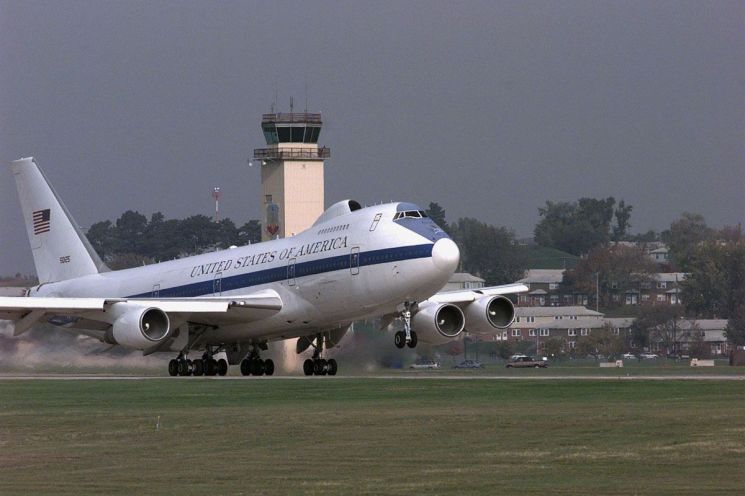 The existing emergency nuclear command and control aircraft, the E-4B Nightwatch. U.S. Air Force website
Such nuclear command and control aircraft typically operate in tandem with Air Force One, the dedicated aircraft used by the U.S. President during overseas trips, as a contingency measure. Unlike Air Force One, which is indistinguishable from a civilian Boeing 747, the nuclear command and control aircraft features a prominent radar dome on top of the fuselage. The U.S. government operates five to six of these aircraft, with some serving as dedicated planes for the Secretary of Defense.
The E-4A was first developed in 1973 and was later upgraded to the current E-4B model in 1985. The E-4B is equipped to withstand electromagnetic pulse (EMP) attacks and features blast protection systems against missile and artillery attacks. It can carry a crew of 112, including flight and operations personnel, and can fly for over 35 hours on a single refueling. With aerial refueling, it can remain airborne for up to a week without landing.
Additionally, the aircraft is equipped with multiple command and control systems to serve as an airborne command center in the event of a nuclear attack on the mainland. Even if all ground communications are cut off, it can communicate via satellite and other networks. The aircraft can also be equipped with nuclear weapons for emergencies, earning it the nickname 'Doomsday Plane.' While the exact specifications of the new E-4C model have not yet been disclosed, it is expected to have significantly enhanced capabilities compared to the existing E-4B.
U.S. on Guard Against China's Nuclear Buildup..."By 2030, China's Nuclear Capabilities May Rival the U.S. and Russia"
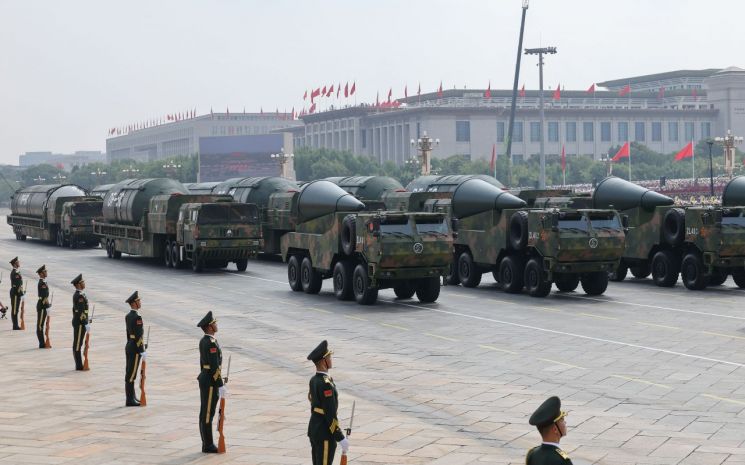 Various Chinese nuclear missiles displayed at the 80th Victory Day military parade held on the 3rd (local time) in Beijing, China. Photo by Xinhua News Agency
Analysts believe the U.S. government's rush to develop a new nuclear command and control aircraft following the Golden Dome system is motivated by concerns over China's expanding nuclear arsenal. Although the gap between U.S. and Chinese nuclear capabilities remains large for now, China is rapidly increasing its stockpile of nuclear weapons, gradually narrowing the gap.
According to the Stockholm International Peace Research Institute (SIPRI), China is estimated to possess about 600 nuclear warheads this year, an increase of 100 warheads compared to last year. In contrast, the number of U.S. nuclear warheads continues to decline. As of 2025, the United States has a total of 5,177 nuclear warheads, of which 1,770 are deployed for operational use, 1,930 are not deployed, and 1,477 are retired or awaiting dismantlement.
If China continues to increase its deployed nuclear warheads by 100 each year at its current pace, projections suggest that its nuclear capabilities could rival those of the United States by the 2030s. SIPRI reported, "China is constructing approximately 350 fixed intercontinental ballistic missile (ICBM) silos in its northern deserts and eastern mountainous regions. Depending on how China structures its nuclear forces, it could possess as many ICBMs as the United States by around 2030."
The Center for Strategic and International Studies (CSIS), a U.S. think tank, also warned, "China will be able to stockpile large amounts of nuclear material in the coming years through new fast breeder reactors, rapidly increasing its number of nuclear weapons. In contrast, the U.S. nuclear modernization program is progressing slowly due to budget issues and political conflicts, raising the risk that the United States could fall behind in competition with China."
© The Asia Business Daily(www.asiae.co.kr). All rights reserved.














