Core Region of the Global South, Strategic Value
Assessing Key Issues After the Israel-Iran Crisis
Strengthening Support for Korean Technology Companies in the Middle East
There have been calls for Korean companies to proactively expand investment and cooperation in the Middle East, a region currently undergoing a period of upheaval following the Iran-Israel crisis.
The Korea Trade-Investment Promotion Agency (KOTRA) held the "2025 Middle East Trade and Investment Expansion Strategy Meeting" on the 8th (local time) in Dubai, United Arab Emirates. The meeting focused on discussing export and investment strategies in response to recent changes in the Middle Eastern political landscape and trade environment. Thirteen heads of KOTRA's Middle East trade offices attended the meeting, where they addressed key topics such as strategies for leveraging industrial diversification centered on advanced industries in Gulf Cooperation Council (GCC) countries, opportunities arising from the development of Middle Eastern economic security sectors, and current issues following the recent Middle East crisis.
In his opening remarks, KOTRA President Kang Kyungsung stated, "Since the Iran-Israel crisis in June, the Middle East has been experiencing a period of upheaval that is shaking up existing dynamics. Despite these turbulent times, the Middle East remains a market of strategic value for us, serving as our largest project market and a core region of the Global South. Now is the time to seize opportunities amid risks by utilizing trade cooperation such as the Korea-UAE Comprehensive Economic Partnership Agreement (CEPA) and the Korea-GCC Free Trade Agreement (FTA)."
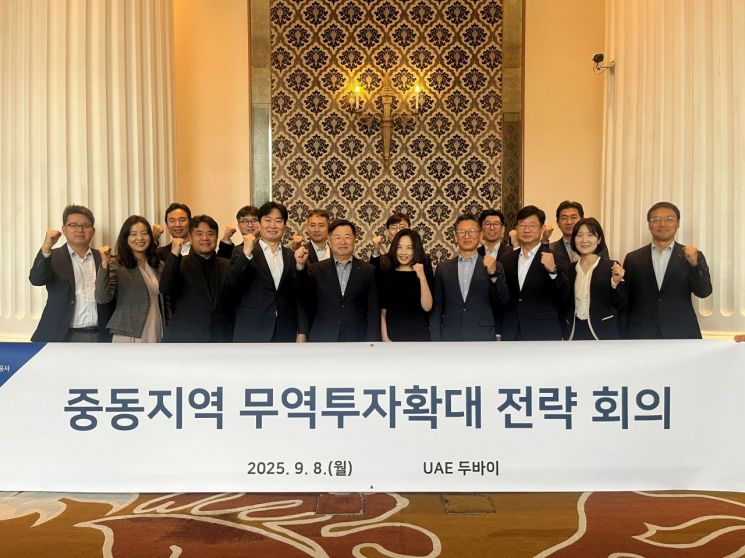 Participants of the "2025 Middle East Trade and Investment Expansion Strategy Meeting" held on the 8th in Dubai, United Arab Emirates, are taking a commemorative photo. KOTRA.
The Middle East is a key strategic market with a population of 600 million and a GDP of 4 trillion dollars, accounting for nearly half (49.8%) of the annual project orders won by Korean companies last year. Recently, Gulf countries have been pushing forward major national projects such as decarbonization transitions, large-scale infrastructure investments, and the development of artificial intelligence and smart cities. Korean companies have secured large-scale projects such as the Saudi gas combined cycle power plant (Doosan Enerbility, 2.2 trillion won) and the UAE's Azban solar power project (Korea Western Power, 1 trillion won).
However, KOTRA noted that recent Israel-Iran tensions and instability in maritime logistics in the Red Sea and the Strait of Hormuz are posing threats to Korean companies' expansion into the Middle East and to global supply chains. As risks and opportunities intersect in the region, a proactive response from an economic security perspective is now required.
Saudi Arabia, the UAE, and Qatar are competing to secure leadership in artificial intelligence (AI), making it a central pillar of their long-term national development strategies. Middle Eastern sovereign wealth funds, which account for 38% of the world's total, are expanding strategic investments to foster the AI ecosystem. The Middle Eastern market is characterized by swift decision-making led by royal leadership, and there are calls for Korean companies to secure an advantageous position as global competition in AI intensifies.
KOTRA is supporting the entry of Korean technology companies into the region by leveraging key local events such as UAE AI Week (April) and the Korea-Qatar AI Cooperation Forum (September). The agency is also expanding its base through strategic partnerships with AI policy institutions. In addition, KOTRA plans to strengthen on-the-ground support by identifying promising industry demand and connecting domestic AI and digital companies with local opportunities.
As geopolitical risks persist in the Middle East, Gulf countries are aiming to build self-reliant defense production ecosystems, moving beyond weapons purchases to establish localization-based partnership models such as long-term technology cooperation, joint development, and joint venture (JV) formation. Korea has already achieved results by exporting Middle East-tailored defense products based on advanced technologies, such as the Cheongung-II missile and the K9 self-propelled howitzer.
In the energy sector, policies to achieve both carbon neutrality and energy security are accelerating, with large-scale investments in renewable energy such as hydrogen, solar, and wind power underway. In this context, KOTRA is pushing for localization beyond the export of finished defense products, including technology internalization and joint development of components, while also expanding opportunities for cooperation on energy plant projects.
Immediately after the crisis on June 13, KOTRA launched the "Middle East Crisis Emergency Response Task Force (TF)" and, together with its 13 trade offices, monitored the local situation around the clock. Although a ceasefire was achieved on June 24, KOTRA continued to assess key issues and export environments in countries such as Israel and Iran, given the ongoing geopolitical crisis. In the short term, the agency discussed tailored support measures to minimize export disruptions, such as delays in buyer consultations and contract execution. It also analyzed long-term opportunities, including potential reconstruction projects in the event of stabilization or the lifting of economic sanctions.
President Kang emphasized, "The higher the geopolitical risk in a region, the more important it is to respond proactively and precisely. KOTRA, together with its local trade offices, will respond swiftly to changes in the Middle Eastern trade environment as a partner for exporting companies. Through collaboration with the government and businesses, we will work as One Team Korea to expand project orders and uncover new opportunities in AI, defense, and energy."
© The Asia Business Daily(www.asiae.co.kr). All rights reserved.












