A team of Korean researchers has pioneered a breakthrough by applying quantum computing to the design of multivariate porous materials (MTV), making it significantly easier to solve complex MTV design challenges.
MTV is a material that can be custom-designed at the molecular level, much like a set of LEGO blocks, allowing for the free realization of desired structures. This flexibility enables a wide range of applications, such as energy storage and conversion, which can contribute to solving environmental issues and advancing next-generation energy technologies.
On September 9, KAIST announced that a research team led by Professor Ji-Han Kim from the Department of Biological Chemical Engineering has developed a new framework that utilizes quantum computers to efficiently explore the design space of millions of MTVs.
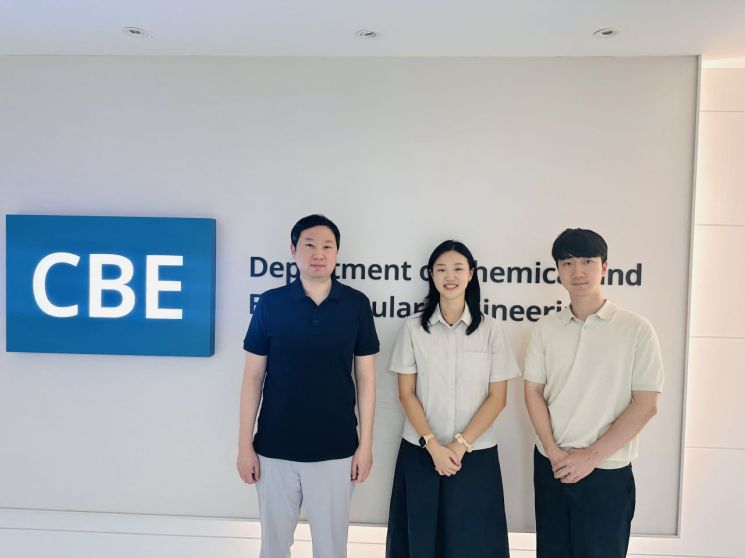 (From left) Professor Ji-Han Kim, PhD candidate Shin-Young Kang, PhD candidate Young-Hoon Kim. Courtesy of KAIST
MTV porous materials are formed by combining two or more types of organic ligands (linkers) and metal clusters, serving as building blocks. This allows for the design or synthesis of new structures through various combinations, making them useful in the fields of energy and the environment.
However, as the variety of components increases, the number of possible combinations grows exponentially. For this reason, the traditional method using classical computers, which requires checking each structure individually, could not handle the design and property prediction of MTV structures with complex linker combinations.
To address this, the research team represented the complex porous structures as "networks drawn on a map (graphs)." Each connection point and type of block was converted into qubits that quantum computers can process. The team then formulated the question, "Which blocks, and in what proportions, will create the most stable structure?" so that it could be solved by a quantum computer.
During the problem-solving process, the quantum computer calculated multiple possibilities simultaneously. This approach is akin to spreading out millions of LEGO blocks at once and selecting the most robust combination, dramatically reducing the enormous number of cases that classical computers would need to calculate one by one and greatly improving the efficiency of the search.
Notably, when the research team experimented with four previously reported MTV structures, they obtained the same results both in simulation and on an IBM quantum computer. This demonstrates that quantum computers can be applied to MTV design to solve complex problems.
Looking ahead, the team plans to combine this method with machine learning, expanding the platform to consider not only simple structure design but also synthesizability, gas adsorption performance, and electrochemical properties all at once.
Professor Kim stated, "This research is the world's first case of overcoming the bottleneck in complex MTV design using quantum computing. The achievement can be widely applied as a customized material design technology in fields where precise composition is critical, such as carbon capture and separation, selective catalytic reactions, and ion-conducting electrolytes."
This research was supported by the Mid-Career Researcher Support Program and the Heterogeneous Materials Support Program of the Ministry of Science and ICT. PhD candidates Shin-Young Kang and Young-Hoon Kim from the Department of Biological Chemical Engineering participated as co-first authors. The results were published online in the international journal ACS Central Science, an American Chemical Society publication, on August 22.
© The Asia Business Daily(www.asiae.co.kr). All rights reserved.












