Criminal Procedure Act: "Witness Examination Can Be Requested Before Trial"
Legal Experts: "Rare Case, Unlikely to Be Accepted by the Court"
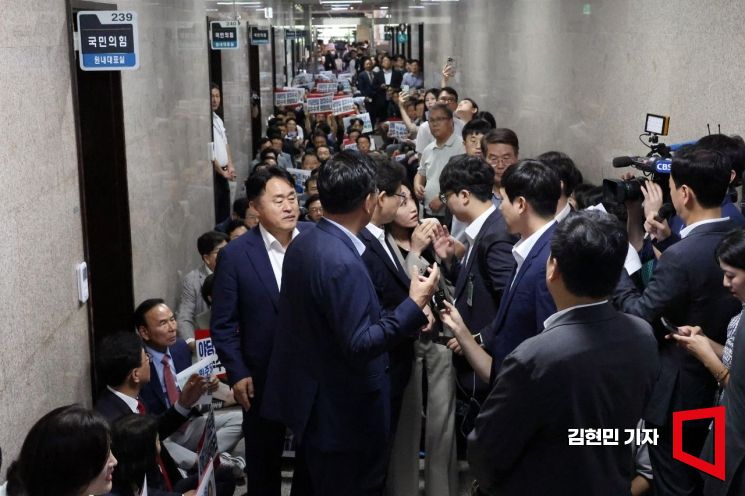 On the 3rd, at the National Assembly, special investigator Jo Eunseok and his team investigating the 'alleged obstruction of the martial law lifting vote' attempted to search the floor leader's office of the People Power Party. In response, People Power Party lawmakers who were staging a sit-in protested and blocked the attempt.
The special prosecutor's team investigating the 'alleged obstruction of the martial law lifting vote' (led by Special Prosecutor Cho Eunseok) announced its intention to consider 'witness examination' for certain reference persons deemed necessary for the investigation.
On September 8, Deputy Special Prosecutor Park Jiyeong stated at a regular briefing, "We are requesting the attendance of those necessary to uncover the truth regarding the case of obstruction of the National Assembly's resolution and are seeking cooperation from various angles. Article 221-2 of the Criminal Procedure Act stipulates that if a person who is clearly recognized as knowing indispensable facts for the investigation refuses to appear or testify, the prosecutor may request the court to examine the witness before the first trial date."
She continued, "If the court accepts the request for witness examination, a witness who does not comply with the summons can even be brought in by force. We ask that individuals voluntarily appear and cooperate with uncovering the truth before such a request is made."
However, even if the special prosecutor's team requests witness examination from the court, it does not appear likely that the court will readily accept it. This is because, even if the team proves that a particular individual has clear knowledge of the facts, the court is unlikely to grant the request. In fact, such cases are reportedly rare.
For this reason, some critics argue that the special prosecutor's team is resorting to the witness examination tactic as a last resort to effectively pressure lawmakers and related parties from the People Power Party.
The special prosecutor's team is investigating allegations that former People Power Party floor leader Chu Kyungho, at the request of former President Yoon Sukyeol's camp, repeatedly changed the location of the party caucus to prevent other lawmakers from participating in the martial law lifting vote. In this connection, the team has placed People Power Party lawmakers who did not participate in the vote and remained in the floor leader's office at the time under investigation. It is known that, at the time, eight lawmakers were present in the floor leader's office, including former floor leader Chu, Kim Heejung, Song Eonseok, Lim Ija, Jeong Heeyong, Kim Daesik, Shin Dongwook, and Jo Jiyeon.
Deputy Special Prosecutor Park stated, "Everyone who was in the floor leader's office has been reported and, by virtue of the report itself, is now a suspect. These individuals can be summoned, and if they do not comply, procedures can proceed. However, the request for witness examination is being considered not for the lawmakers who were in the floor leader's office, but for others who were not present but are necessary for uncovering the facts of the case."
© The Asia Business Daily(www.asiae.co.kr). All rights reserved.












