Ruling Party Pushes Prosecutorial Reform, Opposition Seeks to Curb Legislative Monopoly
Focus on Outcome of One-on-One Meeting Between President Lee and Leader Jang
Possibility of Policy Council Discussed... Some Expect No Tangible Results
The political landscape has reached a critical turning point with a luncheon meeting between President Lee Jaemyung and the leaders of both the ruling and opposition parties. As the standoff between the parties continues, attention is focused on whether this meeting can open the door to cooperation. Analysts believe that the key to this turning point lies with Jang Donghyuk, leader of the People Power Party, who is set to hold his first one-on-one meeting with President Lee.
On September 8, Jang convened the Supreme Council meeting of his party to finalize the agenda and the tone of the messages for his meeting with President Lee. Following a meeting with party leadership on September 7 to organize the agenda, he continued to deliberate on strategy right up until the meeting.
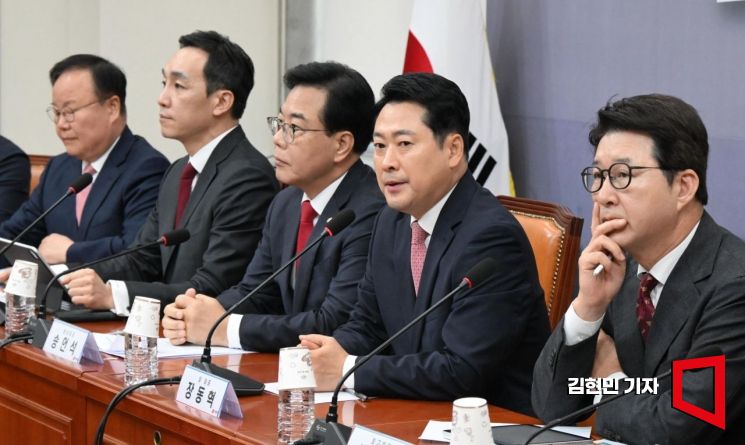 Jang Donghyuk, leader of the People Power Party, is speaking at the Supreme Council meeting held at the National Assembly on September 8, 2025. Photo by Kim Hyunmin
The initial point of interest is whether the leaders of the ruling and opposition parties, who have long been at odds, will be seen shaking hands. Previously, Jeong Cheongrae, leader of the Democratic Party, remarked, "I will not shake hands with forces of insurrection," while Song Eonseok, floor leader of the People Power Party, retorted, "I only talk to people," highlighting the ongoing confrontation. Park Suhyeon, chief spokesperson for the Democratic Party, told reporters after the Supreme Council meeting that "with the president's mediation, the long-standing deadlock where the party leaders have not shaken hands may be resolved," adding that Jeong expressed hope for "a genuine handshake, not just a formality."
The meeting table is expected to address recent and sensitive issues. With the government’s organizational reform plan-centered on the dissolution of the prosecution service-announced on September 7, the Democratic Party plans to once again emphasize the need for rapid prosecutorial and judicial reforms, including a stronger special prosecutor bill and the establishment of a special tribunal for insurrection. Jeong Cheongrae stated at the party’s Supreme Council meeting, "Prosecutorial reform, which previous administrations failed to achieve, has been possible thanks to President Lee’s determination," vowing, "We will ensure the government organization act passes in the National Assembly by the end of this month."
In contrast, the People Power Party plans to focus on the ruling party’s unilateral legislative push, including the government reorganization plan, the Yellow Envelope Act (amendments to Articles 2 and 3 of the Trade Union and Labor Relations Adjustment Act), and a more stringent amendment to the Commercial Act. On external issues, they are expected to demand concrete results from the recent South Korea-U.S. summit. The party also plans to criticize the government’s inadequate response to the recent arrest and detention of Korean nationals in the state of Georgia, United States.
As the party leaders reaffirm their existing differences, attention is focused on the outcome of the one-on-one meeting between President Lee and Jang. Jang proposed the one-on-one meeting in response to President Lee’s invitation for talks with party leaders, and President Lee accepted, heightening expectations. Although Jang has previously taken a hardline stance against the Lee Jaemyung administration, he is expected to actively call on the president to play a constructive role in seeking practical solutions, given the party’s minority status and the need to find a breakthrough amid the ruling party’s tough line. At the Supreme Council meeting, Jang stated, "I see significance in the president opening a channel for dialogue with party leadership," adding, "I hope today’s conversation will serve as an opportunity to resolve the current impasse."
As part of this, there is speculation that Jang may propose regularizing such meetings, for example by establishing a "ruling-opposition-government policy council." This would create a channel for cooperation on issues affecting people’s livelihoods while also providing a means for the opposition to voice resistance to attempts to suppress it. A People Power Party official said, "President Lee is unlikely to be entirely comfortable with the Democratic Party’s unilateral legislative drive, so he may be the first to propose a policy council. If there is mutual understanding on this, it could lead to a breakthrough in dialogue."
On the other hand, some believe the meeting will end with no tangible results. Shin Yul, a professor at Myongji University, commented, "Judging by the Democratic Party’s actions, President Lee’s calls for moderation are not being heeded at all," predicting, "There will be no major outcome, as the president cannot control the party." Political commentator Lee Jonghoon also said, "President Lee may listen to Jang’s concerns but will not provide any answers," adding, "The opposition will end up using the fruitless meeting as fuel for a public relations campaign."
© The Asia Business Daily(www.asiae.co.kr). All rights reserved.












