Securing the Future with Quantum Security:
Government, Academia, and Industry Join Forces for Innovation
"Building a Reliable Cryptographic System for the AI Era by 2035"
"Government Guidelines Needed to Open the Market"
The government will seek to establish best practices for building hybrid models that integrate quantum security technology into the nation's core infrastructure by 2030. The goal is to lead the innovation of a safe and reliable national security system based on quantum security technology to support the era of artificial intelligence (AI).
On September 3, Jaemyung Ryu, the 2nd Vice Minister of the Ministry of Science and ICT, held a meeting at Kookmin University with experts from industry, academia, and research in the field of quantum security, including post-quantum cryptography (PQC) and quantum key distribution (QKD). This initiative comes in response to the urgent need for a paradigm shift in security, such as the spread of quantum security technology, as rapidly advancing quantum computers and increasingly sophisticated cyberattacks threaten cryptographic systems.
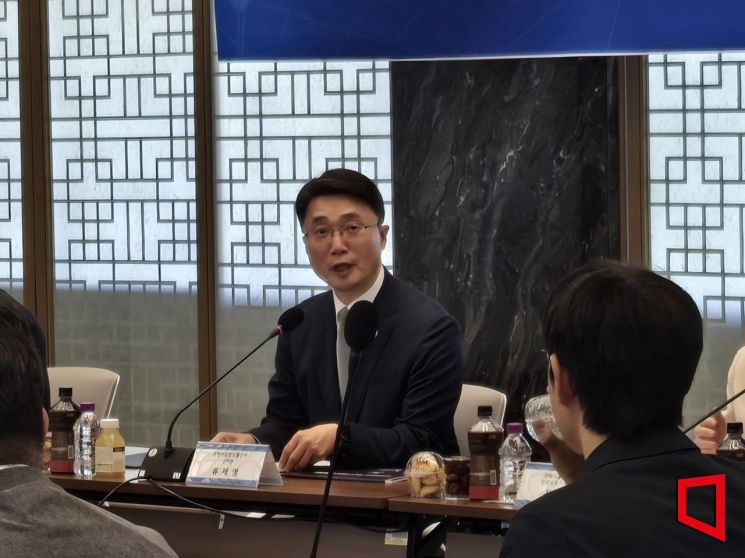 Jaemyung Ryu, the 2nd Vice Minister of the Ministry of Science and ICT, is speaking at a meeting with industry, academia, and research experts in the field of quantum security held at Kookmin University on the 3rd. Photo by Kyungjo Noh
The government has set out a plan to establish a foundation for the transition to post-quantum cryptography systems by 2030 and to build a technological and policy support system by 2035 to implement secure cryptographic systems. Next year, a budget of 3.6 billion won will be allocated to focus on satellite QKD, PQC-QKD hybrid models, and automated PQC support.
Vice Minister Ryu stated, "Quantum security is a future key driver that will significantly enhance national security capabilities," adding, "Building a robust security system in the quantum era is not something that can be achieved overnight, but a task that requires ten years of preparation."
He further emphasized, "It is regrettable that the importance of security areas such as cybersecurity incidents and quantum security is often overlooked until an incident occurs or a crisis is imminent. We must raise awareness of how critical this issue is to society and recognize that unless we act now, we could face serious consequences in the future. I urge everyone to join in systematically changing the security paradigm to prepare for the quantum era."
On this day, companies called for government support, including policy guidelines, pointing out that it is difficult to secure profitability compared to investment costs from a business perspective.
Kyungrok Lee, CEO of IDQ, said, "Companies prioritize return on investment (ROI), so unless the benefits of adopting quantum cryptography solutions are clear, they are reluctant to implement them. To accelerate the adoption of quantum security, which is lagging behind the global market, strong government-level guidelines are necessary."
Sangmin Lee, director at SK Telecom, also commented, "Since the amount companies can invest is limited, there is skepticism about whether to continue the business. If the government considers ways to foster the market, it would help sustain the business." He added, "Standards and certifications must be managed at the national level. Without clear criteria, client companies will not actually use the solutions."
Umgae Joo, executive director at LG Uplus, pointed out, "Although quantum communication items are included in the national network fee structure, they are only reflected upon request from actual users. The market needs to open up for a virtuous cycle of private sector development, but it seems the government is only acting as a catalyst."
Some attendees suggested replacing the term "transition to post-quantum cryptography" with a phrase that encompasses the entire field of quantum security, noting that focusing solely on PQC could give the impression that QKD and other technologies are being excluded.
Vice Minister Ryu concluded, "There seems to be a lot for the government to do. Due to the technical complexity and wide range of applications, many challenges exist, requiring close cooperation between the public and private sectors. Moving forward, we will expand pilot projects for post-quantum cryptography transition and quantum key distribution testbeds, as well as foster specialized talent and companies to build the industrial foundation."
© The Asia Business Daily(www.asiae.co.kr). All rights reserved.












