"Even if They Have Children, Only One"
Changing Patterns of Childbirth
Over the past 30 years, the landscape of marriage and childbirth in South Korea has changed dramatically. The number of marriages has nearly halved, but marriages with foreigners have increased by more than 50%. Due to the intensifying low birth rate, the number of babies born has dropped to about one-third of previous levels.

According to "Changes in Marriage and Births Over the Past 30 Years," released by Statistics Korea on September 3, the number of marriages, which stood at 398,500 in 1995, peaked at 434,900 in 1996, and then dropped to 191,700 by 2022. Last year, the number slightly rebounded to 222,400, but this is still 44.2% lower than 30 years ago.
In contrast, marriages with foreigners increased by 53.9% during the same period, from 13,500 to 20,800. The proportion of such marriages among all marriages also expanded from 3.4% to 9.3%, meaning that currently, one out of every ten marriages is multicultural. Marriages between Korean men and foreign women rose by 50.7%, while marriages between Korean women and foreign men increased by 64.2%.
The average age at first marriage has also risen. In 1995, the average age was 28.4 for men and 25.3 for women, but last year, it reached 33.9 for men and 31.6 for women, meaning both men and women now typically marry in their 30s.
"Even if They Have Children, Only One"...Changing Patterns of Childbirth
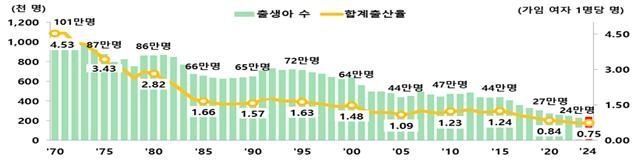
The number of births dropped by 66.7%, from 715,000 in 1995 to 238,000 last year. The total fertility rate also fell by more than half, from 1.63 to 0.75. The timing of childbirth has also been delayed. The average age at childbirth for women increased from 27.9 to 33.7, and for men from 31.1 to 36.1, both rising by more than five years.
Childbirth patterns have shifted as well. While the number of firstborns decreased by 57.7%, from 345,800 in 1995 to 146,100 last year, the number of second and third children dropped by 231,900 (75.4%) and 45,100 (73.5%), respectively, over the same period. As a result, the proportion of firstborns among all births rose from 48.4% in 1995 to 61.3% in 2024, an increase of 13.0 percentage points. This indicates a growing tendency for families to have only one child. The proportion of births outside of marriage expanded from 1.2% to 5.8%, and the share of multiple births, such as twins, increased from 1.3% to 5.7%.
© The Asia Business Daily(www.asiae.co.kr). All rights reserved.












