Determined to Challenge the U.S.-Led Order
Not Merely a Commemoration of the Past,
But a Bid to Reshape the Future World
Signals of a New Cold War Structure Emerge
On September 3, during the 80th anniversary Victory Day parade held in Beijing, the image of Chinese President Xi Jinping standing at the center of Tiananmen Gate, flanked by North Korean State Affairs Commission Chairman Kim Jong Un and Russian President Vladimir Putin, was widely interpreted as a deliberate display intended to underscore the solidarity among North Korea, China, and Russia to the West. Analysts say this not only demonstrates their willingness to challenge the U.S.-led world order, but also serves as a message to both domestic and international audiences that the three countries have established a strategic alliance. As the host of the event, China positioned itself as the leading force uniting non-Western countries that are politically and economically isolated, offering an alternative to the United States and other Western powers.
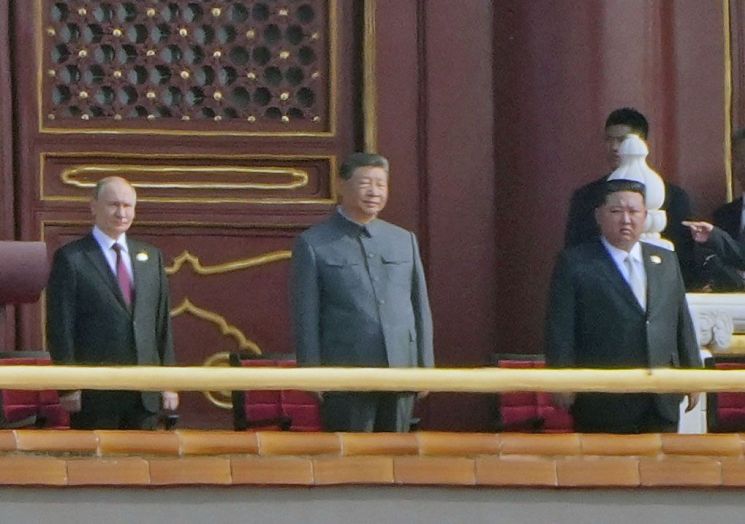
Foreign media outlets noted that the scene of the three leaders standing atop Tiananmen Gate carried significance beyond mere ceremony. It was not simply a matter of protocol, but a symbolic display that the three countries have no intention of diverging from each other diplomatically or militarily.
CNN commented, "Xi Jinping, Kim Jong Un, and Putin are embarking on a new journey together," adding, "This is the first time the three leaders have shared the same stage, and there appears to be little chance they will part ways diplomatically or militarily in the near future." Reuters also pointed out that President Xi visually emphasized the solidarity of non-Western countries by placing President Putin and Chairman Kim on either side of him.
The image of the North Korean, Chinese, and Russian leaders sitting side by side, broadcast live around the world, has sparked speculation that it heralds a new Cold War structure. AFPBB reported, "This is the first time since 1959 that Xi Jinping, Putin, and Kim Jong Un have stood together at Tiananmen," describing it as a symbolic staging reminiscent of the new Cold War era. The Guardian also described the joint appearance of the three leaders as "highly impressive," noting that China showcased advanced weaponry in front of leaders from countries that have resisted the West.
This was not a simple protocol event, but rather a political message intended to publicly reinforce the solidarity among North Korea, China, and Russia. The Asahi Shimbun interpreted it as "a clear intention to strongly imprint the North Korea-China-Russia alliance on the world." The Guardian added, "This event is not merely about commemorating the past, but is a stage that strongly reveals the direction of forces seeking to reshape the future world order."
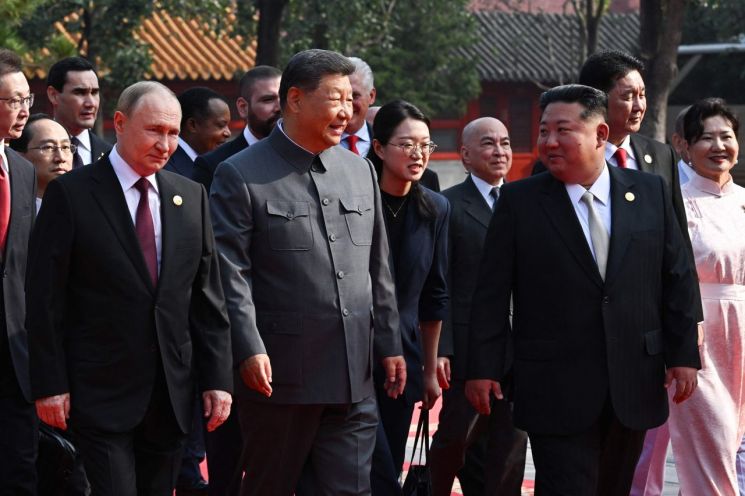
The Washington Post stated, "As China's relations with the United States and Europe have soured, it is focusing on strengthening ties with non-Western leaders such as Putin and Kim Jong Un," interpreting the event as part of efforts to build an alliance capable of challenging Western global leadership. Reuters reported, "This gathering visually demonstrates the solidarity among countries isolated by the West due to the Russia-Ukraine war, and President Xi seeks to convey a message of a new world order that opposes the U.S.-led system."
At the center of this triangular alliance is, without question, China. Since the administration of U.S. President Donald Trump, China has engaged in a trade war involving high tariffs, and tensions have yet to be fully resolved. The three countries have demonstrated their strengthened unity, drawing closer together in the face of ongoing tariff conflicts and the Ukraine war, both of which have pitted them against the United States.
Many key Western leaders were notably absent from this year's parade. In 2015, during the 70th anniversary Victory Day parade, China welcomed six European leaders, but this year, most were absent. Analysts attribute this to backlash against China's indirect support of Russia, which launched the war in Ukraine. The Nihon Keizai Shimbun (Nikkei) reported, "The West is dissatisfied with China's support for Russia, and G7 leaders do not wish to be seen watching a parade alongside Putin," adding, "Today, as U.S.-China tensions intensify, relations between the G7 and China have clearly deteriorated."
Some interpret the absences as a deliberate move to avoid falling out of favor with the United States. The Diplomat, a U.S. foreign affairs magazine, suggested, "Amid President Trump's divisive approach, some countries may have lowered their level of participation to avoid the appearance of taking sides."
The empty seats were filled by Chairman Kim and President Putin. Kim Jong Un's appearance at a multilateral summit for the first time since taking power in 2011 was seen as signaling the emergence of a new axis of authoritarianism. It has been 66 years since the leaders of North Korea, China, and Russia have gathered together, the last time being the 1959 Beijing North Korea-China-Soviet Union summit. The Financial Times (FT) analyzed, "Kim Jong Un's attendance heightens concerns among U.S. allies about the rise of an authoritarian axis," especially given that North Korean troops are currently fighting alongside Russian forces in the Ukraine war.
The Guardian described the parade as "a symbolic scene of the so-called 'Heptile of Upheaval,' an alliance of authoritarian states," noting that while most Western leaders were absent, only leaders from non-Western countries such as Russia, Iran, and Myanmar attended, making the China-centered alliance even more prominent.
Another point of interest was the large turnout of Global South leaders, representing emerging and developing countries in the Southern Hemisphere. This suggests China is seeking to position itself as the leader of the Global South. Xinhua News Agency reported that top-level officials from 26 countries attended. Reuters noted, "The large presence of Central Asian and Southeast Asian leaders demonstrates China's intention to strengthen its ties with the Global South and establish itself as the center of an anti-Western alliance."
Some point out that the triangular alliance is limited by its pragmatic nature, being based more on practical diplomacy than ideological unity. The U.S. outlet Vox analyzed, "If the United States employs a divide-and-conquer strategy, cracks could easily appear." The Wall Street Journal (WSJ) also assessed that while this triangle is clearly an 'anti-U.S. alliance,' it remains a fragile partnership lacking a decisive mutual defense treaty or deep trust. The differing political priorities of each country mean there is little binding force to defend one another in the event of an actual conflict.
© The Asia Business Daily(www.asiae.co.kr). All rights reserved.













