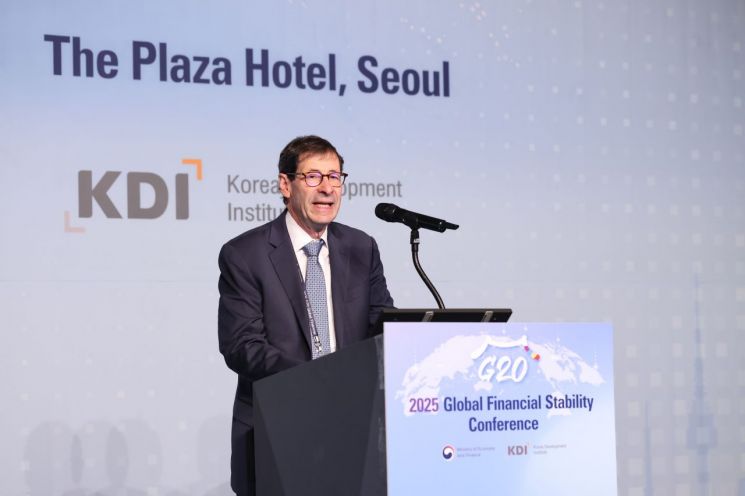
 Morris Obstfeld, Senior Fellow at the Peterson Institute for International Economics and Emeritus Professor of Economics at the University of California, Berkeley, is delivering the keynote speech at the "2025 G20 Global Financial Stability Conference" held on the 3rd at The Plaza Hotel in Jung-gu, Seoul. Provided by the Korea Development Institute (KDI)
There is an assessment that, in order to overcome the situation where the United States is challenging the liberal trade order and erecting higher tariff barriers, the willingness of countries other than the United States to cooperate is crucial. While concerns are mounting over the actions of the United States, experts predict that building a close multilateral trade system could provide Europe and Asia with an opportunity to increase their influence.
Morris Obstfeld, Senior Fellow at the Peterson Institute for International Economics, delivered a keynote speech on this topic at the "2025 G20 Global Financial Stability Conference" held on the 3rd at The Plaza Hotel in Jung-gu, Seoul. Obstfeld is a world-renowned economist, Emeritus Professor of Economics at the University of California, Berkeley, and former Chief Economist of the International Monetary Fund (IMF).
Obstfeld's presentation focused on "Changes in the Trade System and Financial Stability." He assessed that the situation, in which the United States has imposed tariffs on various countries and destabilized the free trade system since the launch of Donald Trump's second administration, will ultimately have negative consequences for the United States itself. In particular, he warned that the status of the dollar as the global key currency could weaken.
Obstfeld stated, "The (closed) policies of the Trump administration are undermining the strengths of the dollar," and added, "They are threatening fragmentation in the global market." He continued, "(Countries outside the United States) are working to protect themselves, and one way to decouple from the United States is to use the dollar less," noting, "There are reports that other countries are preferring non-dollar funding and trying to reduce their dollar holdings in terms of asset allocation." He also said, "The dollar could decline in the global economy."
He further commented, "(The United States) is politically encouraging stablecoins, which could pose a threat to some countries," and warned, "This could lead to dollar instability." He predicted, "If that happens, instead of integration, we could see fragmentation of the global payment system." He also said, "The U.S. fiscal system is weakening, and Treasury debt could become a source of pressure," adding, "When global shocks occur, dollar assets may no longer be safe assets."
As the United States continues its closed-off approach, he emphasized that other countries must "renew their commitment to multilateralism" in response. Obstfeld explained, "Ultimately, it depends on how willing other countries are to cooperate," and added, "A coalition of willing countries could solve this issue." However, he cautioned, "With the United States abandoning multilateralism, we need to consider whether international financial institutions alone can sustain this structure and whether it is sustainable."
He also expressed concern that "if countries (outside the United States) fail to unite, U.S. power could grow even stronger." However, he predicted, "Some minority countries may be able to establish close trade systems with countries other than the United States," and said, "Europe and Asia have ample opportunity to expand their influence through multilateral cooperation." He concluded, "If the United States stands alone, the remaining countries could unite to make the world safer," and emphasized, "Cooperation is becoming more important as U.S. actions are exerting pressure."
The G20 Global Financial Stability Conference held on this day was co-hosted by the Ministry of Economy and Finance and the Korea Development Institute (KDI). Under the theme of "Strengthening Financial Stability and Enhancing Resilience in an Environment of Structural Change and Uncertainty," the conference was organized to discuss changes in the global financial order and major challenges facing the international economy.
© The Asia Business Daily(www.asiae.co.kr). All rights reserved.












