Hyundai Motor Union, Korea's Largest Single-Workplace Union, Launches First Strike in 7 Years
"Yellow Envelope Act" Strengthens Right to Strike
Korea GM and GGM Unions Also Begin Strikes
HD Hyundai, Key to Korea-U.S. Cooperation, Hit Hard b
The domestic manufacturing industry, having overcome tariff barriers, is now facing the threat of strikes. Observers note that the changes in labor-management dynamics following the recent passage of the so-called Yellow Envelope Law (amendments to Articles 2 and 3 of the Trade Union and Labor Relations Adjustment Act) are starting to manifest in reality. With the Hyundai Motor labor union, considered the barometer of labor relations in the domestic manufacturing sector, launching a strike for the first time in seven years, analysts say the strengthening of unions' right to strike is becoming a reality.
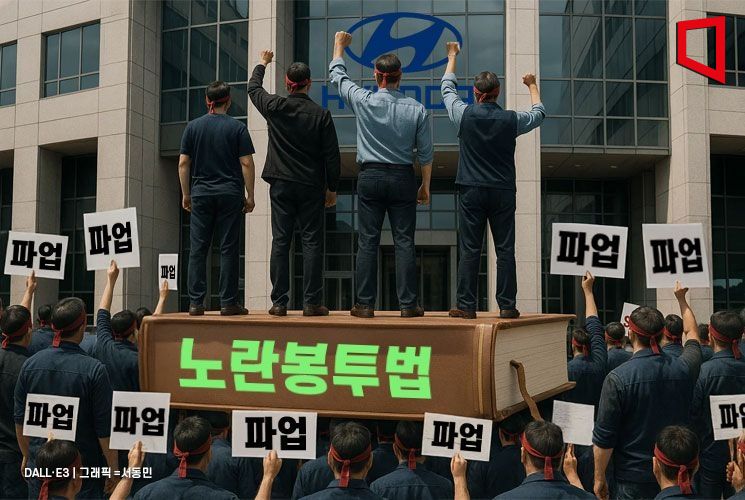
On September 3, the Hyundai Motor union announced that it would begin a partial strike from that day until September 5. The union will strike for two hours each on September 3 and 4, and for four hours on September 5. Since their initial meeting in June, Hyundai Motor’s labor and management have held 20 rounds of negotiations without reaching an agreement. During negotiations on the previous afternoon, management presented a second proposal that included a 95,000 won increase in base pay, a performance bonus of 400% plus 14 million won, 30 shares of company stock, and a 200,000 won traditional market gift certificate. However, the union decided to strike, arguing that the offer was insufficient compared to union members’ contributions.
Although the partial strike lasts less than four hours a day, the impact of Hyundai Motor’s strike-the largest single-site union in the country and the flagship of the Korean Metal Workers’ Union-is significant for labor relations nationwide. The progress of Hyundai Motor’s wage negotiations serves as a benchmark for labor-management talks at other Hyundai Motor Group affiliates.
Until now, the Hyundai Motor union has exercised restraint in striking, considering the domestic economic downturn and public criticism labeling it as a “privileged union.” However, with management’s wage offer falling far short of expectations and no breakthrough on key issues such as extending the retirement age, the union ultimately opted for a strike. Meanwhile, the Korea GM union, another major automaker, has also been staging partial strikes since September 1, demanding wage increases, a halt to asset sales, and job security. Gwangju Global Motors (GGM), established as a “labor-management cooperation model,” is also suffering from strike action.
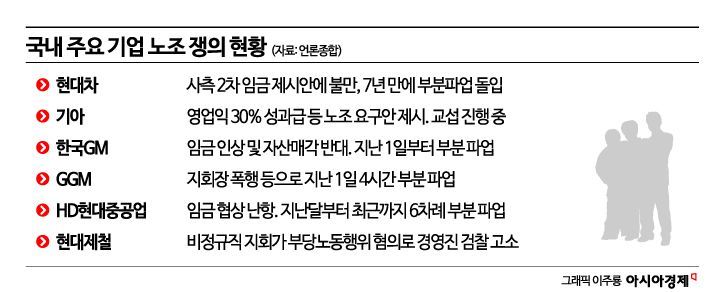
HD Hyundai, which is responsible for the Korea-U.S. shipbuilding cooperation project known as MASGA (Make American Shipbuilding Great Again), is also reeling from union strikes. The HD Hyundai Heavy Industries union is striking jointly with HD Hyundai Mipo and HD Hyundai Samho on this day. Since starting wage negotiations in May, the union has carried out a total of six partial strikes as of the previous day. Although labor and management reached a tentative wage agreement in July, it was rejected at a union general meeting, and there has been no progress since. The union has announced four consecutive days of partial strikes through September 5.
There are concerns both inside and outside the company that prolonged labor-management conflict could negatively affect Korea-U.S. cooperation. In particular, if senior officials from the U.S. government visit the HD Hyundai Heavy Industries shipyard in Ulsan during the Asia-Pacific Economic Cooperation (APEC) summit in Gyeongju next month, the exposure of such unstable labor relations could become a burden. An HD Hyundai Heavy Industries official stated, “If the strike continues during this period of global cooperation, it will only leave scars for both the company and its members. Now is the time for labor and management to seek a path of coexistence through dialogue for the future.”
© The Asia Business Daily(www.asiae.co.kr). All rights reserved.













