Integration Talks for Daesan Plant in Seosan, Chungnam Gain Traction
"Concerns Over Asset Impairment and Liquidity Deterioration... Tax Relief Needed"
Proposal for U.S. Ethane Imports Also Raised; Government Says "Will Review"
The petrochemical industry, which has begun discussions on consolidating naphtha cracking centers (NCC), has emphasized the need for regulatory relief measures to mitigate the inevitable tax, financial, and energy risks that arise during the process of facility integration and restructuring.
On September 1, at the 8th conference room of the National Assembly Members' Office Building, a public hearing for the enactment of a special act to support the petrochemical industry was hosted by Assemblyman Ju Cheolhyun of the Democratic Party of Korea (Yeosu City Gap, Jeonnam), with attendance from the Ministry of Trade, Industry and Energy, the Fair Trade Commission, experts from academia and the legal sector, chairpersons of the Yeosu, Ulsan, and Seosan Chambers of Commerce and Industry, as well as executives from major petrochemical companies.
Lawmakers from both the ruling and opposition parties, including Sung Iljong and Seo Beomsoo from the People Power Party, and Kim Woni, Kim Moonsu, and Jo Gyewon from the Democratic Party, participated in large numbers. They expressed agreement on the necessity for a special act, citing the limitations of the "self-rescue first, support later" principle.
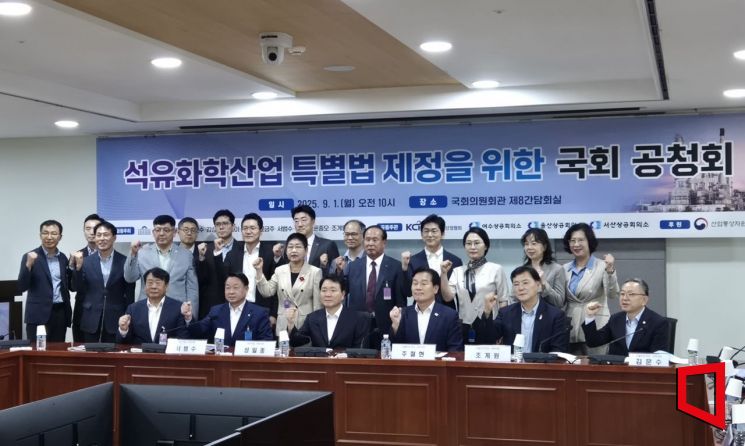 On the 1st, at the National Assembly Members' Office Building, 8th Conference Room, a public hearing titled "Public Hearing for the Enactment of the Special Act to Support the Petrochemical Industry," hosted by Ju Cheolhyun, a member of the Democratic Party of Korea (Yeosu City, Jeonnam), was held. Attendees included ruling and opposition party lawmakers, experts from the Ministry of Trade, Industry and Energy and the Fair Trade Commission, academia and legal sectors, chairpersons of the Yeosu, Ulsan, and Seosan Chambers of Commerce and Industry, as well as executives from major petrochemical companies, who are taking a commemorative photo. Photo by Oh Jieun
At the event, Jung Daeok, Head of Planning at HD Hyundai Chemical, requested concrete support measures, assuming the integration of the Daesan plant in Seosan, South Chungcheong Province, with Lotte Chemical. During the hearing, Jung stated, "There is a risk of asset impairment during the integration of the Daesan plant, and there are also concerns about worsening liquidity."
As specific support measures, he mentioned: ▲ exemption from corporate, acquisition, and registration taxes incurred during asset transfers; ▲ financial support and payment guarantees to address asset impairment resulting from reduced borrowings and assets; ▲ deregulation to allow direct import and use of liquefied natural gas (LNG) through amendments to the Urban Gas Act; and ▲ reduction of the excessively high statutory LNG charges for fuel use compared to power generation.
He also separately proposed a project to introduce U.S.-sourced ethane and suggested measures to reduce product costs.
He said, "U.S. ethane produces less carbon than conventional naphtha or LPG, and based on current prices, it can save $200 per ton. While site and pier acquisition and port permits have been completed, infrastructure investment in tanks and ships alone will require about 2 trillion won." In response, Lee Dongcheol, Head of the Chemical Industry Team at the Ministry of Trade, Industry and Energy, agreed on the need to introduce ethane and said institutional support measures would be reviewed.
Lotte Chemical also added its voice. Kwak Kiseop, Head of Business Support at the Basic Materials Business Division, said, "At the Yeosu Industrial Complex, the amount of orders from large corporations has decreased by 44%, and local tax revenue has nearly halved. Industrial restructuring cannot be achieved at the level of a single company." He particularly called for improvements to disclosure procedures for approved business restructuring companies, adding, "The system should be revised to allow changes to existing disclosures during processes such as mergers and splits."
The fact that the industry itself has presented such specific financial support measures is interpreted as a sign that the integration discussions for the Daesan plant have made significant progress at the working level. Currently, at Daesan, Lotte Chemical operates an NCC with a capacity of 1.1 million tons, while HD Hyundai Chemical operates an NCC with a capacity of 850,000 tons. HD Hyundai Chemical is a joint venture owned by HD Hyundai Oilbank (60%) and Lotte Chemical (40%), and there is speculation that HD Hyundai Chemical is likely to acquire and integrate Lotte Chemical's facilities for unified operation in the future.
Lee Junheon, Director of the Market Surveillance Policy Division at the Fair Trade Commission, also stated, "We will process the review of mergers and acquisitions as quickly as possible. Some forms of joint conduct to improve efficiency are already permissible under current law. We will support the swift restructuring of businesses."
© The Asia Business Daily(www.asiae.co.kr). All rights reserved.












