Sharp Drop in Minor Emergency Cases Amid Resident Doctor Shortage
Share of Self-Harm and Suicide Among Teens and Young Adults
Rises from 26.7% to 39.4% Over the Past Decade
Last year, as resident doctors collectively resigned in protest against the expansion of medical school quotas, hospital operations were disrupted, leading to a sharp decline of over 50% in the number of injured patients visiting emergency rooms. Among those who visited the emergency room for injuries, the proportion of self-harm and suicide cases increased by 3.6 times over the past decade, with a particularly significant rise among patients in their teens and twenties.
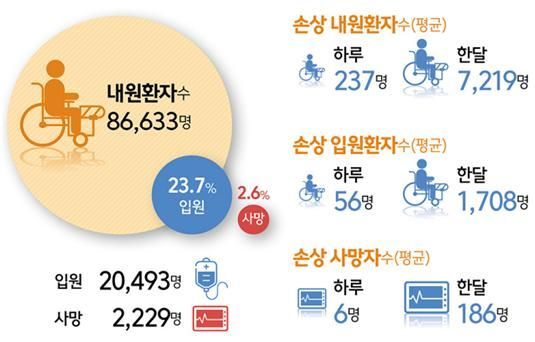
According to the "2024 Statistics on Types and Causes of Injuries" released by the Korea Disease Control and Prevention Agency (KDCA) on August 28, the number of injured patients visiting the emergency rooms of 23 participating hospitals last year was 86,633, a decrease of 57.4% compared to the previous year. However, the proportion of injured patients admitted to the hospital after visiting the emergency room rose by 7.6 percentage points to 23.7%, and the mortality rate increased by 1.4 percentage points to 2.6%.
Injured patients include those affected by various external factors such as accidents, disasters, or poisoning, excluding diseases. The KDCA explained, "Due to the situation in the medical community, access to emergency rooms was restricted, resulting in fewer visits by patients with minor injuries, while patients with severe injuries mainly used the emergency room."
Among all injured patients, the proportion of those who were injured or died due to intentional acts such as self-harm, suicide, violence, or homicide was 11.1%. This is the first time since the survey began in 2006 that the proportion of intentional injuries has exceeded 10%.
In particular, self-harm and suicide cases accounted for 8.0% of all injured patients, which is 3.6 times higher than the 2.2% recorded in 2014, ten years ago. Furthermore, the proportion of patients in their teens and twenties among self-harm and suicide cases rose sharply from 26.7% in 2014 to 39.4% last year.
The KDCA evaluated, "The most common reason for self-harm and suicide attempts was psychiatric issues such as depression (45.6%), which indicates that mental health problems are spreading at a serious level among young and middle-aged adults."
Injuries resulting from intentional acts were also found to be closely related to alcohol consumption. Among patients who visited the emergency room while intoxicated, nearly 4 out of 10 (38.6%) were injured due to intentional acts. Of these, self-harm and suicide accounted for 24.9%, and violence or homicide accounted for 13.7%.
In contrast, the vast majority of patients who were not intoxicated (91.8%) visited the emergency room due to unintentional injuries, with only 7.9% of injuries resulting from intentional acts.
The KDCA explained, "The incidence of intentional injuries was about five times higher among those who were intoxicated compared to those who were not," emphasizing the importance of raising awareness about the dangers of alcohol consumption.
Looking at the types of injuries among all patients, falls accounted for the largest proportion (40.0%), followed by blunt force injuries (15.2%) and traffic accidents (15.1%). In the case of traffic accidents, the proportion of "other/unknown land transport"-which includes personal mobility devices such as electric scooters-surged from 0.4% in 2014 to 5.0% last year, a 12.5-fold increase. The rates of protective equipment usage were 74.2% for motorcycle helmets, 71.2% for seat belts, 55.2% for car seats, and 16.2% for bicycle helmets.
By age group, those aged 70 and older accounted for 19.3% of all injured patients, the highest proportion since the survey began in 2006. In particular, for fall accidents, the proportion of patients aged 70 and above was 35.3%.
For pediatric and adolescent patients, it was especially important to prevent falls at home for those under one year old; to use car seats when riding in vehicles for those aged 1 to 2; to strengthen safety during play or on routes to and from school for those aged 3 to 6; to wear bicycle helmets for those aged 7 to 12; and for those aged 13 to 18, the risk of injuries from motorcycle accidents or drug intoxication for suicide purposes was prominent.
Im Seungkwan, Commissioner of the KDCA, stated, "These statistics highlight serious social and medical challenges, such as the increase in self-harm and suicide among adolescents and the risk of injuries in homes and living spaces," adding, "It is important to provide customized preventive education and improve environments, taking into account the developmental characteristics of each age group."
© The Asia Business Daily(www.asiae.co.kr). All rights reserved.












