458,784 Units Produced from January to July, Up 12%
Monthly Output Surpasses 40,000 After Tariffs Imposed
Automobile Exports to U.S. Continue to Decline
"Urgent Need for Measures to Support Domestic Production"
Hyundai Motor Company and Kia have seen their U.S. local production volumes increase by double digits this year compared to last year.
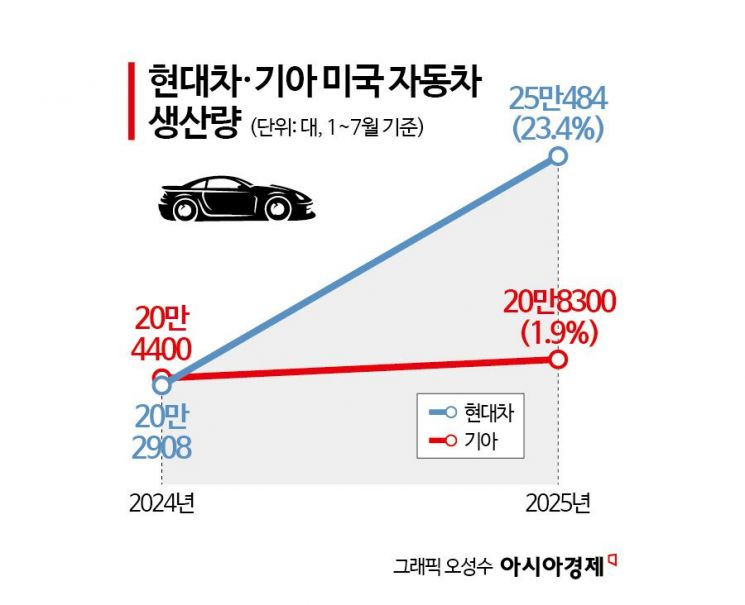
According to the Korea Mobility Industry Association on August 1, Hyundai Motor Company and Kia produced a total of 458,784 vehicles in the United States from January to July. This represents an increase of over 12% compared to the same period last year (407,308 units).
Hyundai Motor Company produced 250,484 vehicles locally, a sharp rise of 23.4% from 202,908 units in the same period last year. Kia produced 208,300 vehicles, an increase of 1.9% from last year's 204,400 units.
This growth in local production is attributed to the impact of U.S. tariffs. Hyundai Motor Company had been producing an average of 35,000 vehicles per month in the first quarter, but after the imposition of automobile tariffs in the United States in April and May, monthly production exceeded 40,000 units. Kia also set monthly records by producing 30,300 units in April and 31,400 units in May.
If this trend of increased local production continues through the end of the year, Hyundai Motor Company and Kia's U.S. production is expected to approach 800,000 units for the first time. Their U.S. production reached an all-time high of 727,000 units in 2023, but fell to 715,732 units last year.
As U.S. production has increased, exports from Korea have declined. From January to July, Korea's automobile exports to the United States totaled 801,109 units, an 8.3% decrease from 874,182 units during the same period last year.
With the continued impact of tariffs expected, industry forecasts suggest that local production will keep rising. Hyundai Motor Group plans to invest $26 billion (approximately 36 trillion won) in the United States over the next four years, aiming to expand its U.S. finished vehicle production capacity from 700,000 units last year to over 1.2 million units by 2028.
Hyundai Motor Group is also accelerating the localization of its supply chain. The company has launched a task force to diversify parts sourcing in the United States and is currently reviewing bids from around 200 suppliers to determine the optimal balance between domestic exports and local sourcing.
Due to tariff responses and other factors, exports from Korea to the United States are declining, raising concerns that domestic production could shrink in the long term. Industry experts point out that customized support is needed to boost domestic production.
The Lee Jaemyung administration has set a goal in its five-year national policy plan to raise Korea's automobile production, currently ranked seventh globally at 4.12 million units, to fifth place by 2030. Last year, Germany ranked fifth with 4.42 million units, a difference of about 300,000 units.
Kim Juhong, Executive Director of the Korea Automobile Mobility Industry Association, stated, "We cannot stop local production aimed at reducing tariff burdens," adding, "Policy support is needed to maintain and expand the domestic production system by encouraging both production and consumption."
© The Asia Business Daily(www.asiae.co.kr). All rights reserved.














