Sharp Decline in Growth Rate Compared to Pre-Implementation
0.45 Percentage Points Drop This Year, 0.60 Percentage Points Next Year
Heavy Impact Expected in Key Export Sectors Such as Automobiles
"Compared to the period before implementation, U.S. tariff policies are expected to significantly lower South Korea's economic growth rate by 0.45 percentage points this year and 0.60 percentage points next year."
On August 28, the Bank of Korea's Economic Research Bureau announced this in its August economic outlook report, "The Impact of U.S. Tariff Policies on the Korean Economy."
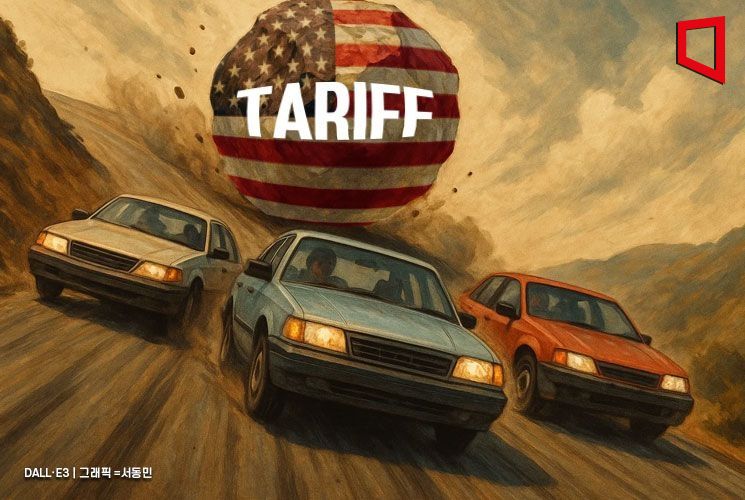
At the end of last month, with the conclusion of tariff negotiations between the United States and major countries, the overall framework for U.S. tariff policies-including tariff rates and implementation timelines-has been largely established. In South Korea's case, despite relatively successful negotiations, the average tariff rate imposed by the United States on Korean products has risen sharply from zero under the Korea-U.S. Free Trade Agreement (FTA) to around 15%. This is expected to deliver a significant shock to the Korean economy, which is highly dependent on exports to the United States.
The Bank of Korea identified three main channels through which U.S. tariffs will impact the Korean economy: trade, finance, and uncertainty. The impact on growth via the trade channel is estimated at 0.23 percentage points this year and 0.34 percentage points next year. The report forecasts that export costs to the United States will rise due to tariffs, and that U.S. inflation will reduce aggregate demand, causing a sharp decline in exports to the U.S. While some export substitution to other markets may occur, the contraction in import demand due to slower growth in other countries is expected to have a greater negative effect. By product category, sectors facing high tariffs such as metals and machinery, as well as automobiles-which have a high proportion of exports to the U.S.-are expected to be hit hardest.
Through the financial channel, the growth rate is projected to decrease by 0.09 percentage points this year and 0.10 percentage points next year, mainly due to weaker domestic demand. U.S. tariffs are increasing inflationary pressures, leading to a more restrictive monetary policy in the U.S. compared to a scenario without tariffs. As a result, improvements in domestic and global financial conditions are being delayed, which negatively affects the real economy. In fact, most assessments indicate that the Federal Reserve's decision to cut interest rates is being postponed due to the current U.S. tariff policy.
Via the uncertainty channel, growth is expected to decline by 0.13 percentage points this year and 0.16 percentage points next year, again mainly due to weaker domestic demand. As uncertainty rises, businesses and households tend to delay economic decisions while waiting to see how the situation unfolds, which in turn dampens investment and consumption.
Until now, the domestic and global impact of tariffs has been less severe than feared, thanks to mutual tariff deferrals and companies absorbing some of the burden. However, these effects are expected to grow going forward, as U.S. inflation is already rising and new export orders in global manufacturing are declining. South Korea's exports to the United States, especially in steel and auto parts, are also weakening.
The Bank of Korea's Economic Research Bureau predicted, "U.S. tariff policies will not only have a short-term economic impact, but also bring about changes in the global trade order, domestic and international political economy, and industrial structure." The report explains that the expansion of local production in the U.S. could lead to the hollowing out of domestic industries in South Korea, resulting in job losses and even a brain drain.
© The Asia Business Daily(www.asiae.co.kr). All rights reserved.












