The Ojeong-dong area in Bucheon, Gyeonggi Province is emerging as a new core hub in the western metropolitan area, driven by the dual benefits of large-scale urban development and the expansion of a metropolitan transportation network.
The project to underground the Gyeongin Expressway, which passed the preliminary feasibility study in January, is scheduled to begin construction between 2028 and 2029, with completion targeted for 2032. This project involves building a 15.3-kilometer underground expressway beneath the Gyeongin Expressway, aiming to expand road capacity and alleviate congestion. The existing road will be transformed into an eco-friendly green space and roadway, enhancing the urban environment. The Seoul-Gwangmyeong Expressway, set to open in 2027, will significantly improve accessibility to Gwangmyeong, Yeouido, and the Gangnam area via the Dongbucheon Interchange.
Additionally, Bucheon City is promoting the creation of an R&D and knowledge industry-centered complex, a cultural content hub, and a high-tech industry belt through its "2040 Urban Master Plan." In Daejang New Town, major anchor companies such as SK Green Techno Campus, Korean Air UAM R&D Center, and DN Solutions R&D Center have confirmed their move-in, with more than 10,000 resident employees and tens of thousands of annual population inflows expected by 2030.
The former Ojeong military base site is currently undergoing relocation and land purification. Starting from 2026, as purification is completed, new apartment complexes will be supplied sequentially. The area is planned to be developed into a high-end smart city residential complex with about 4,000 units. Through synergy with the nearby Daejang-dong Industrial Complex, the area is expected to transform into a future-oriented new city where residential, work, and industrial functions are harmoniously integrated.
As a result, the Ojeong and Daejang districts in Bucheon are expected to attract a diverse range of residents, including those seeking to upgrade from old apartments in the area, high-income professionals such as researchers and technicians, newlyweds and one- to two-person households who prefer compact layouts. This signifies not just a simple population increase, but a structural change with the inflow of residents with higher purchasing power and income levels. Consequently, both regional economic revitalization and expansion of the living sphere are highly likely to occur simultaneously.
In particular, the Daejang-Hongdae Line, which is scheduled to begin construction in 2025 and open between 2030 and 2031, will connect Hongdae Entrance Station on Seoul Subway Line 2 to Goyang in Gyeonggi Province, Gangseo District and Yangcheon District in Seoul, and Daejang New Town in Bucheon. This line will allow transfers to Seoul Subway Lines 2, 5, and 9, making it convenient to travel to major areas of Seoul.
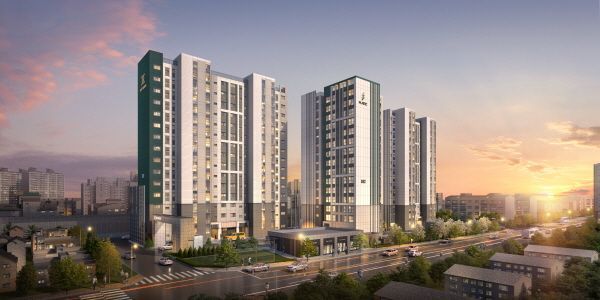
At the center of these development opportunities is "Ojeong Haemoro Smart City." This future-oriented residential complex features advanced design, convenient transportation access, and abundant living infrastructure, attracting attention from both end-users and investors alike.
The complex will be built in the Ojeong-dong area of Bucheon, consisting of three buildings ranging from two basement floors to 15 above-ground floors, with a total of 200 units. Of these, 47 units will be offered for general sale. All units are oriented mainly to the south or east to maximize sunlight and ventilation.
The interior layout adopts a 2BAY+LDK design to enhance space efficiency in the living room and kitchen. Notably, both rooms are large, offering a basic two-room configuration with an optional three-room layout, catering to a variety of lifestyles including one- to two-person households, newlyweds, and small families. With balcony expansion, features such as upper and lower kitchen cabinets, low-emissivity double-glazed windows, an electric laundry drying rack, built-in wardrobes, and a utility room are provided to enhance living convenience.
The location conditions are also excellent. Within a 2-kilometer radius, there are Homeplus, a traditional market, the City Northern Library, Ojeong Grand Park, a large hospital, and a 119 Safety Center. Nearby, educational facilities such as Deoksan Elementary, Middle, and High Schools, Dodang Elementary, Middle, and High Schools, and Bucheon North High School are concentrated, providing outstanding educational conditions. The complex is also adjacent to large-scale development areas such as Bucheon Daejang New Town, Wonjong Public Housing District, Ojeong Logistics Complex, and Ojeong General Industrial Complex, allowing residents to share residential, work, and cultural functions.
The transportation environment is also among the best in the western metropolitan area. Both Wonjong Station on the Seohae Line and the new station on the Daejang-Hongdae Line are within walking distance. Major metropolitan transportation projects such as the GTX-B Line, the undergrounding of the Gyeongin Expressway, and the Seoul-Gwangmyeong Expressway are also planned.
© The Asia Business Daily(www.asiae.co.kr). All rights reserved.












