Identical Products to IKEA Sold at Pyongyang’s Upscale Mall
Caf? “Mirae Reserve” Imitates Starbucks Reserve with Unique Logo
Payments in US Dollars Common; Prices Considered High
There have been reports from foreigners that not only are stores in North Korea modeled after brands like Starbucks and IKEA, but North Korean residents are also using applications similar to those in the West.
On the 24th (local time), The New York Times (NYT) reported this after obtaining videos from three recent visitors to North Korea: a Russian tourist, a Swedish marathon runner, and a Chinese student. NYT described these videos as "a rare glimpse into how this isolated country imitates the consumerism of the outside world."
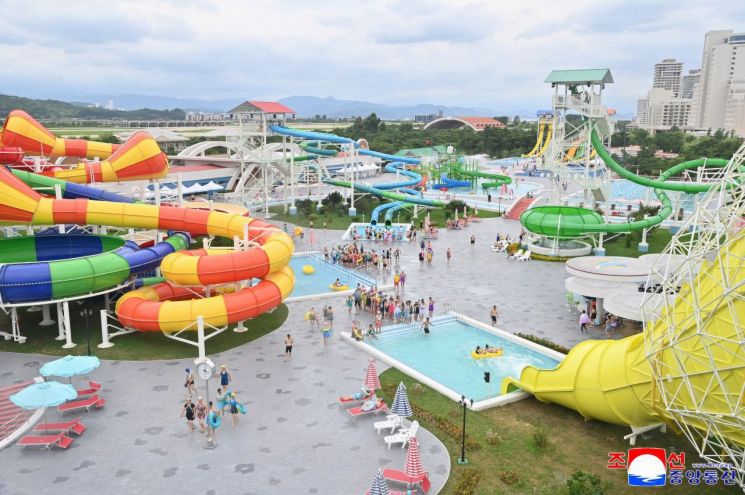 The Water Park at Wonsan Galma Coastal Tourist Area, which opened on the 1st of last month. Photo by Korean Central News Agency, Yonhap News Agency
Identical Products Sold as in IKEA Stores
A Chinese student studying language in Pyongyang said that one of the most luxurious places in the city is a multi-story shopping mall called 'Rangrang Aeguk Geumganggwan,' which sells furniture, kitchenware, and groceries. The student and fellow Chinese students referred to it as the 'North Korean IKEA,' as the store layout and products seemed to be direct copies of the Swedish furniture company IKEA. It is unclear whether these items are counterfeits or genuine products smuggled in, but some items, such as lamps and shades, appear to have identical product names and packaging as those sold in IKEA stores.
This shopping mall also features a caf? modeled after Starbucks' premium outlet, Starbucks Reserve, which is called 'Mirae Reserve' in North Korea. The logo, which typically features a star, has been stylishly transformed into the letter 'M.' The student said they usually paid for goods in US dollars and found prices in Pyongyang to be relatively high. They recalled, "I once paid 25 dollars (about 34,000 won) for three cups of coffee at Mirae Reserve."
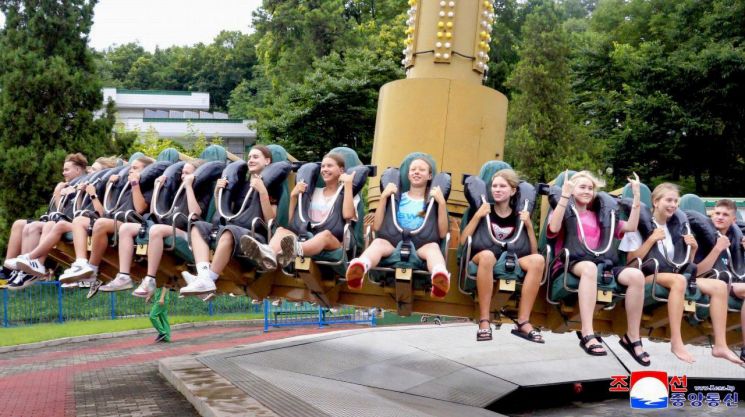 Russian student youth camp participants in the North Korea-Russia Youth Friendship Camp are riding amusement rides in North Korea on the 29th of last month. Photo by Korean Central News Agency, Yonhap News Agency
Street Vendors Prefer QR Payments Over Cash
Johan Nylander, a 53-year-old Swedish national living in Hong Kong who participated in the Pyongyang Marathon in April, said that most payments in the capital seemed to be made using mobile phones. He added, "Even small street vendors selling bottled water and juice prefer digital payments using QR codes over cash." He also noted, "North Korean residents' mobile phones have a variety of apps commonly seen around the world, such as for videos, text messaging, North Korean-style ride-hailing, and shopping."
NYT also shared the experience of Daria Zubkova, a 35-year-old Russian woman who recently visited the newly opened Wonsan Galma Coastal Tourist Area. Zubkova, one of the first foreign tourists to visit the area, said that while the trip was similar to previous beach vacations, there were some unique aspects. Zubkova, a veterinarian from Saint Petersburg, said North Korea had long been a country she wanted to visit, and she paid about 1,400 dollars (approximately 1.94 million won) for a week-long trip. She remarked that everything from the train that took her to the resort, to the hotel room, and the beach facilities appeared brand new, saying, "It looked like a place straight out of a picture."
The Russian tourists enjoyed jet skiing and barbecues on the beach accompanied by beers from the United States, Japan, and China. They also went shopping for Ugg boots, which she had been unable to buy in Russia due to not finding the right size.
NYT commented on these developments in North Korea by saying, "They are imitating their capitalist adversaries to mitigate the effects of international sanctions and secure cash." The report also explained that due to Western sanctions, it is forbidden for foreign brands to sell luxury goods or open joint ventures in North Korea.
© The Asia Business Daily(www.asiae.co.kr). All rights reserved.













