From Seafood to Vegetables and Fruits:
U.S. Food Industry Faces Tariff Backlash
"85% of U.S. Seafood Consumption Sourced Overseas"
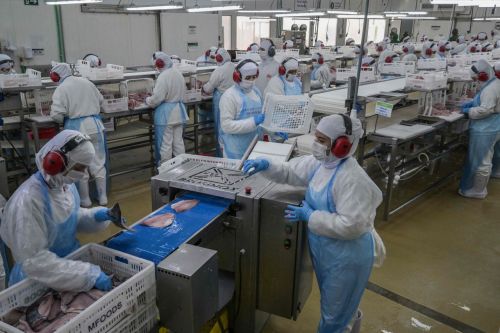 Workers are processing tilapia at a seafood company workshop located in Hipaina, Brazil. Photo by AFP
The Financial Times (FT) reported on August 24 (local time) that the U.S. food industry is urging the Donald Trump administration to exempt key items such as seafood, vegetables, and fruits from tariffs.
Gavin Gibbons, Chief Strategy Officer of the National Fisheries Institute (NFI), a seafood trade association, stated, "Seafood is fundamentally different from other foods," adding, "We want exemptions for the entire seafood category."
He cited the fact that 85% of seafood consumed in the United States is imported. For example, the U.S. imports 90% of its total shrimp consumption, with one-third of that coming from India. In this situation, if President Donald Trump imposes a 50% tariff on India for purchasing Russian crude oil, shrimp prices would rise to unaffordable levels.
He further explained that domestic seafood catches in the U.S. have already reached the maximum sustainable yield and cannot be increased further, and that expanding aquaculture is also difficult due to regulations. In fact, according to the Department of Commerce, the U.S. seafood trade deficit reached $24 billion (about 33 trillion won) as of 2022.
Rebecca Adcock, Vice President of Government Affairs at the International Fresh Produce Association (IFPA), an agricultural trade group, said, "We are requesting that fruits and vegetables be excluded from tariff discussions." The U.S. imports $36 billion (about 50 trillion won) worth of fruits and vegetables, much of which comes from Mexico, Peru, and Canada.
The Food Industry Association (FMI), whose member companies include Walmart and supermarket chain Albertsons, pointed out in a recent report that the import share of cucumbers surged from 35% in 1990 to 90% today. Producing 90% of cucumbers domestically would require year-round greenhouse cultivation, inevitably driving up prices. Andy Harig, Vice President at FMI, emphasized, "Tariffs are designed to increase prices," and added, "Some tariffs are significant enough to result in noticeable price hikes."
The National Restaurant Association (NRA) also sent a letter last month to Jamieson Greer, the U.S. Trade Representative, stating, "If tariffs are imposed on fresh ingredients that are only produced seasonally in the U.S., food prices will soar." The letter added, "Since food and beverage products are not categories in which the U.S. runs large deficits, we hope they will be exempted from tariffs."
However, FT reported that legal experts believe such tariff exemptions may be difficult to obtain, as there is no separate application process established for tariff relief.
© The Asia Business Daily(www.asiae.co.kr). All rights reserved.












