Gyeonggi Province Outlines Four Policy Directions Under Three Key Principles of Initiative, Forward-Thinking, and Local-Centered Approach, Says Governor Kim Dongyeon
Securing 300 Billion KRW Over 10 Years for Groundbreaking Development Fund
Investing 2.5 Trillion KRW in Transportation Infrastructure Improvements by 2040
Enhancing Investment Environment Through Regulatory Easing
Kim Dongyeon, Governor of Gyeonggi Province, stated that "the development of returned concession areas is not just 'compensation for sacrifice,' but an 'investment' that creates a new growth engine for the Korean economy." He outlined specific policy directions for the development of returned concession areas, including the establishment of a development fund totaling 300 billion KRW, the construction of nine new provincial road routes to improve transportation infrastructure, and preemptive regulatory reforms.
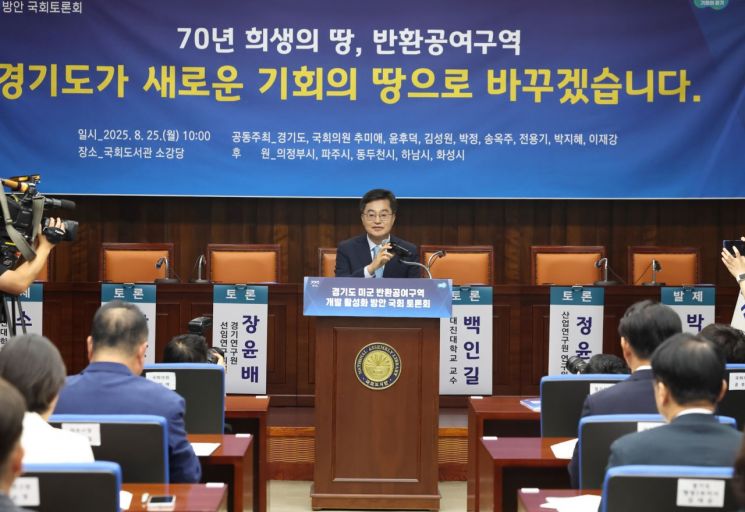 Governor Kim Dongyeon is delivering a greeting at the National Assembly Library Small Auditorium on the 25th during the National Assembly forum on "Measures to Revitalize Development of US Military Returned Land." Provided by Gyeonggi Province
On the 25th, at the National Assembly Library Small Auditorium during the National Assembly forum on "Measures to Revitalize the Development of US Military Returned Concession Areas," Governor Kim Dongyeon said, "The issue of returned concession areas, which had long remained stagnant, has made significant progress under the people's sovereignty government. This is because the President has shown special interest by instructing a forward-thinking review of the returned concession area issue." He added, "Gyeonggi Province, together with the people's sovereignty government, will take the lead in developing the returned concession areas in cooperation with five cities to ensure 'special compensation for special sacrifice.'"
He continued, "Gyeonggi Province has established three key principles for the development of returned concession areas: initiative, forward-thinking, and a local-centered approach. This means Gyeonggi Province will take the lead, act proactively, and focus on the local context, rather than shifting responsibility to the central government." He then presented four policy directions for Gyeonggi Province regarding the development of returned concession areas.
First, Governor Kim said, "We will make a groundbreaking financial investment at the provincial level," adding, "We will secure 300 billion KRW over the next 10 years to create the 'Gyeonggi Province USFK Returned Concession Area Development Fund,' which will be used for land acquisition and the construction of infrastructure such as roads and parks."
Second, he pledged to significantly expand transportation infrastructure linked to the returned concession areas, proposing to invest 2.3 trillion KRW in northern Gyeonggi by 2040 for the construction of nine new provincial road routes, efforts to extend the KTX Paju Munsan line and the GTX-C Dongducheon line as part of the 5th National Railroad Network Plan, and other infrastructure expansion projects.
Governor Kim remarked, "Transportation is the lifeblood that brings stagnant regions back to life," and added, "Last week, I directly contacted the Deputy Prime Minister for Economic Affairs and the Second Vice Minister of the Ministry of Economy and Finance to discuss this matter. We agreed to proceed quickly in line with the new government's policy direction."
Third, he presented concrete plans to improve the investment environment through preemptive regulatory easing.
Governor Kim emphasized, "Gyeonggi Province will revise its own guidelines and ordinances to reduce the ratio of public rental housing in urban development projects within Green Belt (GB) zones from 50% to 35%. In addition, to further promote investment, we will expand the exemption from real estate acquisition tax in returned concession areas from startups and small and medium-sized enterprises to include mid-sized companies, large corporations, and public institutions."
Fourth, he stated that the province would cooperate with the National Assembly and the central government to improve laws and systems, saying, "For long-term unreturned concession areas such as Dongducheon and Uijeongbu, we will promote the enactment and revision of laws to ensure that the state takes responsibility and prepares special compensation measures." He also expressed his intention to work with the National Assembly and the central government to revise the "US Military Concession Area Act" as needed.
Governor Kim stressed, "The 22 returned concession areas in Gyeonggi Province will each have their own unique characteristics, with some becoming business cities, some cultural cities, and others ecological cities. This will transform the lives of residents, change the identity of cities, and serve as a catalyst for redrawing the maps of northern Gyeonggi and Korea." He added, "As the primary partner in national governance, Gyeonggi Province will work closely and take the lead with the central government to ensure the successful development of returned concession areas."
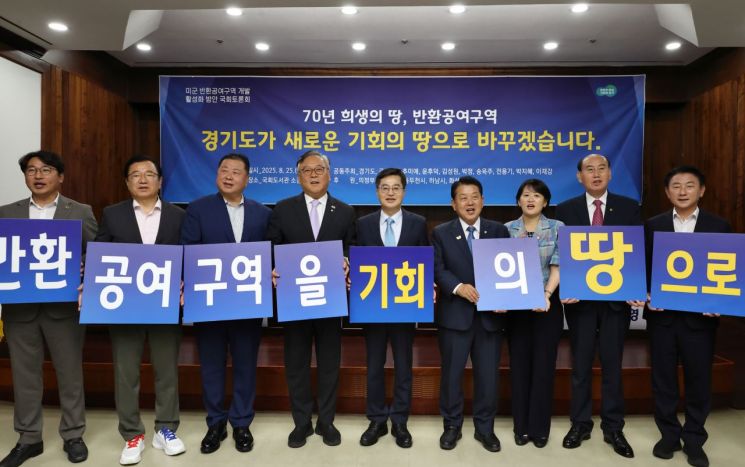 Governor Kim Dongyeon and mayors and county heads of northern Gyeonggi are taking a commemorative photo after the National Assembly forum on "Measures to Revitalize the Development of US Military Returned Concession Areas," held on the 25th at the National Assembly Library Small Auditorium. Provided by Gyeonggi Province
There are a total of 34 returned concession areas in Gyeonggi Province (173 square kilometers, 52.18 million pyeong), accounting for 96% of such areas nationwide. Of these, 22 areas (21.93 million pyeong) are ready for development. This is equivalent to 25 times the size of Yeouido, making the issue of returned concession areas essentially a Gyeonggi Province issue.
The forum was attended by over 120 people, including Governor Kim Dongyeon, the mayors of Uijeongbu, Paju, Dongducheon, and Hanam, Cho Sunghwan, Chair of the Gyeonggi Provincial Council's Planning and Finance Committee, Provincial Assemblyman Lee Honggeun, and other city and county officials. Participants discussed ways to improve laws and systems and promote development to resolve regional imbalances caused by prolonged delays in the return of these areas and various regulations.
For the keynote presentations, So Sungkyu, Vice President of Daejin University, presented "Development Strategies for Northern Gyeonggi through USFK Returned Concession Areas," and Park Soyoung, Research Fellow at the Korea Research Institute for Human Settlements, presented "Legal and Institutional Improvements to Promote the Activation of US Military Returned Concession Areas." The subsequent general discussion was chaired by Kim Sangbong, Professor at Korea University. The discussants agreed that Gyeonggi Province should take the initiative and that customized development, institutional improvements, and financial support tailored to the characteristics and needs of each region should be implemented in parallel.
Gyeonggi Province plans to swiftly implement financial support, infrastructure expansion, and regulatory easing measures that can be pursued independently by the province. Through these efforts, the province aims to build public consensus, strengthen practical implementation systems by collaborating with relevant ministries and the National Assembly to improve laws, systems, and secure financial support. In particular, the plan to establish a fund at the provincial level to support returned concession areas is the first such case for a local government, demonstrating Gyeonggi Province's strong commitment and receiving a positive response from residents.
The forum, co-hosted by Gyeonggi Province and eight National Assembly members representing regions with returned concession areas (Choo Mi-ae, Yoon Hu-deok, Park Jung, Kim Sungwon, Song Okju, Jeon Yonggi, Park Ji-hye, and Lee Jaekang), was organized to seek feasible development strategies for Gyeonggi Province in a situation where, for over 20 years since the return of US military concession areas, development has been delayed, causing ongoing inconvenience for local residents and stagnation of the regional economy.
© The Asia Business Daily(www.asiae.co.kr). All rights reserved.













