Wi Sung-rak's Briefing on the Korea-Japan Summit
Early Restoration of Shuttle Diplomacy, Strong Message of Trilateral Cooperation
Korea and Japan Leaders Build Rapport and Trust During 3 Hours and 30 Minutes of Talks
Small-Group Meeting Las
National Security Advisor Wi Sung-rak evaluated the Korea-Japan summit between President Lee Jaemyung and Japanese Prime Minister Shigeru Ishiba, which lasted longer than expected on the previous day (the 23rd), as highly significant for the early restoration of shuttle diplomacy between the two countries and for proactively delivering a message of strengthened trilateral cooperation among Korea, the United States, and Japan. He also noted that through small-group talks, expanded meetings, a friendship dinner, and social events involving the leaders and their spouses, the two leaders spent more time together than anticipated, deepening their personal rapport and trust.
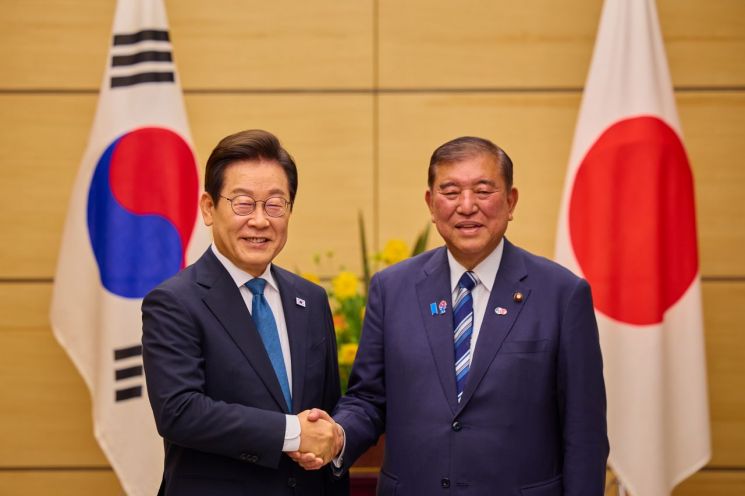
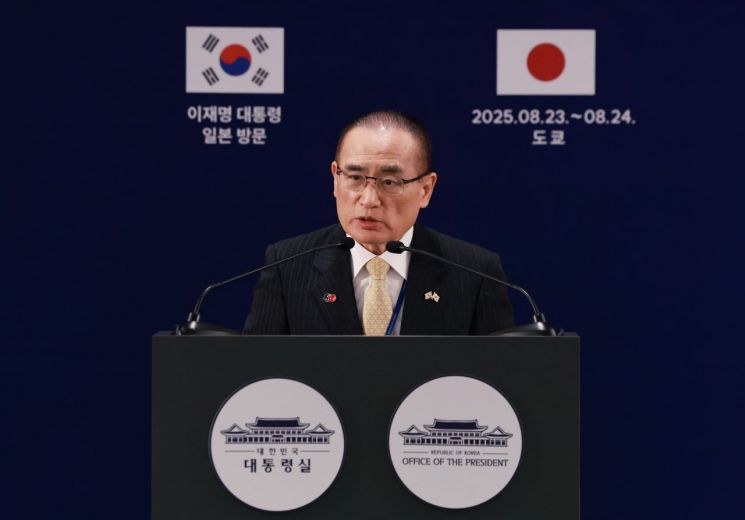
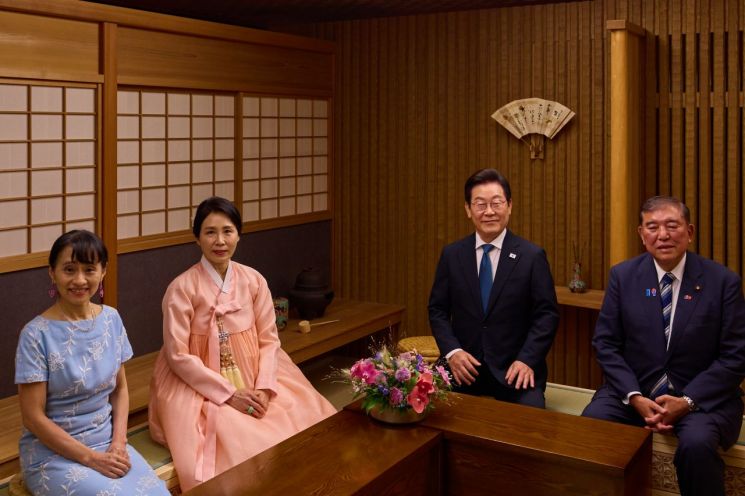
On the 24th, Advisor Wi held a briefing at the press center in Tokyo, Japan, where he assessed the outcome of the Korea-Japan summit in these terms. The small-group and expanded meetings, which covered a wide range of bilateral issues, lasted 113 minutes. The small-group meeting was originally scheduled for 20 minutes but extended well over an hour. Including the subsequent friendship dinner and the "2+2 leaders and spouses social event" held in a traditional Japanese tatami room, the total time the two leaders spent in conversation reached about three hours and thirty minutes. During their discussions, Prime Minister Ishiba reportedly brought the Japanese translation of President Lee's autobiography, The Dream That Brought Me Here, and asked for his signature.
Advisor Wi explained, "The reason the talks were extended was because of the candid and open discussions," adding, "In the expanded meeting, the leaders exchanged views on a wide range of topics, including the overall Korea-Japan relationship, cooperation measures, and regional and global affairs." He further elaborated, "The fact that the two leaders met again after just two months and held such lengthy talks demonstrates that both recognize the rapidly changing international situation and the many joint challenges requiring cooperation, and that they engaged in dialogue while further strengthening their personal ties."
With the agreement to expand shuttle diplomacy to the working-level, the establishment of a consultative body to jointly address common issues is expected to accelerate. According to the joint press statement released after the summit, the two leaders agreed on the need to work together on common social challenges such as low birth rates and aging populations, population decline, regional revitalization, population concentration in metropolitan areas, agriculture, and disaster prevention. They also agreed to launch an intergovernmental consultative body to share policy experiences and seek joint solutions.
During this process, the two leaders also discussed similarities in their political careers. President Lee was noted for his strong interest in regional development, and his style as a politician who constantly takes on challenges in difficult circumstances was highlighted. In particular, President Lee was also described as someone who is willing to speak his mind and take bold action when necessary, even if his views differ from the mainstream, which was cited as another similarity. Advisor Wi stated, "In this atmosphere, the leaders agreed to expand cooperation in various fields alongside shuttle diplomacy," and added, "There was also discussion about the need to consider measures such as operating dedicated immigration counters to expand people-to-people exchanges, including working holiday programs."
It is also noteworthy that by visiting Japan ahead of the Korea-U.S. summit, President Lee raised expectations for improved Korea-Japan relations and strengthened trilateral cooperation. The two leaders devoted considerable time in their talks to discussing the direction of cooperation among Korea, the United States, and Japan, including Korea-U.S. and U.S.-Japan relations, with particular attention to negotiations on U.S. tariffs.
Advisor Wi explained, "In the past, when Korea-Japan relations were not good, the United States often took the lead in promoting trilateral cooperation. This time, however, we took the initiative by visiting Japan first and then the United States. The Japanese side recognized this as evidence that we value the Korea-Japan relationship and that President Lee has a strategic perspective."
'Ishiba Curry', 'Andong Soju', and 'Tottori Beer' Served at the Leaders' Dinner Table
The dinner held immediately after the summit featured food and drinks symbolizing the desire for stronger Korea-Japan cooperation. The Japanese side served so-called "Ishiba Curry," which Prime Minister Ishiba reportedly ate throughout his four years at university, as well as "Andong Jjimdak" (braised chicken), and Korean-style grilled eel topped with kimchi. For beverages, "Andong Soju" and beer from Tottori Prefecture, Prime Minister Ishiba's hometown, were served side by side. White peaches from Okayama, which are known to be President Lee's favorite, were also offered.
Advisor Wi commented, "Looking at the dinner menu, there were many elements related to Korea, showing consideration for Korea and a desire for Korea-Japan cooperation and reconciliation. The conversation topics included the joys and sorrows of politicians' families and various ways politicians communicate with the public, with many stories about social media (SNS) discussed."
Meanwhile, Advisor Wi explained that the preparation of the joint press statement on the Korea-Japan summit was carried out at the direction of President Lee. It was the first time in 17 years that the results of a summit were announced in document form. The "Kim Dae-jung-Obuchi Declaration" in 1998 and the "Roh Moo-hyun-Koizumi Declaration" in 2003 were both issued during state visits to Japan. Since then, joint press statements have often been replaced by joint press conferences.
Advisor Wi stated, "Because this summit was arranged rather quickly, the working-level officials initially agreed not to produce a joint document this time, but after President Lee was briefed, he instructed that, since this was a rare opportunity to resume shuttle diplomacy, it would be better to create a joint document. The working-level officials then consulted again with the Japanese side, and as a result, the statement was issued." However, he noted that there was no significant progress on a second "Kim Dae-jung-Obuchi Declaration" or on cooperation for the denuclearization of the Korean Peninsula, which had attracted attention during the summit. Although these topics were included in the joint press statement, the short preparation time limited the scope of what could be addressed in detail.
© The Asia Business Daily(www.asiae.co.kr). All rights reserved.














