"The Government's Duty to Protect Lives and Safety Includes Overseas Koreans"
Mention of the Kanto Massacre: "I Will Build a Nation Free from State Violence Against Human Rights"
Assessment: "Korea-Japan Relations Are Moving Toward a New Future"
Korean Residents in Japan: "Cooperation and Friendship Between Korea and Japan Are Essential"
This Is the First Time a Korean President Has Chosen Japan as the First Bilateral Visit Destination
During his visit to Japan for the Korea-Japan summit, President Lee bowed his head and apologized to Korean residents in Japan who suffered from espionage fabrication cases orchestrated by past South Korean governments. The espionage fabrication case mentioned by President Lee refers to the 1975 incident in which Kim Ki Chun, then Director of the Anti-Communist Investigation Bureau of the Korean Central Intelligence Agency, led the fabricated indictment of 21 Korean residents in Japan on espionage charges. These individuals were later acquitted in a retrial.
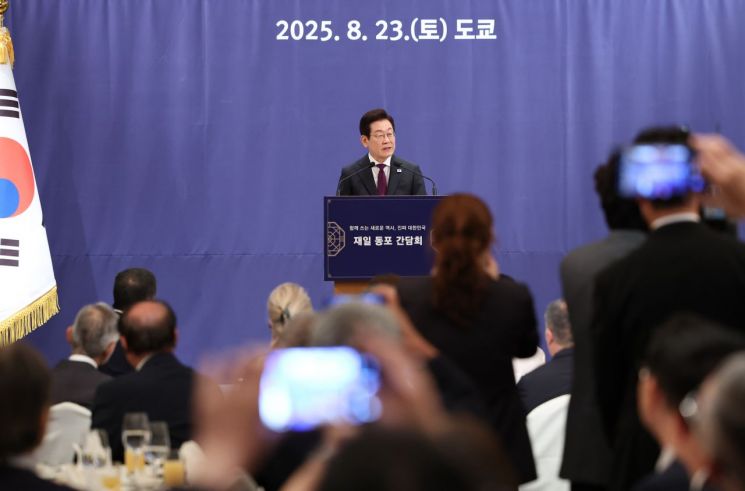 President Lee Jae Myung is speaking at a luncheon meeting with Korean residents in Japan held at a hotel in Tokyo on the 23rd. Photo by Yonhap News
At a luncheon with Korean residents in Japan held at a hotel in downtown Tokyo on the 23rd, President Lee began by saying, "There are shameful and painful chapters in our history that we must confront." He continued, "Throughout the great journey of democratization, many, truly many Korean residents in Japan suffered unjustly as victims of fabricated espionage cases. As the President of the Republic of Korea, I sincerely offer my condolences to the victims and their families of state violence, and I would like to officially apologize once again." President Lee bowed his head as he spoke. The Korean residents in attendance responded with applause.
President Lee's first official engagement after arriving at Haneda Airport in Tokyo on the morning of the 23rd was to meet with Korean residents in Japan. The luncheon was attended by more than 200 Korean residents, including Kim I Joong, head of the Korean Residents Union in Japan (Mindan), as well as President Lee, First Lady Kim Hye Kyung, National Security Advisor Wi Sung Rak, Policy Chief Kim Yong Beom, and Ambassador-designate to Japan Lee Hyuk.
At the event, President Lee also addressed the historical Kanto Massacre. He stated, "We will never forget the tragic events that took place along the Arakawa River 100 years ago, nor the souls of those whose remains are still scattered throughout Japan, unable to return to their homeland." He pledged, "I will do my utmost to build a nation where state violence against human rights never happens again, and a strong country that guarantees the safety and daily lives of its people." President Lee also emphasized, "The government's responsibility to protect the lives and safety of its people extends to overseas Koreans as well. We will pay special attention to ensuring the safety and rights of overseas Koreans and move forward together toward a country where everyone can prosper."
President Lee added, "On the occasion of the recent 80th Liberation Day, I was especially moved when remembering the noble sacrifices of our patriotic ancestors, and in particular, I thought of the Korean residents in Japan." He mentioned the February 8 Declaration of Independence and the independence movement. President Lee said, "I am deeply moved to see the traces of your passionate lives embedded throughout central Tokyo. At every turn in Korea's tumultuous history, the dedication and sacrifice of our compatriots have been present."
He went on to say, "Despite the pain of colonial rule and subsequent division, Korean residents in Japan have always been steadfast supporters and pillars for their homeland. I have heard that 9 out of 10 Korean diplomatic missions in Japan today were established thanks to the donations of Korean residents in Japan."
Regarding Korea-Japan relations, President Lee assessed that the two countries are moving toward a new future. He said, "As neighbors sharing the same yard, 12 million people travel between the two countries every year. The bilateral trade volume, which was $220 million in 1965, has increased 350 times to $77.2 billion in 2024. Ddeokbokki, gimbap, samgyeopsal, and chimaek are no longer just Korean foods, and on the Japanese side, people are learning, feeling, and experiencing Korea through K-beauty and pop culture."
Earlier, Kim, head of Mindan, welcomed President Lee by saying, "From the first-generation seniors who contributed to Korea's modernization and economic development, we are now into the fourth and fifth generations. Now that Korea has become a proud advanced nation, cooperation and friendship between Korea and Japan are more essential than ever for a brighter future. Korean organizations will unite and continue to work tirelessly." This marks the first time in history that a Korean president has chosen Japan as the destination for his first bilateral visit.
© The Asia Business Daily(www.asiae.co.kr). All rights reserved.