Choi Cites South Korea-U.S. Summit
Questions How the United States Will View the Broadcasting Laws
On August 21, Choi Hyungdu, a member of the People Power Party, became the first speaker to launch a filibuster (unlimited debate) to block the passage of the amendment to the Korea Educational Broadcasting System (EBS) Act. He criticized the changes to the broadcasting governance structure, warning that it could become a case of "gyogaksalwoo" (killing the cow while trying to fix its horn).
Choi Hyungdu, who serves as the People Power Party's secretary on the National Assembly's Science, ICT, Broadcasting, and Communications Committee, began his filibuster after the EBS Act amendment was introduced to the plenary session. The amendment proposes increasing the number of EBS board members from nine to thirteen and diversifying the recommending bodies. Along with the amendments to the Broadcasting Act and the Foundation for Broadcast Culture Act, which passed the plenary session after previous filibusters ended, this bill is referred to as one of the 'three broadcasting laws.'
Earlier, Kim Wooyoung, a Democratic Party lawmaker on the same committee, explained the bill before Choi began his filibuster, stating, "The purpose is to guarantee EBS's independence, political neutrality, and rational management," and "to expand the board of directors to reflect representation from various sectors of society and to make the process of appointing the president more democratic and transparent."
Choi stated, "The reason the EBS Act has remained unchanged up to the 21st National Assembly is not because previous lawmakers were ignorant, lazy, or pursuing partisan interests. It is because this is the global standard," adding, "I have repeatedly explained the global standard to my fellow lawmakers in the committee, but the ruling party harshly criticized it, saying, 'We don't care about the global standard; we need to change it because the Yoon Suk Yeol administration has done so poorly.'"
He continued, "If that's the case, then don't repeat the mistakes of the previous ruling party and simply follow the established principles. Why go out of your way to make public broadcasting deviate even further from the global standard?" he emphasized.
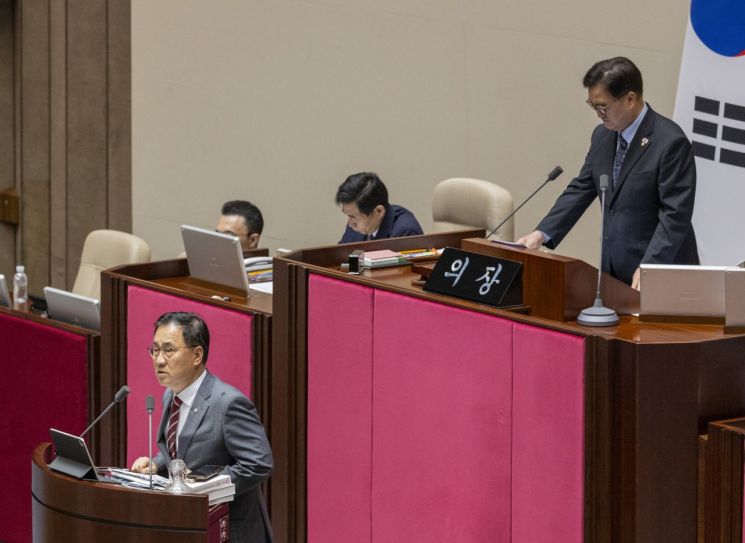
He also raised issues regarding the democratic representation in the changes to the governance structure, such as the new board member recommendation criteria. Choi said, "Is it acceptable to hand over terrestrial broadcasting, which is public property, and the people's broadcasting to those who have not been entrusted by the people? This is a direct violation of Article 1 of the Constitution," adding, "To restore public broadcasting as a fair broadcaster for the people, changing the governance structure alone is not enough. What matters is that we manage it better; simply changing the law will not improve things."
He also argued that the structure of the supplementary provisions in the revised Broadcasting Act closely resembles those of the National Security Legislative Council Act (Gukbowi Act), which was ruled unconstitutional by the Constitutional Court in 1989, and that retroactive legislation raises serious constitutional concerns. After explaining his background in the media labor union, Choi claimed, "(The three broadcasting laws) are intended for the media union of the Korean Confederation of Trade Unions (KCTU) and the broadcasting union to control broadcasting companies."
Specifically regarding the EBS Act, he criticized, "By increasing the number of representatives from teachers' organizations on the board from one to two, a complicated provision was inserted to include the Korean Teachers and Education Workers Union (Jeon-gyo-jo). If this law passes, Democratic Party lawmakers will be shunned by teachers nationwide. They will think, 'This law was made for Jeon-gyo-jo.'"
Choi further argued that the passage of the three broadcasting laws would draw criticism from the international community. Referring to the upcoming South Korea-U.S. summit scheduled for August 25 (local time), he said, "If such issues (the three broadcasting laws) are raised in the United States, what will Americans think?" and emphasized, "If the international community begins to suspect that 'this country is deviating from universal values' or 'trying to shake the freedom of the press,' then the authority of our president will be undermined during the summit."
© The Asia Business Daily(www.asiae.co.kr). All rights reserved.












