The Ministry of Land, Infrastructure and Transport announced on the 21st that it will complete the development of a 5th generation mobile communication (5G)-based airspace network (CNSi) within this year as part of its preparations for the commercialization of urban air mobility (UAM).
The airspace network, abbreviated from Communication, Navigation, and Surveillance information, is a system that helps aircraft determine their position, prevent collisions, and safely reach their destinations in the sky. In 2022, South Korea became the first in the world to secure 5G airspace network technology through national research and development. The Ministry stated that the first phase of development will be completed this year, with plans for further advancement in the future.
A Virtual Integrated Platform (VIPP) will also be established. VIPP enables the simulation of real-world flight scenarios in a virtual environment, allowing for the prevention of accidents and pre-verification of traffic management and safety inspection systems. In addition, the K-UAM Grand Challenge will proceed as scheduled. This demonstration program allows both the public and private sectors to jointly inspect and improve essential elements for commercialization, such as aircraft, operations, and traffic management, directly in the field.
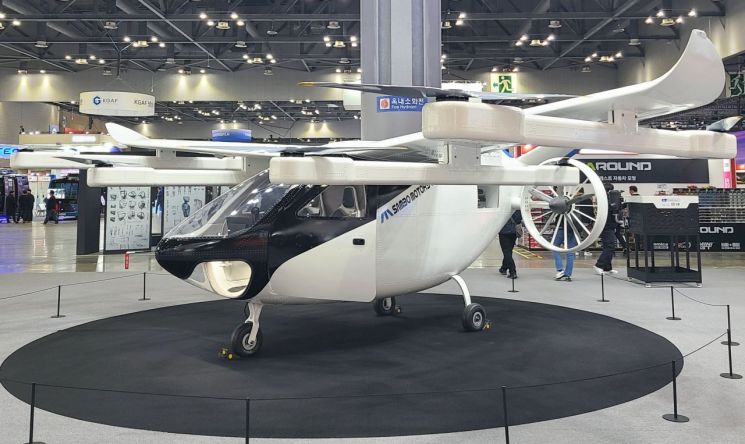 A hydrogen fuel cell hybrid urban air mobility (UAM) vehicle from Sambo Motors Group is exhibited at the 2025 Seoul Mobility Show held in April this year. Photo by Yonhap News
The Ministry will hold an information session on the 22nd at the Korea Aerospace Research Institute in Daejeon for representatives from 11 local governments. The Ministry believes that, in addition to visible aircraft, various foundational elements-such as safety operation systems, vertiports to facilitate takeoff and landing, and pre-verification systems-must be established first.
The session will emphasize that local governments must consider the characteristics of their regional airspace, weather conditions, infrastructure layout, safety inspection systems, and strategies for securing community acceptance when preparing for UAM projects. Plans for utilizing local government cooperation will also be explained.
Kim Hongmok, Director-General of Mobility and Automotive Policy at the Ministry, stated, "For UAM to operate safely in practice, a robust AI-based operation system-though invisible-will determine the success or failure of the UAM era. This will be the starting point for cooperation that combines government technological capabilities with regional expertise to create safe and efficient UAM services."
© The Asia Business Daily(www.asiae.co.kr). All rights reserved.











