An "integrated smart air purification system" capable of rapidly detecting and removing harmful substances in the air, such as fine dust, has been developed.
The Korea Institute of Industrial Technology (KITECH) announced on August 20 that a research team led by Principal Researcher Seongjun Do from the Fiber Solutions Division has developed the "HAPs-Solver (Hazardous Air Pollutants Solution)," which can remove hazardous gases and ultrafine dust, as well as detect airborne pathogens in real time.
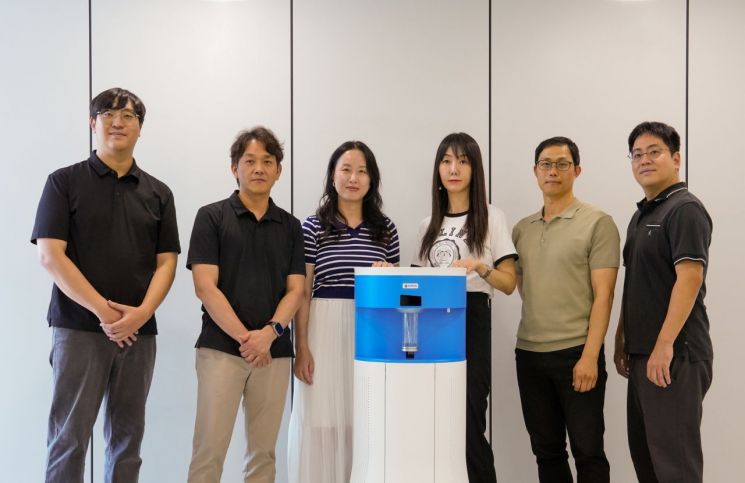 (From left) Kyudong Lee, Seongjun Do, Aeyeon Kang, Juran Kim, Junho Hyeong, Woosung Lee. Provided by Korea Institute of Industrial Technology
Hazardous gases, fine dust, and pathogens differ in particle size, chemical properties, and how they remain suspended in the air, so separate technologies and devices have traditionally been required for air purification. In contrast, the HAPs-Solver developed by the research team offers the advantage of purifying air with a single integrated product.
First, to effectively capture airborne pathogens, the team applied a self-designed and manufactured "high-performance cyclone-based collector" at the top of the system.
This collector features a self-rotating cone structure that generates strong centrifugal force, pushing fine airborne particles toward the outer wall and collecting them in liquid form.
The collected liquid is then analyzed using "surface-enhanced Raman spectroscopy (SERS) immunoassay" technology on a gold nanostructure, precisely measuring the Raman signals generated by antigen-antibody binding and converting them into data. The converted data is then analyzed using a digital counting technique and data analysis method devised by the team, enabling detection of even trace amounts of pathogens. The entire process from collection to analysis takes less than 150 minutes.
The lower part of the HAPs-Solver is equipped with a filter to remove hazardous gases. This hazardous gas removal filter is a metal-organic framework (MOF)-based fiber filter that can adsorb up to 99.9% of ammonia, formaldehyde, and hydrogen sulfide.
To block ultrafine dust, the team applied a self-developed ePTFE membrane composite filter. The ePTFE (expanded polytetrafluoroethylene) membrane is an ultrafine filtration membrane with a micro-porous structure. The researchers succeeded in creating a multi-layer composite filter by combining this with melt-blown nonwoven fabric.
The developed filter blocks more than 99.9% of ultrafine dust while maintaining high durability and air permeability, ensuring filtration performance is sustained even during prolonged use.
Principal Researcher Seongjun Do stated, "The HAPs-Solver is an integrated solution that can manage various airborne hazardous substances within a single system," adding, "We plan to conduct further demonstrations so that it can be practically utilized in multi-use facilities such as nursing homes and daycare centers in the future."
© The Asia Business Daily(www.asiae.co.kr). All rights reserved.












