A recent study has found that the Mugunghwa, Korea’s national flower, has the most remarkable carbon absorption capacity among small trees. In addition to its cultural symbolism, this scientific evidence demonstrates that the Mugunghwa plays a significant role as green space in urban areas for achieving carbon neutrality.
The Korea National Arboretum and Garden Management Service (hereafter referred to as KNAGMS) announced on August 19 that it had produced these research results in collaboration with the National Institute of Forest Science.
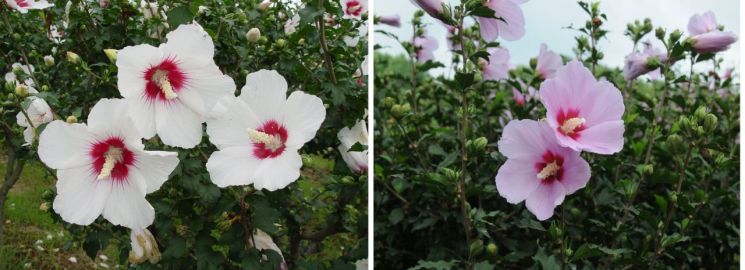 Comparison photo of Mugunghwa watercolor (left) and Chilbo (right). Provided by Korea National Arboretum and Garden Management Agency.
This research was conducted as part of a project to develop carbon absorption coefficients aimed at enhancing carbon uptake in green spaces such as gardens and urban forests. The purpose is to quantitatively assess the carbon absorption of shrubs commonly planted in urban green spaces and utilize this data to maximize the effect of carbon neutrality.
The joint research team selected two Mugunghwa varieties for the study based on a public preference survey by the National Institute of Forest Science: ‘Wonhwa’ (41%), which has white petals with a red center, and ‘Chilbo’ (21.6%), which has pink petals with a red center.
The study found that a single 15-year-old Mugunghwa tree (Chilbo variety) absorbs an average of 0.37 kg of carbon per year, which is 6 to 7 times higher than the previously registered national coefficients for Euonymus japonicus (0.05 kg) and Euonymus alatus (0.06 kg). Until now, Euonymus japonicus and Euonymus alatus have been recognized as species with excellent carbon absorption among small trees.
The Mugunghwa was also found to store 5.5 to 8.5 times more total carbon than other shrub species. This represents the highest level of carbon absorption ability among 15-year-old small trees studied to date.
KNAGMS plans to use these research findings as scientific evidence in future national forestry policies and projects to expand carbon sinks, such as the creation of Mugunghwa gardens and street tree avenues by public institutions.
KNAGMS expects that, as a result of this study, if the Mugunghwa is more widely used in urban forests and gardens, it will enhance both its cultural value as the national flower and its effectiveness in carbon absorption.
Shim Sangtaek, Chairman of KNAGMS, said, "This study is significant in that it scientifically proves the Mugunghwa’s practical contribution to carbon neutrality in everyday environments, in addition to its symbolic value as the national flower," adding, "KNAGMS will seek ways to make the Mugunghwa more familiar to the public and to establish it as a symbol of hope in the face of the climate crisis by expanding its use."
© The Asia Business Daily(www.asiae.co.kr). All rights reserved.












