"Large-Scale Deployment of National Guard to Washington D.C.; Preparations for Armament"
Measures to Strengthen Control Over Democratic-Leaning Major Cities
Concerns Over "America's Economic Engines Losing Power"
There is growing criticism of a series of actions taken by U.S. President Donald Trump, including the deployment of hundreds of National Guard troops to Washington, D.C. Analysts suggest that the stated justification of maintaining public order is merely a pretext, and that these moves are aimed at pressuring Democratic-leaning areas to weaken their political influence.
According to the Wall Street Journal (WSJ) on the 17th (local time), more National Guard troops are heading to Washington, D.C. than initially reported, and they are reportedly preparing to be armed.
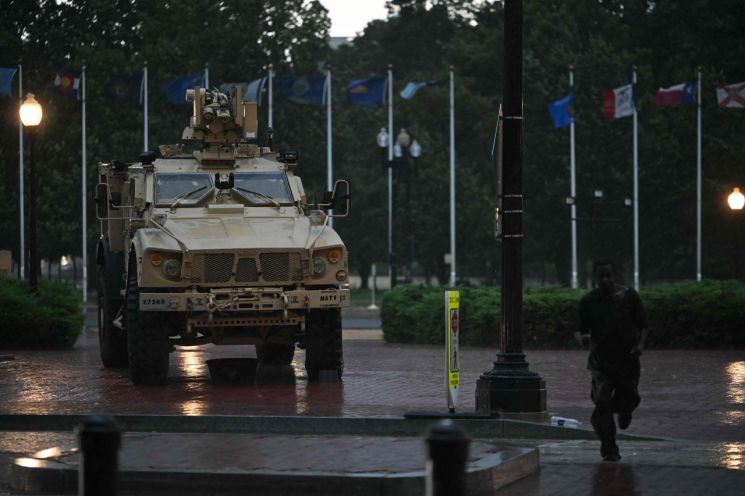 On the 17th (local time), a National Guard vehicle was caught in the rain in front of Union Station in Washington D.C. President Trump announced on the 11th that the National Guard and others would be deployed to suppress violent crime in Washington. The day before, three states with Republican governors announced they would send up to 750 National Guard members to Washington D.C. Photo by AFP Yonhap News
According to officials, some of the troops deployed to Washington, D.C. have been ordered to prepare to carry weapons. The initial deployment of 800 troops was intended to be unarmed, but late at night on the 15th, they were notified that they could soon be armed.
The day before, three states with Republican governors-West Virginia, South Carolina, and Ohio-announced plans to send 300 to 400, 200, and 150 National Guard members, respectively, to Washington, D.C.
President Trump claimed on the 11th that the large-scale deployment of National Guard troops to Washington, D.C. was necessary because the area was plagued by crime. However, violent crime in Washington, D.C. actually fell to its lowest level in 30 years last year, with a 35% decrease compared to the previous year, contradicting President Trump's claims.
So far, the National Guard has only been involved in administrative and logistical support, as well as patrols, rather than actual law enforcement duties such as making arrests. However, there are concerns that military forces could become more directly involved in maintaining public order.
However, experts such as Joseph Nunn, an attorney with the National Security Program at the Brennan Center for Justice, believe that President Trump will find it difficult to deploy the National Guard in other regions as he did in Washington, D.C. Washington, D.C. is a unique case where the President, not a governor, has command authority over the National Guard. In states like New York, deploying the National Guard to address crime would likely face opposition from Democratic governors.
But this is not all. Earlier this month, President Trump also attempted to redraw federal congressional districts in Texas, aiming to increase the number of Republican seats in next year’s midterm elections. He also ordered a new population census that excludes undocumented immigrants, even though it was not the regular census period. Foreign media outlets have analyzed these moves as efforts to manipulate government statistics and redistricting in favor of the Trump administration.
In June, there was also a large-scale immigration crackdown in Los Angeles (LA), a city with strong Democratic support. When protests erupted in response, Trump ordered the deployment of the National Guard.
These actions are seen as attempts by President Trump to strengthen his control over major cities with Democratic leanings that oppose his policies. Although Trump performed better in the 2024 presidential election than before, the majority of large cities still remain Democratic strongholds.
Experts warn that President Trump, who is hostile toward major cities, views these centers of innovation not as assets for national competitiveness, but as potential adversaries. They argue that weakening the functions of major cities could undermine America’s competitiveness in the long term. CNN pointed out the economic side effects, noting that after the immigration crackdown in LA, the number of private sector workers in California decreased by 750,000.
Mark Muro, Senior Fellow at Brookings Metro, commented, "Cities, which are the engines of the U.S. economy, are being weakened and treated like colonial outposts," adding, "(The Trump administration) sees cities as a problem, but they are the core foundation for competing with countries like China and others."
© The Asia Business Daily(www.asiae.co.kr). All rights reserved.












