Reducing Plastic in System Air Conditioner Manufacturing
900g Less Plastic Per Unit
Sequential Application to Future Residential and Commercial Models
LG Electronics is reducing carbon emissions by applying a manufacturing process that decreases plastic usage in its system air conditioners.
On August 17, LG Electronics announced that it has recently received verification from the global testing and certification body TUV Rheinland that its commercial 4-way system air conditioner reduces carbon dioxide emissions by 14.85 kg (kgCO₂eq, a value converting greenhouse gas emissions to carbon dioxide equivalents) per unit.
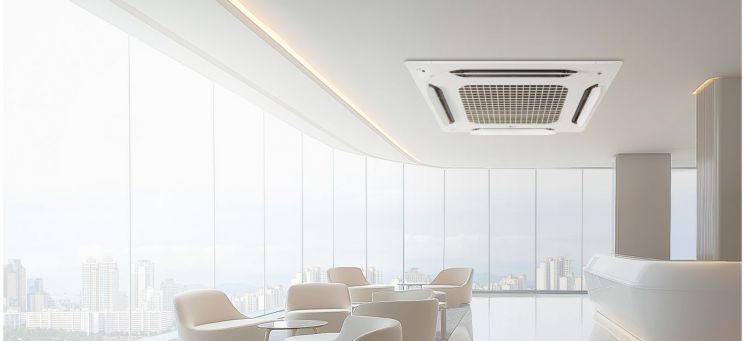 A commercial 4-way system air conditioner verified by the global testing and certification body TUV Rheinland to have reduced carbon dioxide emissions by 14.85 kg (kgCO₂eq) per unit. LG Electronics.
The key to this reduction in carbon emissions lies in changes to both the manufacturing process and materials used for the exterior panel of the system air conditioner. For the first time, LG Electronics introduced a "physical foaming molding" process, which injects nitrogen gas to create bubbles inside the material, instead of conventional plastic manufacturing methods. This innovation reduces plastic usage by approximately 900 grams per 4-way system air conditioner unit.
To implement this process, the plastic material was also changed from ABS (acrylonitrile butadiene styrene) to PP (polypropylene), which has a lower carbon dioxide emission footprint.
With these changes in manufacturing process and materials, the verified system air conditioners from LG Electronics are expected to reduce plastic usage by about 270 tons and carbon dioxide emissions by more than 4,400 tons (tCO₂eq) during production. This amount of carbon dioxide is equivalent to what a 30-year-old pine forest covering an area the size of more than 580 soccer fields would absorb in one year.
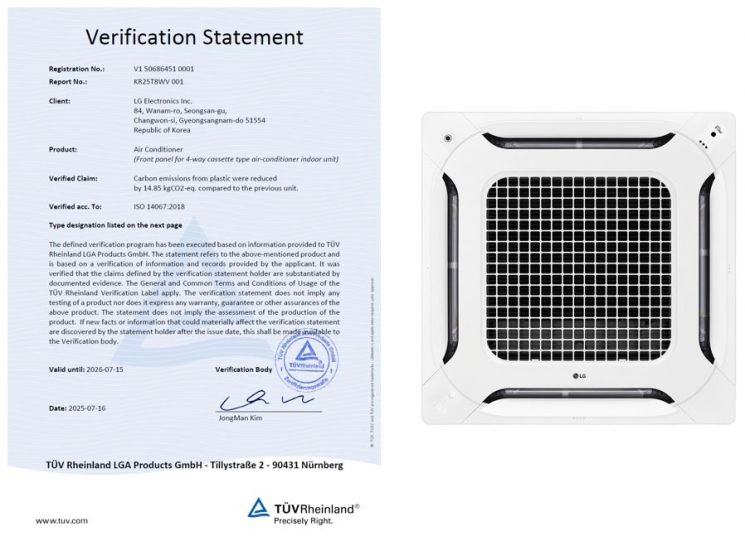 A commercial 4-way system air conditioner verified by the global testing and certification body TUV Rheinland to have reduced carbon dioxide emissions by 14.85 kg (kgCO₂eq) per unit. LG Electronics.
Since June, LG Electronics has been producing commercial 4-way system air conditioners using the physical foaming process to reduce carbon dioxide emissions. The company plans to sequentially apply this process to future residential and commercial system air conditioner models as well.
In its sustainability report, LG Electronics has set a goal to reduce greenhouse gas emissions by 54.6% by 2030 compared to 2017 levels, and is actively pursuing the introduction of high-efficiency energy equipment and expanding the use of renewable electricity in its production processes.
As carbon neutrality becomes a global issue, LG Electronics is also continuing efforts to reduce carbon emissions under actual usage conditions by producing high-efficiency appliances based on its core technology in key components. The company applies inverter technology, which adjusts the operating speed of motors and compressors to run products only as much as needed depending on the situation. In addition, LG Electronics is actively responding to environmental regulations by recently launching an inverter scroll chiller that uses R32 refrigerant, which has a global warming potential (GWP) of about 30% compared to the conventional R410A refrigerant.
Bae Jeonghyeon, head of the SAC (System Air Conditioner) Division at LG Electronics' ES (Eco Solution) Business Headquarters, said, "We will continue our efforts to create environmentally conscious products by reducing plastic usage through new manufacturing processes and increasing the use of eco-friendly refrigerants."
© The Asia Business Daily(www.asiae.co.kr). All rights reserved.













