Taxpayer Funds Flow to Foreign-Owned Stores
Backlash Grows Over Delayed Exclusion from Eligible Locations
Criticism is mounting over the government's "Livelihood Recovery Consumption Coupon" policy, as it was belatedly revealed that the coupons could be used at directly operated stores of large foreign corporations. This is seen as contradicting the policy's original intent. In particular, the exclusion of domestic conglomerate stores from eligible locations has sparked concerns over fairness.
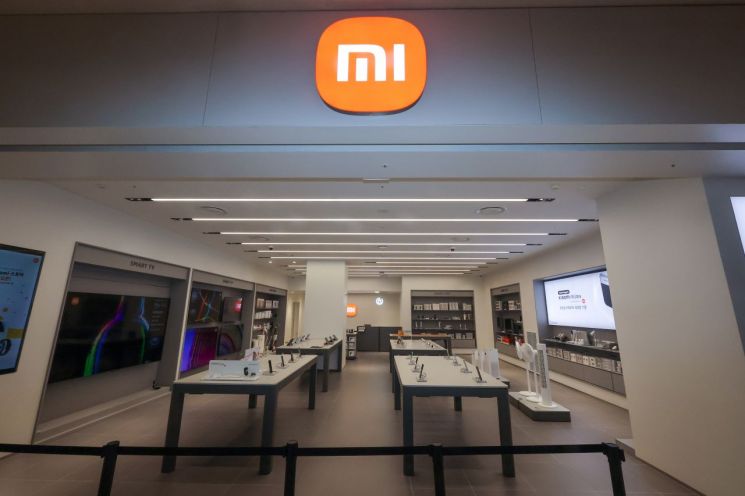 The first official offline Xiaomi store in Korea, located at Seoul Yeouido Xiaomi Store in Seoul IFC Mall Yeouido branch. Photo by Yonhap News
The consumption coupon program, which began on July 21, was introduced with the goal of revitalizing the local economy and was designed to benefit only small businesses with annual sales of 3 billion won or less. However, controversy has grown after it was discovered that coupons could be used at the newly opened Xiaomi Korea directly operated store in Yeouido, Seoul.
The Xiaomi store displayed notices both inside and outside the store for about three weeks after the coupon program started, informing customers that payments with the coupons were accepted. Employees also actively promoted this on-site. This store was classified as a newly established credit card merchant under the Ministry of the Interior and Safety's criteria, and was considered a "small business" regardless of its annual sales, thus exempting it from industry restrictions.
Tax Benefits for a Global Company with 71 Trillion Won in Annual Sales Spark Controversy
However, the reality of the company tells a different story. Xiaomi is a leading Chinese IT conglomerate that distributes products worldwide, with last year's sales exceeding 70 trillion won. This figure is even higher than that of SK Hynix, a major Korean semiconductor company. The inclusion of such a global corporation as a beneficiary of the policy is being criticized as a clear loophole.
In contrast, offline stores of Samsung Electronics and LG Electronics, which represent Korea's electronics industry, were excluded from the list of eligible locations from the outset. As a result, consumers have voiced dissatisfaction, saying, "In effect, Korean companies were excluded while support flowed to a Chinese conglomerate."
Government: "Immediate Exclusion Measures"... Criticism Persists
As the situation escalated, the Ministry of the Interior and Safety announced via a press release that the Xiaomi store had been excluded from the list of locations where the consumption coupons could be used. The press release explained, "The Xiaomi directly operated store opened on June 28 this year and was registered as a credit card merchant, making it difficult to preemptively restrict it," and added, "We took action as soon as we became aware of the issue."
However, this decision came more than three weeks after the Livelihood Recovery Consumption Coupons were issued, during which time significant spending is presumed to have occurred. This has led to criticism that the government is "locking the stable door after the horse has bolted." According to a recent survey conducted by polling agency PMI of 1,000 adults, 81.1% of respondents reported having already used the consumption coupons, raising the possibility that a substantial portion of the policy funds may have already flowed to the Chinese conglomerate.
© The Asia Business Daily(www.asiae.co.kr). All rights reserved.












